The vulnerability known by CVE-2025-55182, nicknamed “React2Shell,” received immediate attention in the aftermath of its public disclosure lately. This vulnerability allows an attacker to carry out remote code execution in React Server Components without any authentication, thus invoking arbitrary commands on compromised servers. Exploitation began within hours of public disclosure. The initial attacks mainly focused on basic command executions, such as “whoami,” for verification purposes. It is pertinent to highlight that state-sponsored APT actors from China and North Korea were among the earliest exploiters of this vulnerability.
Understanding React2Shell (CVE-2025-55182)
React2Shell is a critical remote code execution (RCE) flaw in React Server Components. It stems from unsafe deserialization in the RSC “Flight” protocol, allowing malicious input to execute arbitrary commands. Security teams gave the flaw a maximum severity score (CVSS 10.0). React 19.x (and its ecosystem) and recent Next.js versions using the App Router are vulnerable. In short, any web app running affected React components could be fully compromised by this bug.
Swift Exploitation on Exposed Systems
Attackers moved quickly. It shows that exploit attempts on Dec. 5, with volume significantly higher by Dec. 8. Initial steps were basic checks: running whoami, performing simple math or hashing to confirm code execution. Once confirmed, attackers typically used wget or curl to fetch malicious payloads. Some even deployed PowerShell scripts on Windows to install the XMRig Monero miner.
Broader campaigns dropped common malware too: Mirai and Gafgyt IoT botnets spread via vulnerable routers and devices, and new cryptominers were launched. The RondoDox IoT malware is a striking example: its installer hunts for other malware and stops security processes (killing AppArmor/SELinux) before fetching a multi-platform payload via wget, curl or BusyBox.
APT Threat Actors Exploiting React2Shell
Security researchers quickly linked React2Shell exploitation to advanced adversaries. Key groups include:
- Earth Lamia (China) – A state-affiliated APT that targets multiple industries worldwide. It was observed probing and exploiting React2Shell within hours of disclosure.
- Jackpot Panda (China) – Another Chinese-linked group, focusing on East/Southeast Asian targets, which also rushed to weaponize the vulnerability.
- North Korean Lazarus – Suspected of involvement: analysts reported React2Shell being used to install EtherRAT, a sophisticated Linux backdoor that leverages Ethereum smart contracts for command-and-control.
- Iranian-affiliated actors – Observed exploiting this flaw as well, indicating interest from multiple nation-state teams.
- Other China-linked clusters – Additional Chinese espionage teams were identified deploying specialized tools via the flaw, including the MINOCAT proxy, SNOWLIGHT downloader, HISONIC backdoor, and AngryRebel.Linux trojan.
Google React2Shell Fix: Is CVE-2025-55182 Patched?
- Yes, CVE-2025-55182 (React2Shell) has been fixed by the Google-backed React maintainers.
- The patch was released in December 3, 2025, shortly after public disclosure.
- The problem existed because of unsafe deserialization in React Server Components (RSC). Countermeasures included securing the RSC “Flight” protocol and blocking dangerous execution paths.
- Patched React versions include: React 19.0.1, 19.1.2, 19.2.1 and later.
- Frameworks built on React, including Next.js, released coordinated security updates to remove inherited exposure.
- Even with the presence of the solution, attacks are being actively conducted in the field because of deployments that are not patched or are outdated.
- Organizations with vulnerable React Server Components need to do an immediate update and check if any legacy or publicly accessible RSC endpoints have been left reachable.

Malware and Payloads in the Wild
After initial access, attackers installed varied malware and tools:
- XMRig Miners: Shell scripts such as sex.sh were downloaded and executed in order to establish Monero miners.
- IoT Botnets: Mirai and Gafgyt variants were spread. The RondoDox botnet installer, for example, aggressively communed with a command to end other malware and security processes before generating cross-platform binaries for router, IoT, and server offerings.
- Downloaders/Backdoors: PRC-associated actors used SNOWLIGHT, a cross-platform downloader for a set of VSHELL Backdoor tools, and HISONIC, a Go-language implant which downloads its encrypted payload via cloud storage. A separate actor used ANGRYREBEL.LINUX, a Trojan masquerading as an OpenSSH daemon (sshd) to avoid being detected.
- Tunneling Tools: MINOCAT, which is a custom proxy binary, was used by a specific actor in order to set up hidden directories, cron jobs, and fake services so as to build tunnels.
- North Korean EtherRAT: Securirty experts have discovered a new Linux malware named EtherRAT. This malware relies on Ethereum smart contracts for invisible command and control, with a variety of persistent methods and it self Downloads Node.js runtime environments.
Immediate Mitigation Steps for React2Shell
- Patch React Server Components and all affected frameworks immediately.
- Upgrade to fixed versions (React 19.0.1, 19.1.2, 19.2.1 or later).
- Verify that no vulnerable components remain in production.
- Audit servers for web shells and unauthorized accounts.
- Check for crypto-mining activity and suspicious outbound connections.
- Deploy WAF or proxy rules to block malicious RSC payloads.
- Filter dangerous patterns such as
#__proto__andchild_process.execSync. - Monitor logs for abnormal process creation or unexpected traffic.
- Focus on behavior-based detection due to fileless or encrypted payloads.
- Prepare for rapid incident response as React2Shell is exploited quickly.
Conclusion: A Frontend Flaw That Became a Server-Side Crisis
React2Shell showed how quickly a modern application flaw can turn into a full infrastructure compromise. A single unsafe deserialization path in React Server Components allowed unauthenticated remote code execution transforming trusted frontend frameworks into direct server backdoors.
Within hours, nation-state APTs were exploiting exposed systems. Within days, cryptominers, backdoors, and tunneling tools were deployed at scale. No phishing. No credentials. Just vulnerable code executing attacker commands as designed.
When application logic is allowed to execute blindly, attackers don’t need persistence they inherit it.
Why This Vulnerability Was So Dangerous in Practice
React2Shell wasn’t devastating because it was unknown.
It was devastating because it was reachable and unpatched.
- Internet-facing React Server Components
- Delayed patching across production environments
- Legacy deployments still exposed after disclosure
- Fileless command execution using native tools
- Attackers moving faster than remediation cycles
Once exploitation began, every exposed server became a candidate for immediate compromise.
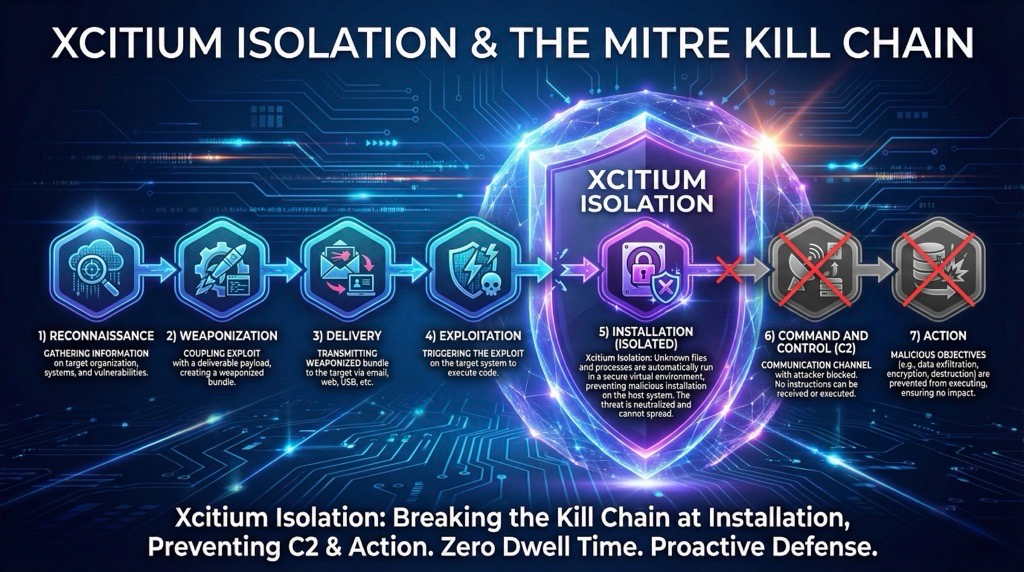
How Xcitium Prevents React2Shell From Becoming a Breach
With Xcitium, the attack chain is broken at multiple points.
Before exploitation, Xcitium Vulnerability Assessment identifies exposed React Server Components and unpatched frameworks vulnerable to CVE-2025-55182 allowing teams to prioritize remediation before attackers arrive.
If exploitation is attempted, Xcitium Server Security (Advanced EDR for Servers) ensures the attack cannot progress:
- Arbitrary commands launched via React2Shell are stopped at execution
- Fileless payloads fail to run on the server
- Downloaded malware never gains control
- Cryptominers, backdoors, and APT toolchains collapse immediately
Even if a vulnerable component is exposed, the attacker cannot move forward.
Modern Web Security Requires Both Visibility and Execution Control
React2Shell proves a hard truth: finding vulnerabilities early matters but stopping execution is what prevents breaches.
Xcitium delivers both.
Identify the exposure.
Stop the execution.
Break the attack.
Protect your applications and servers against modern RCE exploitation.
Choose Xcitium Vulnerability Assessment and Xcitium Advanced EDR.