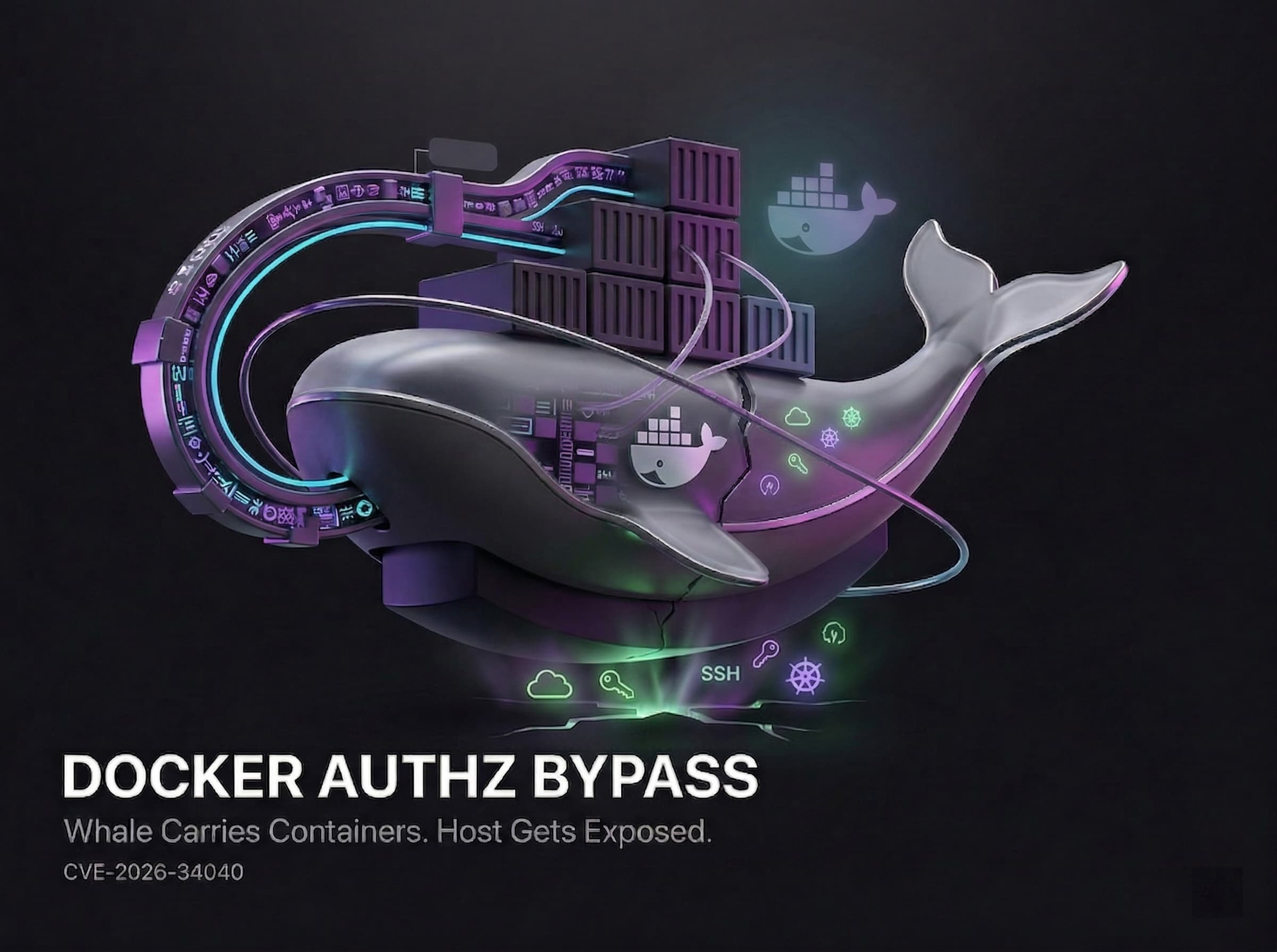

High-severity flaw found in Docker Engine (CVE-2026-34040), where attackers may bypass container authorization and escape the system on the host side. This issue stems from sending a certain HTTP request that will result in an empty request body to the AuthZ plugin in Docker. The authorization plugin will thus allow things that otherwise could not proceed, while Docker will handle the whole malicious request.
An attacker can create a privileged container by sending a Docker API request body over the 1 MB limit, granting the container full file system access on the host side. Since there are more than 92% of companies using containers worldwide, the issue is significant.
How the Authorization Bypass Works
In a typical process flow, each call to the API is sent by Docker to an AuthZ plugin, where the plugin analyzes the contents of the request and makes decisions regarding whether the call should be permitted or denied.
CVE-2026-34040 vulnerability takes advantage of an inconsistency in the body size validation that occurs in Docker’s middleware. When the size of the request body exceeds approximately 1 MB, Docker automatically discards the request body and passes an empty request body to the plugin. Since the plugin sees an empty request, it permits it.
In the meantime, Docker’s daemon executes the command in the initial request, which may involve running a command to establish a privileged container with root-level permissions to the host system.
- Craft large API request: Attacker includes some junk data to make sure that the body is larger than 1 MB.
- AuthZ plugin inspection fails: Since Docker does not accept the oversized body, the plug-in will see nothing but the truncated body.
- Plugin approves action: Lacking any reason for blocking the request, the authorization plug-in will approve the request. No alerts will be triggered at all.
- Docker executes payload: While the authorization plug-in did not detect anything wrong, the Daemon will process the request fully.
Thus, there is a discrepancy between the authorization plug-in’s behavior and the Docker’s actions, resulting in a zero-day attack. With this flaw, attackers may use a single API request to authorize the action that should be blocked with just one oversized HTTP request. This means that even without any additional attacks, vulnerabilities, or any special tricks, such as advanced time delays, a regular attacker may get control over the target.
Impact and Attack Scenarios
This vulnerability compromises a crucial component of container security because it provides attackers with an opportunity to “break out” even before the container initialization process begins. It is enough for an attacker with access to the Docker API to launch an attack in order to circumvent restrictions on executing potentially harmful actions.
With the help of the request padding technique, attackers can easily bypass the restriction imposed by rules that prevent harmful requests (such as mounting volumes from the host system or setting privilege mode).
As a result, the user will have the possibility to start a container with all permissions of the host OS and will gain root-level access. Thus, it will be possible to steal AWS, SSH, and Kubernetes config credentials from the host system.
This technique does not leave any traces. The problem with such an attack is that, since the AuthZ plugin does not see the payload at all, no message about a failed authorization attempt is written anywhere. Therefore, a company can realize the attack only in a retrospective way after analyzing logs, in which case the following message can be found in Docker logs: “request body is larger than 1 MB”.
Legacy Bug and Widespread Exposure
CVE-2026-34040 is a regression that relates to a previous vulnerability. In 2024, Docker fixed a zero-length body bypass (CVE-2024-41110), which had similarities. However, that fix did not account for oversized requests. At the root of this problem is a vulnerability in existence for years. The bug has been present in Docker ever since version 1.10.
This bug’s scope is enormous. Docker is the leading container runtime software solution. Over 90% of organizations leverage containers, and Docker is often chosen as their implementation. However, the problem only impacts instances where there is an AuthZ plugin, such as in secure setups, where teams use a policy tool for whitelisting certain actions. Nonetheless, having such a setup is quite common in large corporations.
Ninety-two percent of enterprise containers run Docker. Therefore, any installation that utilizes this technology is vulnerable to CVE-2026-34040. All attackers have to do is find one vulnerable location in their attack surface, such as the CI/CD agent or developer workstation accessing the Docker API.
AI Agents and Future Threats
This problem receives special emphasis in that it is even possible for it to happen accidentally when using intelligent development toolkits. For instance, a coding assistant powered by artificial intelligence may attempt to debug or control containers using Docker’s APIs. Should the intelligent system come across any problems accessing certain resources, the intelligent software may accidentally add padding to the HTTP requests.
It should be noted that even an intelligent assistant performing a simple operation could generate the padded HTTP request and allow the attacker to escape from the container.
Conclusion: When Authorization Fails, Containers Become Host Access
CVE-2026-34040 is a clear reminder that container security can fail before a workload even starts. A single oversized Docker API request can blind the authorization layer, let a privileged container launch, and turn policy enforcement into silent approval. At that point, the attacker is no longer fighting the container boundary. They are operating against the host.
Why This Threat Matters
This flaw is dangerous because it breaks trust at the control layer:
- The AuthZ plugin sees an empty body and approves the request
- Docker processes the full payload anyway
- A privileged container can be created with host-level access
- Credentials, secrets, and configuration files on the host become reachable
- The attack can leave little or no obvious authorization warning
Why Organizations Are Exposed
Docker is everywhere, and secure setups often depend on authorization plugins to block risky actions. That creates a dangerous assumption, teams believe policy enforcement is working when the middleware path itself is flawed.
This is especially risky in CI/CD systems, developer workstations, and any environment where the Docker API is reachable. If the vulnerable path exists, one crafted request can turn policy into bypass.
Where Xcitium Changes the Outcome
This kind of exposure requires two controls, visibility first, execution safety second.
- Xcitium Vulnerability Assessment makes this flaw visible before attackers find it, identifying vulnerable Docker environments, risky configurations, and exposed attack paths that should be remediated immediately.
- Xcitium Advanced EDR helps ensure that even if an attacker reaches the host, follow-on payloads and malicious execution attempts do not translate into real damage. Code can run without being able to cause damage.
One reveals the exposure.
The other limits what the attacker can do with it.
Secure the Layer Beneath the Container
Container security does not begin inside the container. It begins in the control plane that decides what should never be allowed to run. Patch immediately, restrict Docker API access, and verify that policy enforcement is real, not assumed.