
Kazuar Is No Longer Just a Backdoor
According to recent threat intelligence assessments, the Kazuar malware has developed from being a mere backdoor to becoming a peer-to-peer botnet, allowing for sustained and stealthy access in the affected environment.
In other words, infected machines do not necessarily need to communicate directly with an external command and control server. Instead, Kazuar relies on internal modules, which means fewer machines will communicate externally, thus evading detection through network-based methods.
Why Kazuar Fits Modern Cyber-Espionage Trends
This development is consistent with the current trajectory of state-sponsored cyber activities. The latest trends show that advanced threat actors favor stealth and persistence over massive attacks.
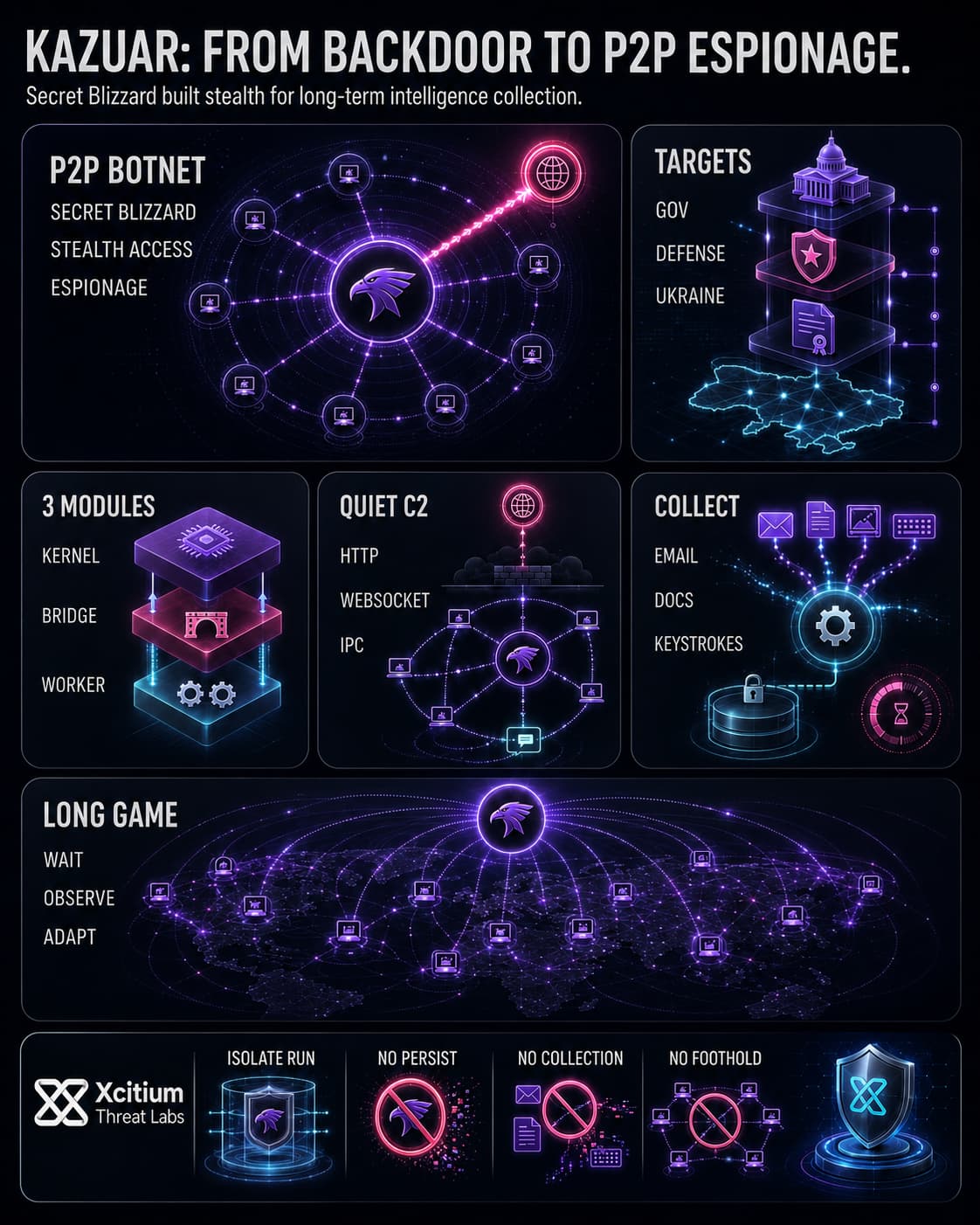
Kazuar used in espionage campaigns aimed at government, diplomacy, defense, and Ukraine-specific targets. Kazuar’s targeting profile also fits a wider pattern of state-aligned cyber activity. Government institutions, research organizations, academic entities, think tanks, and non-governmental organizations remain common targets for espionage operations. Moreover, Ukraine and NATO-linked environments continue to attract significant attention from advanced threat groups. Kazuar should be seen as an intelligence-gathering platform designed for politically and strategically important networks.
Kazuar was known as a .NET-based backdoor with cross-platform capabilities. However, newer variants appear to focus mainly on Windows systems. They also include stronger anti-analysis features, increased automation, and expanded command functionality.
In addition, it has been used against defense-related targets and may attempt to collect data from cloud platforms, source code repositories, communication tools, and sensitive local files. This shows continued development rather than simple reuse of older malware.
Three Modules Make the Botnet Quieter and More Resilient
The development process of Kazuar is best reflected in its modular nature.
There are currently three kinds of modules in use:
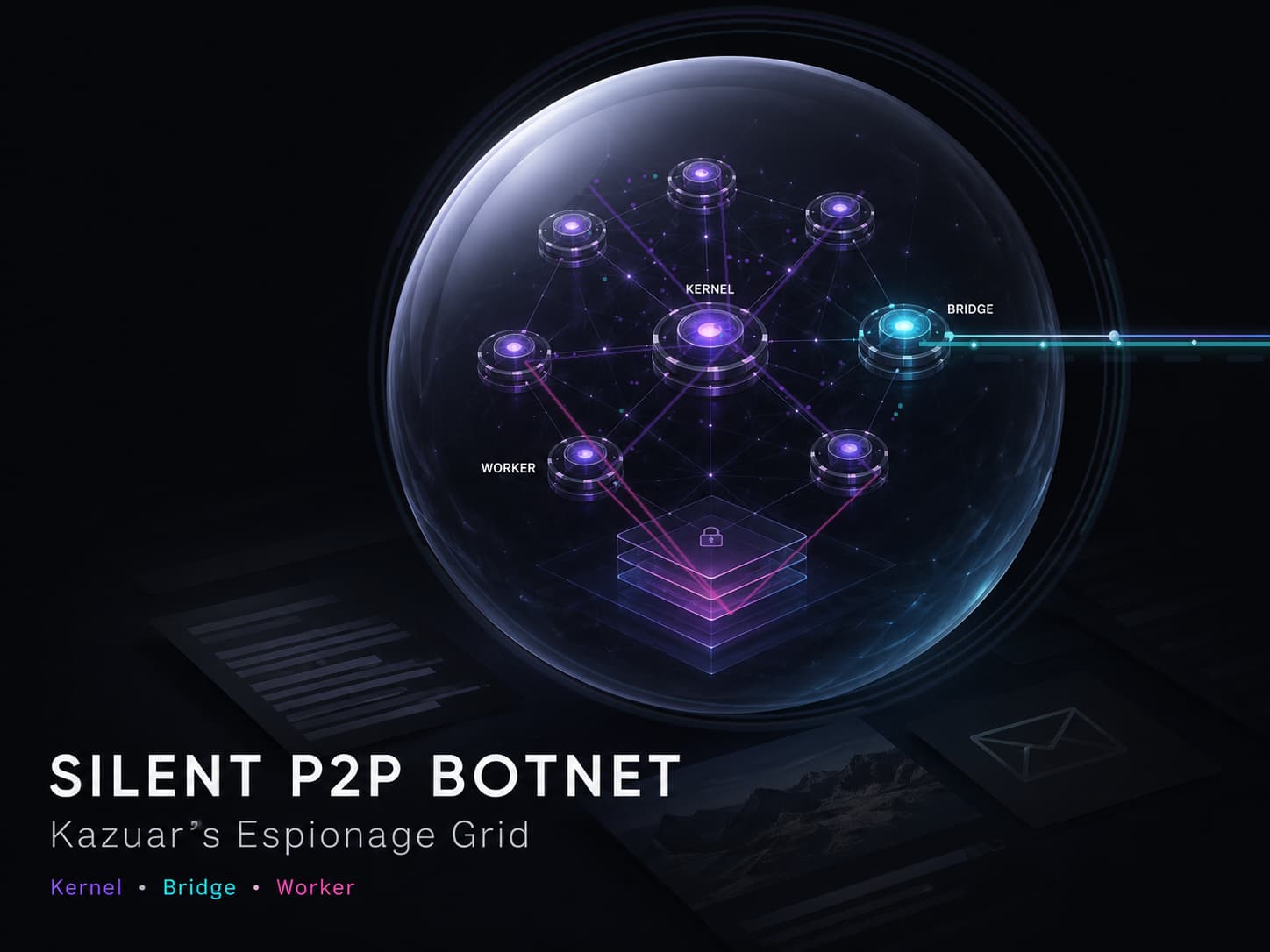
- Kernel: orchestrates the botnet and controls internal activities.
- Bridge: handles external communication processes.
- Worker: performs data gathering and task processing.
Each compromised system can carry all of these modules; yet usually, one Kernel serves as the only connection between the botnet and the outside world. It helps to reduce any possible detection since there is no need for many compromised systems to communicate externally. This approach allows Kazuar to be more covert in target networks and also makes Kazuar resilient because the leadership can be switched when any module fails. Kazuar provides flexible configuration with plenty of possibilities related to communication, execution, evasion, exfiltration time, tasking, and file gathering.
As for external communication, it can be performed using such approaches as HTTP, WebSockets, and exchanges. For internal communication, Kazuar uses hidden window messages, mailslots, and named pipes. It allows operators to change transport protocols, communication intervals, and blackout intervals in order to blend into regular corporate processes.
Why This Architecture Matters for Defenders
There are several unique features associated with Kazuar.
Firstly, it reduces the network footprint. By its design, there is only one leader that is allowed to contact external servers, meaning that the attacker’s communication with compromised hosts is invisible to defenders. Kazuar becomes more resilient to disruption.
If the communication channel is broken, the malware will attempt to use another channel or elect a new leader. Kazuar differentiates between different phases of its activity. Data gathering, preparation, and exfiltration can be performed by different modules using different behavior.
Why Long-Term Espionage Changes Detection
That is important because modern cyber-espionage campaigns often take weeks or even months. It is not true that adversaries always want to rush and get the data as soon as possible; instead, they gather information about the network, harvest credentials, discover valuable machines, and wait for the perfect time to exfiltrate data. Worker modules demonstrate the espionage nature of Kazuar‘s operations. These modules can collect information about the infected machine, recently opened documents, window titles, email data, take screenshots, and log keystrokes. After collection, all gathered data is encrypted and saved locally before being exfiltrated. Overall, these facts point to the conclusion that Kazuar is not a simple implant but rather a managed malware ecosystem designed to conduct espionage operations.
Real Attacks Show How Kazuar Supports Long-Term Espionage
Kazuar takes relative precedence when analyzing its role in the context of modern nation-state operations. Past incidents show that advanced threat actors used access provided by other groups via their botnets and backdoors to infect devices associated with either military or government entities. After gaining access, these actors employed other tools and subsequently installed Kazuar.
Several campaigns involved the infection of military or otherwise important communication devices. Some operations included selective use of malware according to the network environment, which suggests targeted scanning for valuable devices. Other campaigns showed that advanced operators used the infrastructure of other threat groups as a way to remain covert in their operations.
Stealthy Access Remains the Core Pattern
All this behavior fits into one clear pattern in which operators seek to establish sustainable access to the target environment while staying undetected. Kazuar follows this strategy by establishing covert access and then providing a means of information collection without causing any noticeable network activity. Additionally, diplomatic organizations have been targets of espionage efforts. Specifically, some attackers gained access to the network or the service provider in order to infect embassy networks.
While different malware families are employed in such operations, the underlying principle remains consistent across all attacks. Overall, all these operations follow the same pattern whereby advanced operators use stealthy access methods and post-compromise malware to gain and sustain long-term access to valuable environments.
Defenders Need to Watch Behaviors, Not Just Malware Names
The key practical lesson one can draw from Kazuar is that security teams must focus on behavioral indicators and not limit their analysis by malware naming and file hash. Static indicators have their use but prove ineffective in isolation. Modern malware can change filenames, hashes, paths, and communication channels; however, its behavior usually reveals the true purpose of the malware.
As for Kazuar, the following indicators should be monitored:
- Unusual inter-process communications
- Hidden window operations
- Suspected named pipe usage
- Mailslot-based communication
- Staging directories
- Encryption of task/result files
- Screen captures
- Keylogger artifacts
- Regular data exfiltration
In addition, security professionals should improve their awareness of any script and administration activities. PowerShell logs, endpoint telemetry data, process creation events, and network metadata can help identify malicious behavior that may look innocent at first glance.
There are several measures that can effectively protect against such attacks:
- Attack surface reduction controls
- Network protection controls
- Tamper protection
- Running EDR in blocking mode (where possible)
- Increasing PowerShell logging
- Keeping endpoint and network logs for long periods
- Correlation of low signal indicators into an attack story
Long-Term Log Retention Is Critical
The last point deserves special attention because espionage intrusions can last for several weeks or even months, which means that too small a retention period for logs can hamper defenders in assembling the full picture of the attack. To achieve better results, companies should shift from static indicators to behavioral analytics.
In addition, organizations need to understand that certain industries will always be interesting for espionage groups government, diplomacy, defense, research, critical infrastructures, etc. Kazuar is a good example of how modern malware is becoming more stealthy and resilient. Thus, defenders’ approaches should take into account temporal, systemic, and communication aspects of attacks.
Conclusion: Espionage Built for Silence, Not Speed
Kazuar shows how modern state-level malware is evolving beyond traditional backdoors. This is not a noisy intrusion tool built for quick impact. It is a modular peer-to-peer espionage platform designed to stay quiet, reduce external traffic, shift communication roles, and collect intelligence over time.
When only one compromised system needs to speak externally, the rest of the infected network can operate almost invisibly.
Why This Threat Is So Difficult to Detect
Kazuar succeeds because it is built around patience, modularity, and low signal behavior.
- Kernel, Bridge, and Worker modules divide command, communication, and collection tasks
- Internal communication uses hidden Windows messages, named pipes, and mailslots
- Exfiltration can be delayed, staged, encrypted, and blended into normal activity
- Screenshots, keystrokes, Outlook data, documents, and system details can be gathered quietly
- Network-based detection may see only a small fraction of the botnet’s real activity
This is why static indicators are not enough. A threat like Kazuar must be detected through behavior, correlation, and long-term visibility.
Where Xcitium Changes the Outcome
For organizations using Xcitium Advanced EDR, Kazuar’s advantage breaks at execution.
- Unknown implants are isolated the moment they run
- Code can run without being able to cause damage
- Internal communication, persistence, and data collection cannot affect the real system
- Stealthy modules fail before they can build a durable espionage foothold
- Long-term access collapses before intelligence collection becomes operational
If you have Xcitium in place, this attack does not succeed because the malware never gains the freedom it needs to operate.
Stop Espionage Before It Becomes Invisible
State-level threats do not always move fast. They wait, observe, collect, and adapt.
Defending against them requires stopping unknown execution before stealth becomes persistence.
Choose Xcitium Advanced EDR, powered by the patented Zero-Dwell platform.