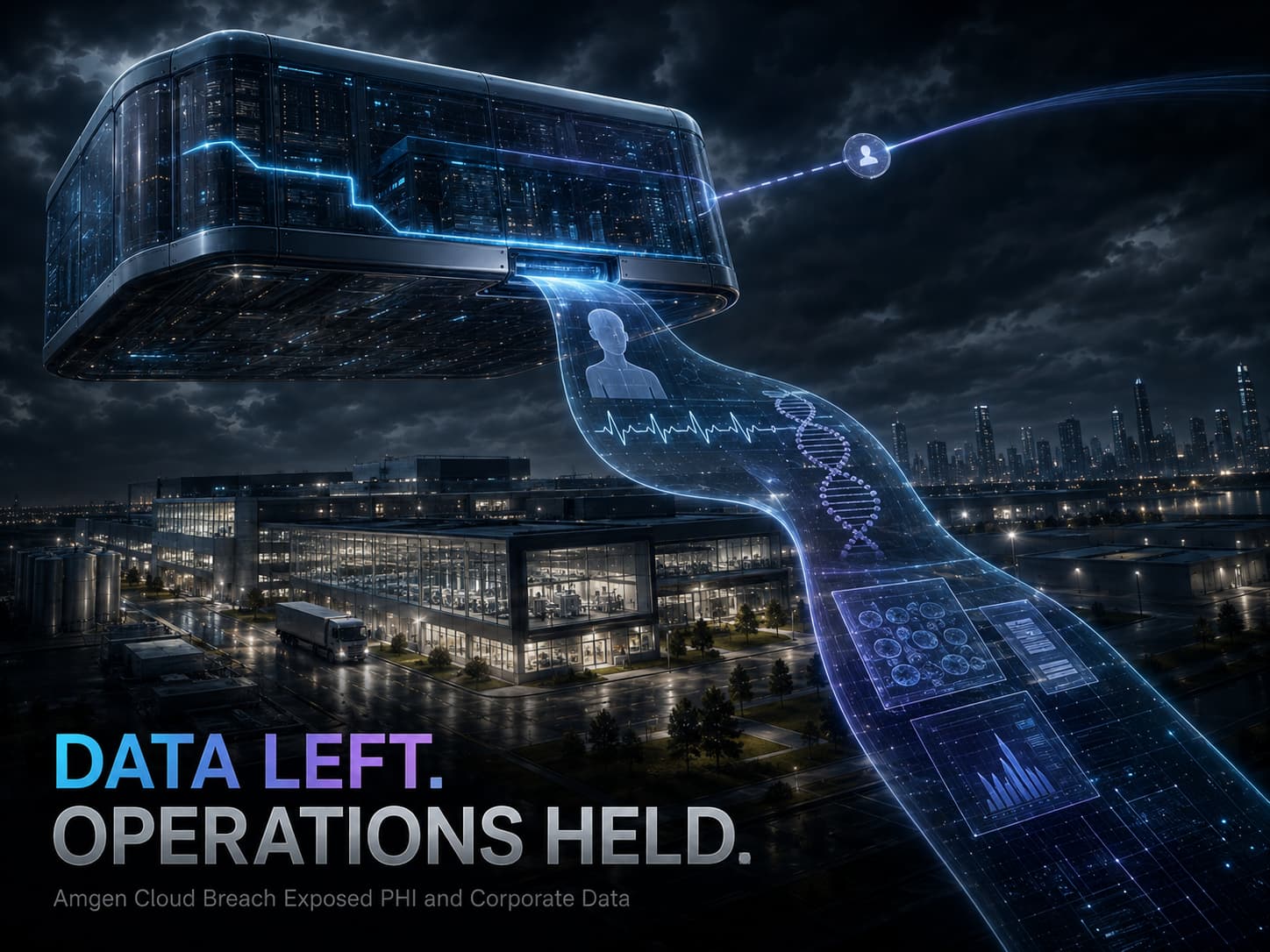
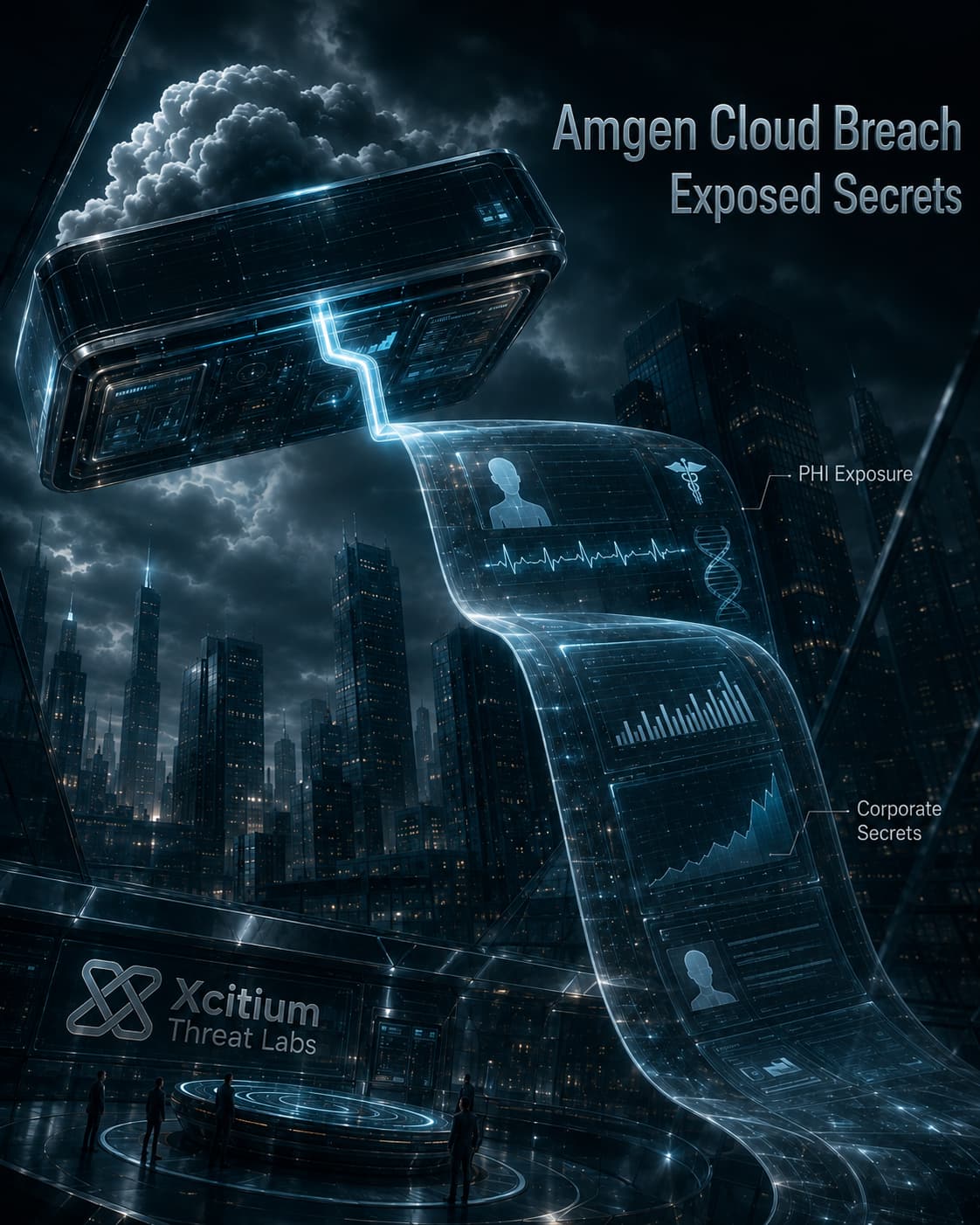
Biology and pharmaceutical technology conglomerate Amgen announced that there had been a security breach where unauthorized access and theft of data was made through its cloud infrastructure. This happened in the month of July 2026 where the company experienced an attack in cloud environments run by third-party service providers, gaining access to proprietary corporate data and protected health information (PHI) of patients.
Amgen made a formal announcement of this incident as material information by filing a Form 8-K to the U.S. Securities and Exchange Commission on July 29, 2026. This shows that there has been a rise in security incidents on cloud infrastructure for companies within the healthcare industry and biotechnology sector.
Compromised Cloud Environments
There have been instances of an unauthorized intrusion in cloud infrastructure run by external service providers where attackers broke into the environment, gained access to the stored databases, and exfiltrated the sensitive data.
Amgen activated its emergency incident response plan immediately upon discovering the breach. The company hired external forensic specialists to contain the incident and evaluate compromised cloud workloads.
CLOUD INFRASTRUCTURE DATA BREACH
In July 2026, biotechnology giant Amgen Inc. detected unauthorized access and exfiltration targeting its third-party cloud environments. Attackers compromised databases storing sensitive Protected Health Information (PHI) and proprietary corporate data, prompting an immediate emergency forensic response and formal SEC material disclosure.
- Internal Manufacturing Network Unaffected
- Drug Production & Supply Chain Unaffected
- Pharmaceutical Safety Standards Unaffected
- Financial Reporting Systems Unaffected
- Annual Financial & Operational Outlook No Material Impact
- Expanding Surface: Healthcare and biotech attack surfaces increasingly extend into third-party cloud workloads.
- Kernel-Level Controls: Protection of sensitive health data requires strict kernel-level execution control on cloud storage nodes.
- Movement & Script Control: Mandatory blocking of unauthorized script executions between external infrastructure boundaries.
- Enforcement Verification: Cyber-insurance carriers & regulators now demand cryptographic evidence of active governance enforcement.
PHI and Corporate Data Exfiltration
The leaked data involved two types of information – private corporate data and PHI data.
Currently, the investigations are being conducted to establish whether trade secrets, clinical trials, patents were stolen. The exact number of affected patients is still unknown as forensics are analyzing the exfiltrated databases.
Mandatory SEC Reporting
According to the SEC rules, public organizations should report the material security breaches within four business days after making the decision on their materiality. For Amgen, such decision was made on July 29, 2026.
It should be noted that there was no disruption of the company’s business operations. The internal manufacturing network, drug production process, and safety standards have not been affected. There was no interruption of the financial reporting system. Currently, Amgen expects no material impact on its financial state or its annual operations.
Cloud Workloads and Execution Governance
The case demonstrates how today’s enterprise attacks surfaces are going outside corporate boundaries to include third-party clouds. Protection of the sensitive health-related data requires the effective execution control and movement control between external infrastructure.
Nowadays, regulators and cyber-insurance companies require the evidence of enforcement. Organizations require the kernel-level execution control and rigorous identity governance in order to avoid running the unauthorized scripts on sensitive cloud storage.
Conclusion: When Third-Party Cloud Access Becomes a Material Breach
The Amgen incident shows that a cyberattack does not need to stop manufacturing to become material.
Unauthorized actors accessed data held in third-party cloud environments and stole company information and protected health information. At the time of disclosure, Amgen had not identified an impact on its products, manufacturing operations, financial reporting systems, or ability to meet patient needs.
Operational continuity matters.
It does not reduce the significance of losing PHI and confidential business data.
The exact initial access method remains undisclosed. The number of affected patients is still unknown, and investigators are assessing whether intellectual property, research, clinical trial information, patents, or trade secrets were among the stolen files.
Why This Threat Matters
This breach demonstrates that confidentiality failure alone can create material business, regulatory, and patient risk.
- Third-party cloud environments extend the enterprise attack surface beyond infrastructure the organization directly operates.
- Data held by a provider remains the organization’s legal, regulatory, and reputational responsibility.
- PHI and proprietary corporate information can be exposed through the same cloud access path.
- Business operations can remain available while sensitive data has already left the environment.
- Unknown breach scope delays patient notification, legal assessment, and recovery decisions.
- Cloud investigations depend on provider telemetry, identity records, workload logs, and data-access evidence.
- Standing privileges, federated trust, tokens, service identities, and administrative access can expand the effect of a single unauthorized session.
- Continued manufacturing is evidence of resilience, not proof that security controls prevented the breach.
The security question is not only whether critical systems stayed online. It is whether the organization can prove who accessed sensitive data, what privileges were used, which workloads were involved, and what controls operated during the intrusion.
Where Xcitium Changes the Outcome
Because the initial access method has not been disclosed, no security product should be credited with preventing the original intrusion based on the available evidence.
The response must focus on the control layers the incident supports.
Xcitium ITDR helps organizations identify abnormal authentication, risky token use, unexpected privilege changes, compromised accounts, and lateral identity activity across integrated identity environments.
For third-party cloud access, organizations should be able to answer:
- Which human and service identities could reach the affected data?
- Which tokens, sessions, certificates, and federated relationships were active?
- Were privileges changed before or during the unauthorized access?
- Did the same identity reach other cloud applications or data stores?
- Can access be revoked without waiting for the provider’s investigation to finish?
ITDR does not prove that the original data theft would have been prevented. It strengthens visibility and response across the identity paths attackers may use to establish, maintain, or expand cloud access.
On supported cloud workloads, administrative endpoints, jump systems, and management servers, Xcitium Advanced EDR, powered by Xcitium’s patented Zero-Dwell platform, applies Execution Governance.
Unknown code does not receive unrestricted execution rights before trust exists.
Where an attacker must run an unknown script, payload, utility, or post-exploit tool on a supported system, the platform governs what that execution can alter or reach before a malicious verdict is required.
Code can run without being able to cause damage.
EDR detects execution. Xcitium governs execution.
This distinction is important in cloud investigations. An alert shows that suspicious behavior was observed. Execution Governance provides evidence that unknown execution was subjected to policy and denied unrestricted access to real system resources. Xcitium’s internal architecture positions these enforcement records as operational proof for security teams, boards, auditors, and insurers.