
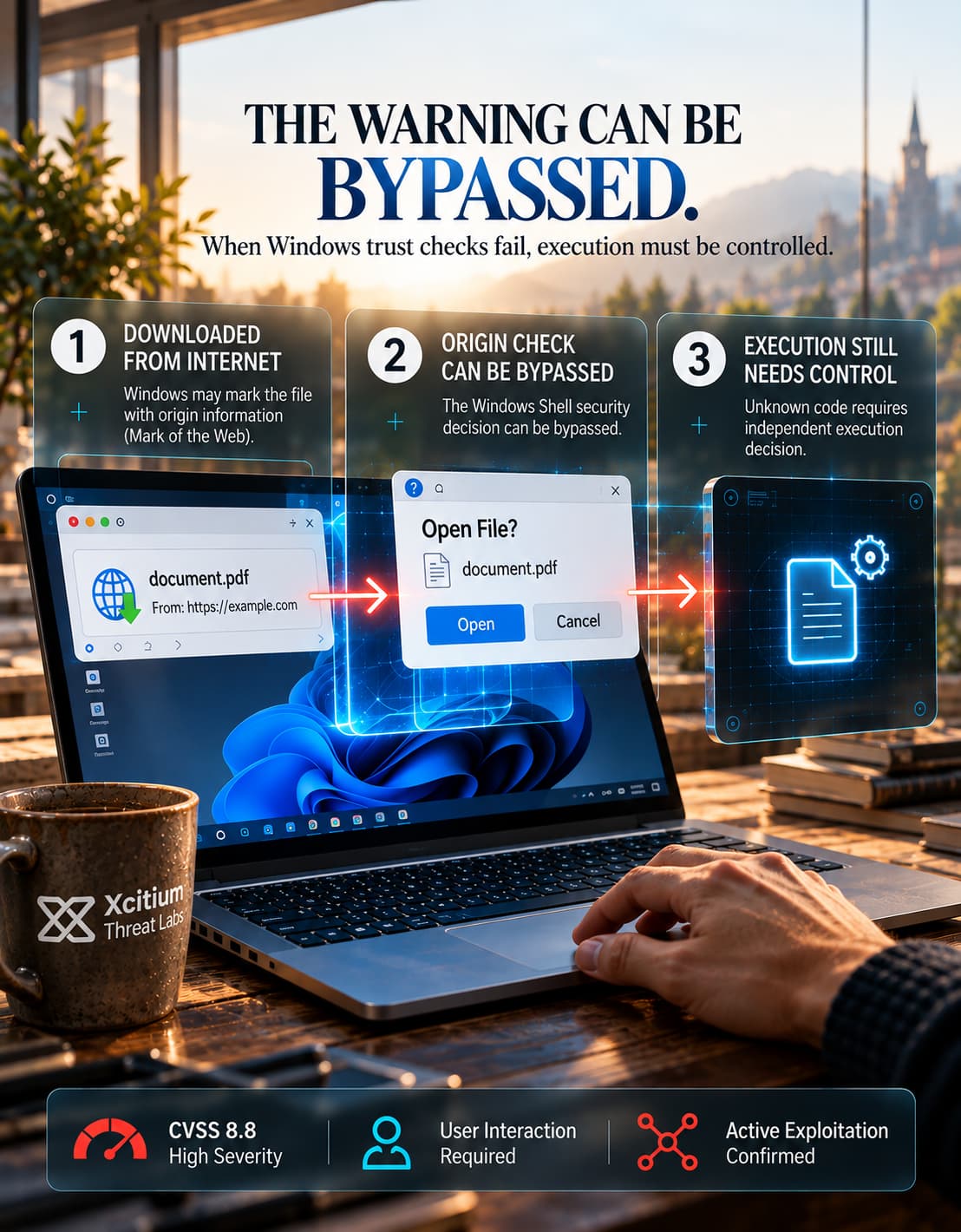
CVE-2026-96951 lets an attacker bypass a security feature associated with files from the internet.
The missing detail is the attack itself. Microsoft has confirmed exploitation but has not identified the malicious file, the commands used, the targets or the number of affected systems. A published detection rule offers a technical clue, though it cannot establish what happened in every confirmed attack.
What is CVE-2026-96951? It is a Windows Shell security feature bypass classified as command injection. Public reporting identifies Mark of the Web as the affected protection. An attacker can reach the vulnerable path over a network, but the published severity record still requires a person to interact with the content.
The Origin Mark Behind Windows File Warnings
Take a document saved from the web to an NTFS drive. Windows may attach an extra stream named Zone.Identifier; ZoneId=3 in that stream points to the Internet zone. The tag is metadata, separate from the document’s main contents. It may not survive every saving path or file system.
That small tag can change what happens next. Office may block macros in an internet-marked document, while Windows Attachment Manager can use the source zone to assess a download. In other words, the label can matter after the first file warning has come and gone.
Yet the CVE record does not say which check fails. According to Microsoft, improper handling of command elements in Windows Shell permits a security feature bypass. It leaves open whether the stream vanishes, a Shell action overlooks it, or another step mishandles the origin. Those possibilities would leave different traces. The published record does not settle the question.
A Detection Rule Points to a Narrower File Path
Snort’s rule for this CVE watches web traffic for Windows settings files that reference Windows Terminal and appear to attempt command execution. Its notes say attacks or scans have been seen in the wild. A scan alone does not show that a machine was compromised.
The rule gives us a glimpse of suspicious traffic, but it is not the missing exploit report. It does not supply a sample file, an executed command, or a timeline from one of Microsoft’s confirmed cases. We also cannot tell from the signature whether another payload followed.
It is tempting to turn the Windows Terminal reference into a full attack story. The public evidence stops earlier. Even if a settings file matched the rule, the match would say nothing on its own about the attacker’s eventual access.
| Common assumption | What the platform actually does |
|---|---|
| A downloaded file always has the same trust label. | Zone metadata depends on the saving application, policy and file system. |
| One Windows warning controls every file type. | Different applications and policies make separate decisions after a file is opened. |
| A file’s origin proves that its contents are malicious. | Origin describes provenance. Content and behavior require their own assessment. |
Network Delivery Still Requires User Interaction
Microsoft scores the flaw 8.8 under CVSS 3.1. Its published vector says the attack can arrive over a network, needs no prior privileges and requires user interaction. Network reachability here describes how hostile content can be delivered. It does not mean an exposed Windows machine can be compromised without anyone opening or acting on that content.
An email attachment or web download is a plausible route because both can place files from outside the organization on an endpoint. Still, the public record does not identify either route as the one used in the confirmed attacks. It also does not identify the attacker, a malware family or a target sector.
The security boundary at issue is the handoff from untrusted content to an ordinary Windows action. If that handoff skips an origin-based warning, a file may appear less risky at the moment someone opens it. The CVE does not establish that every marked file, every file type or every downstream Windows protection loses its checks.
This is where Execution Governance becomes relevant, at the execution boundary for unknown code rather than the file-origin check. The public record contains no payload to assess, so it cannot establish what any endpoint control would have done in the confirmed attacks.
A Released Fix Does Not Measure Deployment
Microsoft released the fix on October 13. Its CVE record lists affected builds across Windows 10, Windows 11 and Windows Server. That list helps identify which machines need the update, but it cannot show whether any specific machine installed it successfully.
CISA added CVE-2026-96951 to its exploited-vulnerability catalog the same day. So the public record establishes a patch and confirmed exploitation. It offers no count of compromised systems and no measure of update deployment or verification. Those missing figures limit any claim about how far the attack spread or how much exposure remains.
Conclusion: The Origin Warning Was Not the Last Boundary
CVE-2026-96951 demonstrates why Windows security cannot depend entirely on how a file’s origin is classified. Mark of the Web helps distinguish content obtained from the internet from locally trusted files, allowing Windows and applications to apply additional security restrictions. When that protection is bypassed, a file from an untrusted source may proceed through an execution path without the expected origin-based safeguards.
The vulnerability affects Windows Shell, where improperly handled command elements can undermine a security feature during user interaction. Microsoft has confirmed active exploitation, but the public record does not identify the malicious files, executed commands, or resulting payloads. A published Snort detection rule points toward Windows settings files referencing Windows Terminal, although that evidence does not establish the complete exploit chain.
The security concern extends beyond a missing warning. Mark of the Web provides context for a trust decision, not a guarantee that downloaded content is safe. If an attacker can bypass that decision, security must still determine whether any subsequent code execution should be permitted and what actions that code can perform.
Why This Threat Matters
- Origin-based protections can be bypassed. A file’s security treatment may change when Windows Shell fails to enforce the expected trust boundary.
- User interaction remains necessary. The vulnerability can be reached through network-delivered content, but exploitation requires a user action rather than automatically compromising an exposed Windows system.
- The exact exploitation mechanism remains undisclosed. Microsoft has not established publicly whether the origin metadata disappears, a Shell operation disregards it, or another component mishandles the security decision.
- Confirmed exploitation increases remediation urgency. The vulnerability was actively exploited before Microsoft’s October 13 security update became available.
- Bypassing one security feature does not defeat every defense. Endpoint execution controls and behavioral monitoring remain relevant even when a file-origin check is circumvented.
Where Defensive Control Must Operate
Xcitium Vulnerability Assessment helps identify affected Windows systems, prioritize the October security updates, and verify that vulnerable installations are remediated.
Xcitium Advanced EDR, powered by Xcitium’s patented Zero-Dwell platform, provides visibility into suspicious execution and follow-on endpoint activity if the bypass progresses to malicious code execution. Execution Governance adds an independent trust-based control at the execution boundary, restricting what unknown code can do rather than relying solely on the file’s origin classification.
Patch the Bypass. Enforce the Execution Boundary.
Organizations should prioritize Microsoft’s October 13 security updates across affected Windows endpoints and servers, verify successful deployment, and investigate suspicious file-opening and Windows Shell activity on systems exposed before remediation.
Security teams should also review how downloaded content moves from browsers and email clients into executable actions. Mark of the Web remains an important security signal, but it should not be the final authority determining whether unfamiliar code can modify the system, launch processes, or establish network connections.