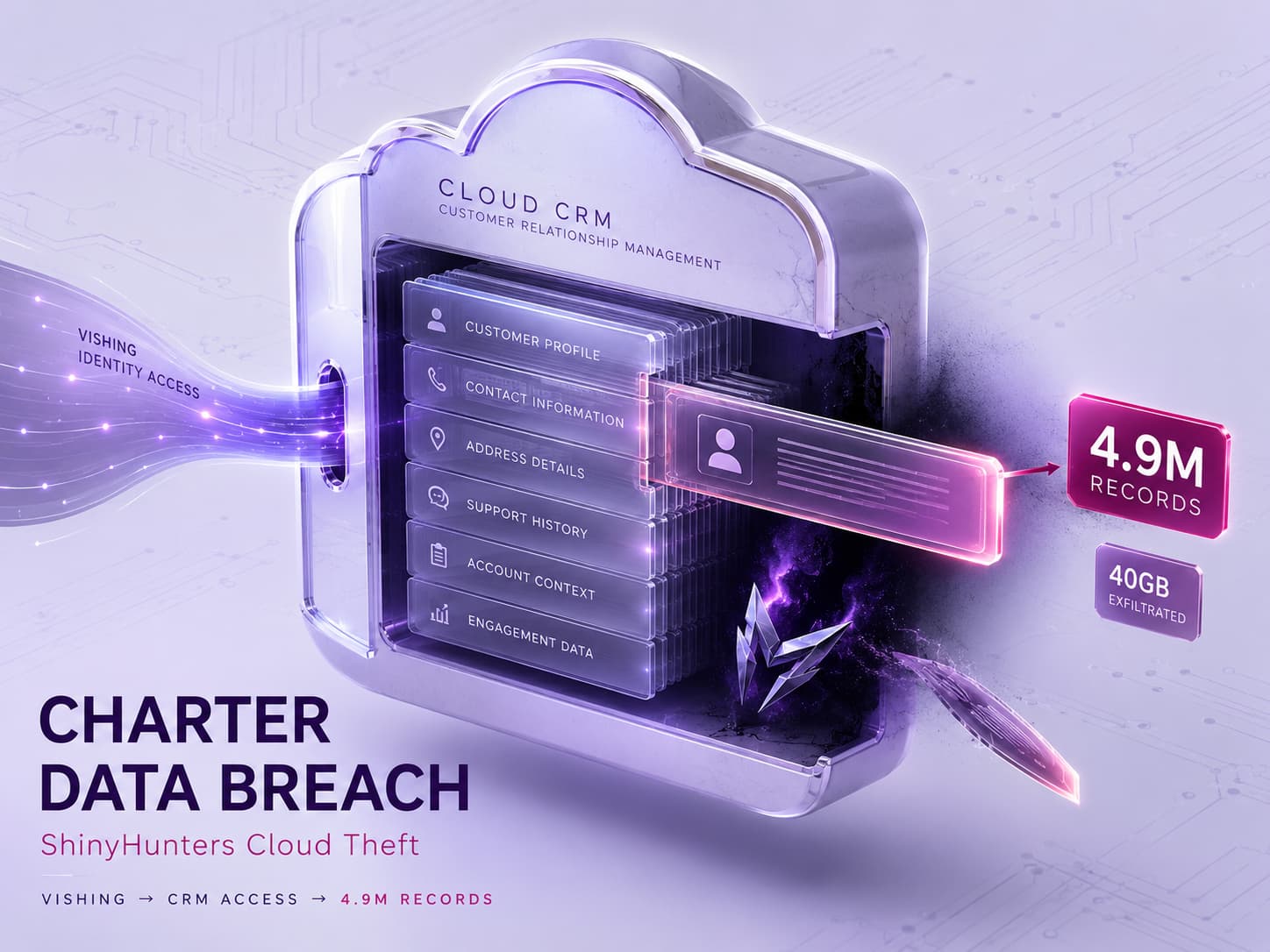
Charter, which offers internet, TV, and phone services under its Spectrum brand, initially announced the incident to regulators and law enforcement while downplaying the scale of data loss.
However, ShinyHunters boldly listed Charter on their dark web leak site, threatening to publish millions of records unless a ransom was paid. About 4.9 million unique accounts had personal details exposed. Charter insists no highly sensitive data was taken, but the breach still marks one of the largest telecom-sector intrusions in recent years.
Charter’s public statements carefully avoided confirming the full extent of the breach. The company told it had “followed security protocols” and alerted authorities, emphasizing that “no sensitive personal information (PI) or customer proprietary network information (CPNI) was exfiltrated”.
In other words, Charter claims only basic customer records from its sales tools were affected, not private call data or account passwords. ShinyHunters, by contrast, claimed to have stolen roughly 42 million records from Charter’s Salesforce system on April 1, 2026. That figure exceeds Charter’s ~32 million active customers, suggesting many duplicate or outdated entries.
Vishing Attack on Charter’s Cloud Systems
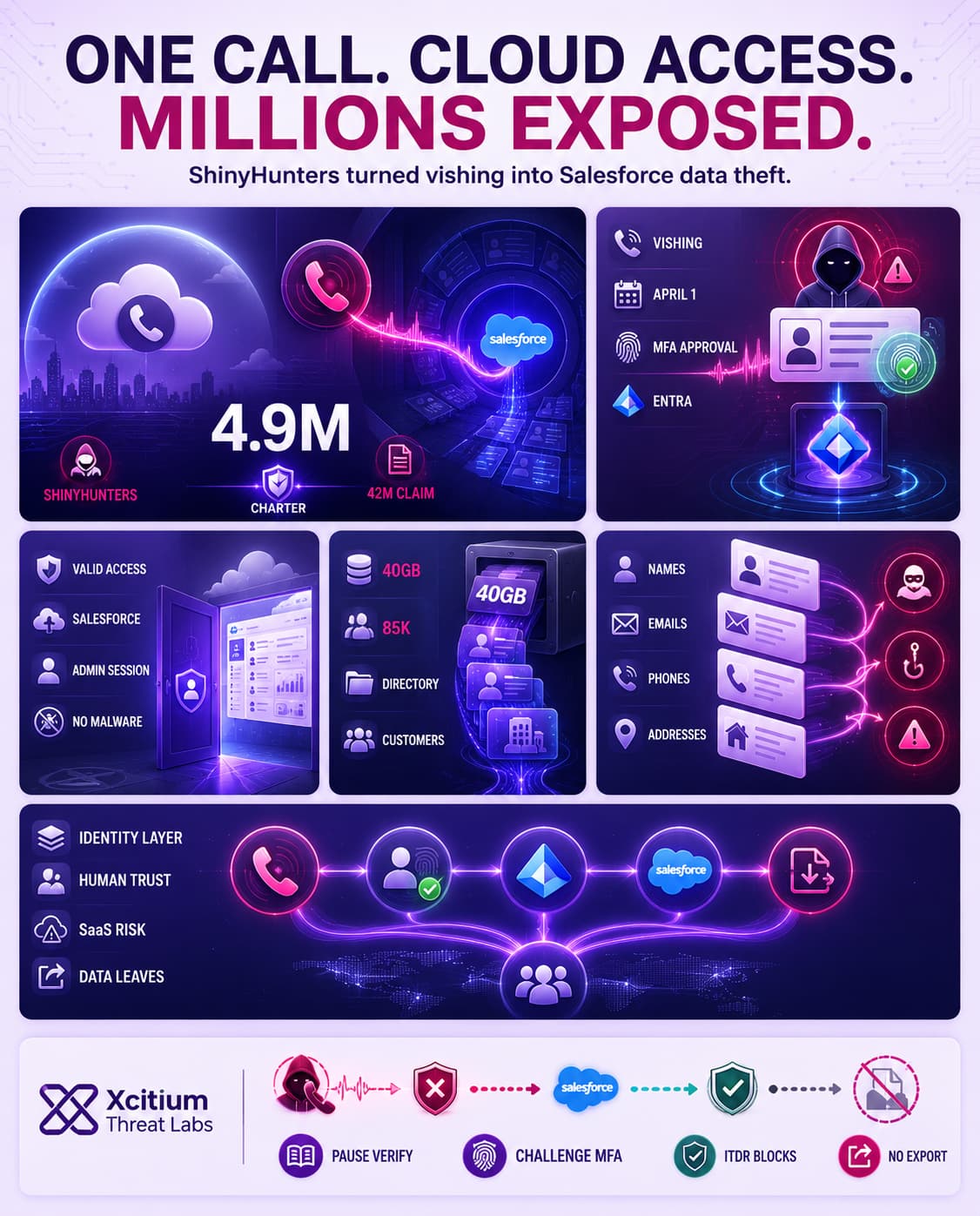
ShinyHunters reportedly gained access through a targeted social engineering scam. The group says it used a vishing (voice phishing) call on April 1 to trick a Charter employee into handing over access to their Microsoft Entra (formerly Azure AD) account.
In simple terms, an attacker phoned an employee and persuaded them to reveal login credentials or approve a login, bypassing any technical firewall. No malware or software exploit was needed the breach relied on human manipulation. Once they had a valid admin session, the intruders moved directly into Charter’s Salesforce environment and began mass-exporting customer data.
Cybercriminals are increasingly exploiting cloud-based tools via compromised credentials. The initial foothold in Microsoft’s identity platform gave them the keys to extract data from Charter’s cloud CRM.
ShinyHunters has used similar tactics in other attacks, social-engineering employees, stealing OAuth tokens or credentials, then pulling huge datasets out of Salesforce or other SaaS platforms. Charter’s breach follows on the heels of Salesforce-related campaigns that hit Panera, ADT, and other large firms this year. It underscores that cloud supply chains and employee account security are now critical entry points for data thieves.
What Data Was Stolen?
ShinyHunters and independent investigators agree that a large volume of customer contact information was taken. Have I Been Pwned confirmed that the leaked dataset contains 4.9 million unique accounts including names, email addresses, phone numbers, and physical addresses. Around 85,000 of the records also had job titles, suggesting an internal employee directory was partly included. In summary, the compromised fields include:
- Names and Email Addresses: Identifiers and contact info for Charter customers (both individual and business accounts).
- Physical Addresses: Customer street and billing addresses that could be used to correlate accounts or plan details.
- Phone Numbers and Plan Info: Details on phone numbers and subscription plans. (Charter disputes whether actual call records or sensitive details like account passwords were taken.).
- Support Ticket Data: Notes from customer support cases, which could include account problems or requests (Stolen, according to ShinyHunters.).
- Business Customers: The stolen file reportedly contained data on both consumer and business clients. Charter’s spokesperson said only sales and account management tools for business customers were impacted.
- Potential CPNI: ShinyHunters claimed some Customer Proprietary Network Information (regarding call history or usage) was in the haul. Charter flatly denies this, but regulators will scrutinize telecom records for compliance.
The ShinyHunters leak site post boasted: “42M+ records containing PII have been compromised” for Charter. That public listing which includes a “download” button exemplifies the gang’s extortion tactics. After Charter refused to pay a ransom, the attackers began publishing the actual data. Investigators found that the leaked archive (over 40GB uncompressed) contained primarily the contact fields above, rather than critical network identifiers.
Even though Charter downplayed the breach, exposing millions of emails and addresses can fuel convincing phishing or identity theft. Law enforcement agencies like the FBI have warned companies not to pay such ransoms, noting that paying doesn’t guarantee data deletion and may encourage further extortion.
Public Leak and Industry Impact
ShinyHunters demanded Charter begin “opening negotiations” by May 27, 2026 before publicly releasing the information. After receiving no response from Charter, ShinyHunters published the information online. Much of the 42 million records appear to be actively traded across various dark web forums or among other hackers. So far, Charter’s management provided little information on the situation. The company acknowledged there was a data breach and confirmed no sensitive information was stolen, but did not clarify the number of users involved nor provide specifics about the bypassed controls.
Charter serves nearly 32 million customers in North America. Data breaches raise security and privacy concerns, especially since basic contact information can be used maliciously, such as making phishing calls seem legitimate using the individual’s support and account history. Telecommunications firms like Charter have additional requirements; any leak involving Customer Proprietary Network Information must adhere to strict federal notification guidelines. At the moment, no such notifications have been received from Charter related to CPNI information. However, customer information still falls under state privacy protection and will eventually need clarification once reviewed legally and/or regulated.
A Pattern of Attacks on Telecom Providers
The Charter breach is a manifestation of a trend in telecoms and cloud services that is worrying. Over the last year, several cloud and telecommunication companies have been repeatedly hit by ransomware groups trying to extort money. Telecom company Telus Digital experienced a breach when ransomware group ShinyHunters breached the company using stolen cloud credentials and stole almost a petabyte worth of information. Others include AT&T, Verizon, Windstream among others that have been affected by either Salt Typhoon, which is believed to be Chinese-backed, or other ransomware groups.
In most cases, the attacks start with social engineering or even a compromised account, followed by a mass download of files and records. This is the approach used by ShinyHunters in its campaigns where once an individual’s credential is exposed, mass download of files follows. The breach at Charter highlights another worrying issue in the cloud security industry, that is, telecoms infrastructure companies have a lot of personal and business information thus make ideal targets.
Key Takeaways:
- A voice-phishing scheme was used by the ShinyHunters to penetrate the network of Charter Communications.
- 4.9 million unique customer records have been compromised through personal and account details of customers.
- Hackers mentioned “Charter 42M records” on their leaking website, indicating their massive impact and demands.
- Though Charter claims that such information is not sensitive, experts say it might lead to fraud cases.
- Such an incident forms part of a trend toward increasing attacks on telecommunications and cloud providers.
Conclusion: When One Voice Call Opens the Cloud
The Charter breach shows how modern data theft no longer needs malware, exploits, or direct network intrusion. One convincing vishing call was enough to compromise identity access, reach cloud systems, and expose millions of customer records. When attackers can persuade an employee to approve access, the enterprise perimeter becomes irrelevant.
This is the new reality of telecom risk. The most valuable data often sits behind SaaS platforms, CRM systems, and cloud identity controls.
Why This Threat Matters
ShinyHunters did not need to break through Charter’s core network. They targeted the human layer, then used valid access to move into business systems and export data.
- Vishing bypasses technical controls by manipulating trust
- Compromised cloud identities unlock high-value SaaS data
- Customer contact records can power convincing follow-up scams
- Business directories expose internal relationships and targeting paths
- Extortion pressure increases once stolen data appears on leak sites
Even when passwords or call records are not exposed, names, emails, phone numbers, addresses, account context, and support history are enough to create serious fraud and phishing risk.
Where Xcitium Changes the Outcome
For organizations using Xcitium ITDR and Xcitium Cyber Awareness Education with Phishing Simulation, this attack would not succeed.
- Employees learn to challenge urgent phone requests, fake IT support claims, and MFA manipulation
- Simulated social engineering builds pause and verify behavior before access is approved
- Suspicious identity activity is detected before valid access becomes mass data export
- Risky sessions, abnormal logins, and unauthorized SaaS access are stopped early
- The attacker loses momentum at the human decision point and the identity control layer
With Xcitium in place, a vishing call does not become cloud compromise.
Protect the Identity Layer Before Data Leaves
Telecom providers hold data that attackers can monetize instantly. Defending that data requires more than perimeter security. It requires trained users, continuous identity monitoring, and fast response when trust is abused.
Strengthen the layer attackers target first.
Stop vishing from becoming access.
Choose Xcitium ITDR and Cyber Awareness Education with Phishing Simulation.