Understanding the SimpleHelp Remote Support Tool
SimpleHelp is an RMM (Remote Monitoring & Management) application used by companies in their IT services for remote monitoring and management of systems. The application enables helpdesk administrators to manage the endpoints on various network systems. However, because of this capability, SimpleHelp becomes a prime target for any attacker.
Recently, a vulnerability was discovered in SimpleHelp’s authentication process. The flaw is referred to by the CVE id 2026-48558 and exists in SimpleHelp up to version 5.5.15. By taking advantage of the vulnerability, attackers can bypass the normal authentication processes and create a Technician account.
Inside the Flaw: OIDC Authentication Bypass
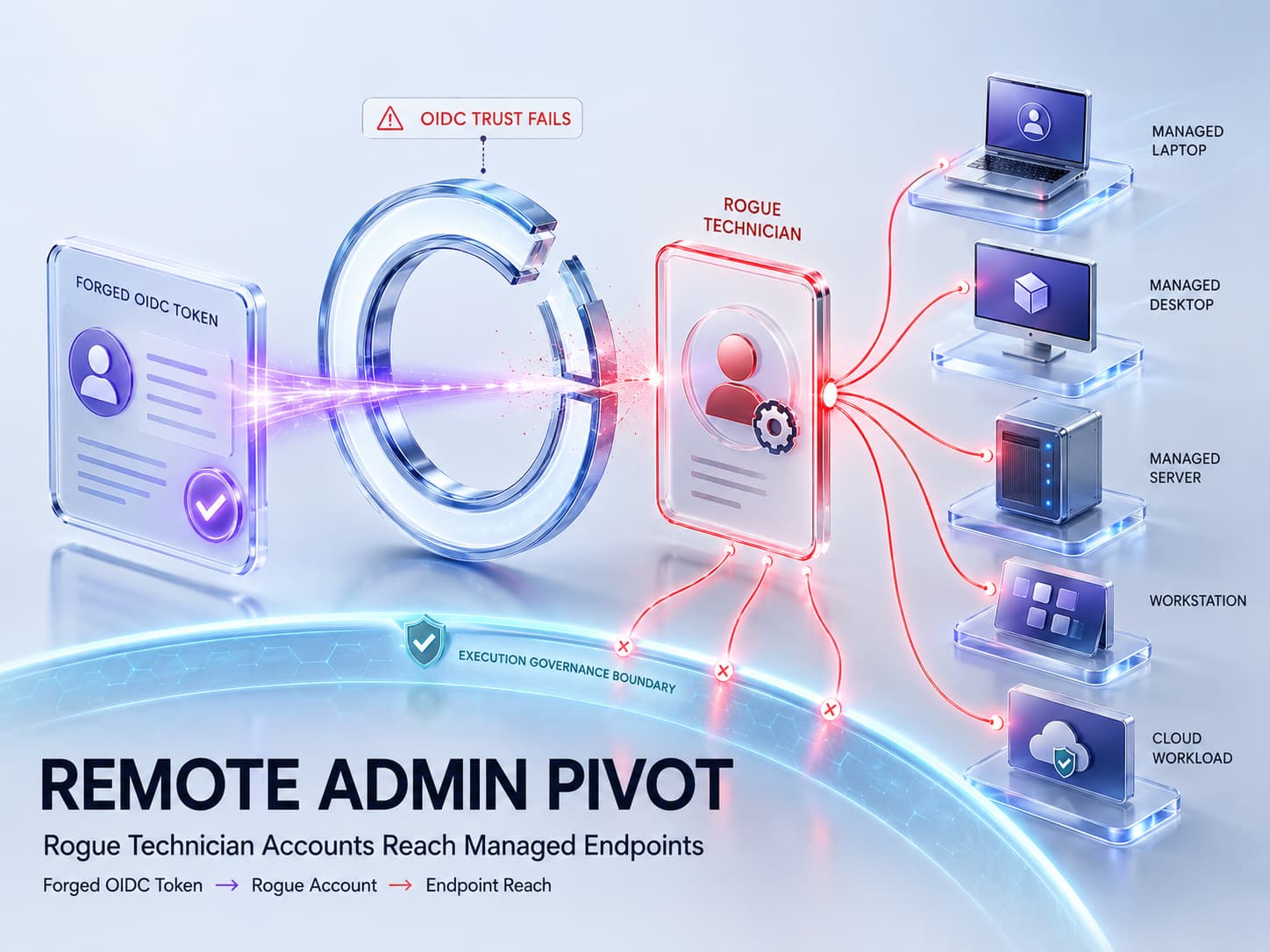
Exploit occurs within deployments where OpenID Connect (OIDC) is used as a single sign-on protocol. It has become popular among organizations when delegating user authentication to IDPs such as Azure AD. SimpleHelp allows OIDC authentication for both generic protocols and Azure AD OIDC protocol. Because of a verification issue with the OIDC tokens, SimpleHelp is prone to accepting the fake identity token despite the lack of any signature verification process.
In other words, an unauthenticated attacker can create a forged identity token, authenticate using it, and receive access to SimpleHelp services under the technician account. This provides an attacker with full capabilities of an administrator account, which includes remote administration of managed computers and execution of scripts on their behalf.
Even multi-factor authentication (MFA) doesn’t save the situation here because usually after the first login to SimpleHelp, technicians have to enroll their account with at least one MFA authentication option. The attack vector makes it possible for an attacker to register and authenticate through MFA simultaneously.
Screenshot of the SimpleHelp administrative interface with a forged “Forged Attacker” technician account. New accounts appear in the list automatically upon creation. They are assigned default administrative rights right away, meaning the attacker obtains an opportunity to control helpdesk functions.
OIDC Auth Bypass
• At least one Technician Group linked to the OIDC provider
• Group must have “Allow group authenticated logins” enabled
• Affected: SimpleHelp up to version 5.5.15
Conditions for Exploitation
This flaw only applies under specific conditions. For a SimpleHelp server to be vulnerable:
- OpenID Connect (OIDC) login must be enabled on the server.
- At least one Technician Group must be linked to the OIDC provider (otherwise OIDC logins wouldn’t work at all).
- That Technician Group must have the “Allow group authenticated logins” option turned on.
Each of these settings is common in enterprise deployments that integrate with Azure AD or other identity providers. In fact, by default many deployments allow group-authenticated logins. If all three prerequisites are met, an unauthenticated attacker on the internet can instantly spawn a new privileged account. Bullet lists like the one above make it clear how simple misconfigurations can be fatal. The point is, environments using OIDC for convenience may inadvertently invite this bypass.
Widespread Exposure: Thousands of Servers At Risk
SimpleHelp is widely deployed, and a significant number of instances are reachable online. Shodan scans indicates nearly 14,000 SimpleHelp servers have an exposed administration interface.
This broad exposure means many companies might be running outdated versions. A sample survey of reachable servers found about 7.2% had the vulnerable OIDC setup. Even a small percentage of 14,000 is hundreds of systems. In concrete terms, any organization that enabled OIDC without updating to the June 2026 patches is at real risk.
Impact: Rogue Technician Accounts and Lateral Movement
The rogue tech account is not just an ordinary user in the system. Technicians are allowed to access remote computers, install software, download files, or even remotely control other machines. Using an RMM tool, attackers achieve full network infiltration. Being in such a position, the attacker acquires all of the necessary privileges to execute harmful scripts, obtain credentials on endpoints, or extract information.
The fact that SimpleHelp is used primarily by IT companies and organizations means that the breach could have affected many downstream victims. CISA identified a path traversal vulnerability (CVE-2024-57727) that ransomware gangs exploited to infiltrate customers’ networks through SimpleHelp servers. The vulnerability helped to exfiltrate config files and credentials. Similarly, the OIDC flaw gives attackers an easy way to infect multiple networks.
Since the purpose of remote helpdesk software is to allow access to other computers, it becomes an automatic backdoor once breached. Hackers assume the guise of real helpdesk personnel, ensuring that all activities performed under their accounts remain within the scope of regular operations. Only unusual events recorded in SimpleHelp logs could give away attackers.
Conclusion: When Remote Support Becomes the Attack Surface
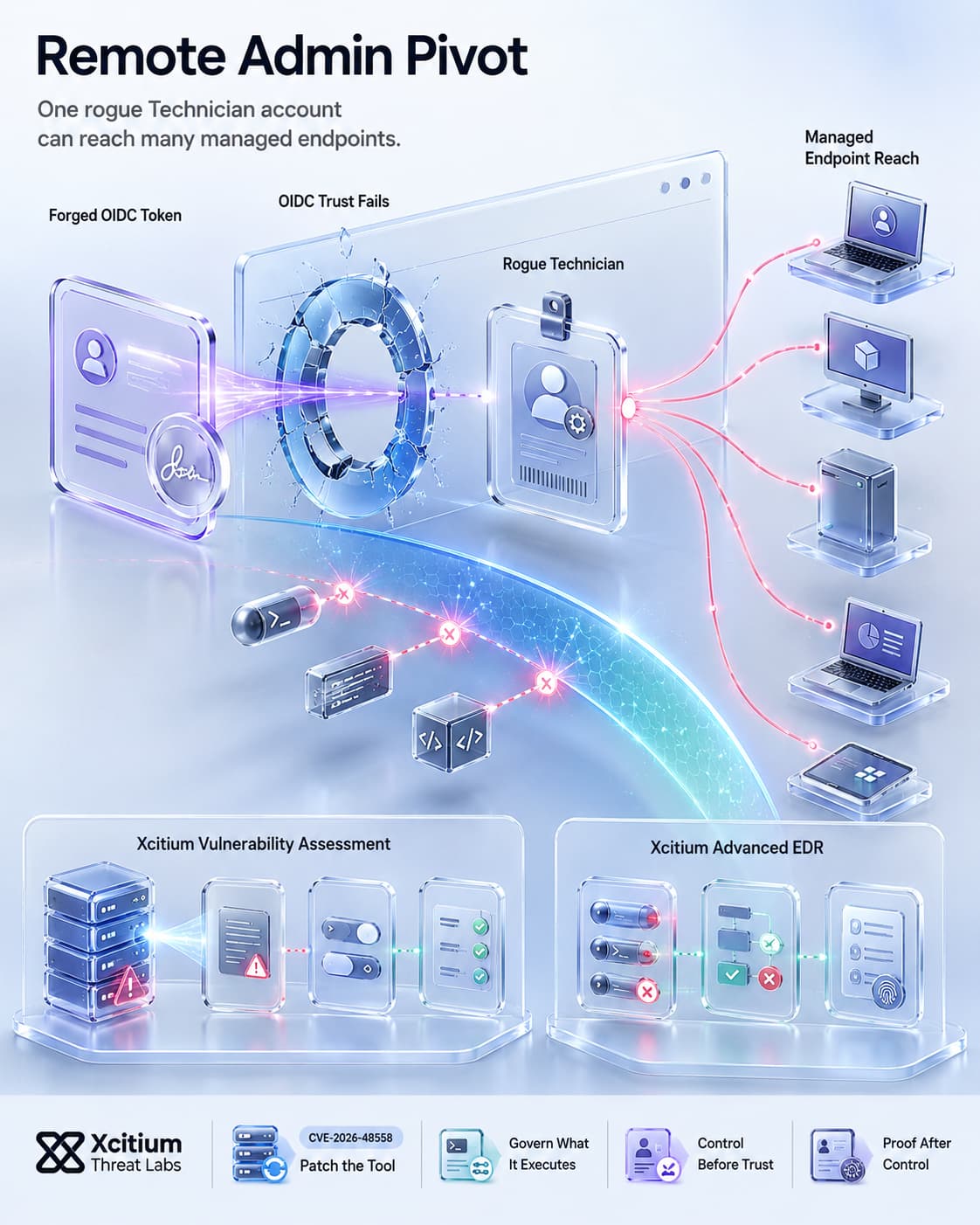
The SimpleHelp OIDC flaw shows why remote support platforms must be treated as privileged control planes, not ordinary applications. A single authentication weakness can allow an unauthenticated attacker to forge access, create a rogue Technician account, and gain the same operational reach trusted IT teams use to manage endpoints.
That is what makes this vulnerability dangerous. The attacker does not need to compromise every machine one by one. They compromise the tool that already has permission to reach them.
Why This Threat Matters
RMM and remote support systems are high-value targets because they sit close to administration, identity, scripting, and endpoint access.
- Rogue Technician accounts can turn into privileged remote access
- Exposed SimpleHelp servers increase the attack surface
- Weak OIDC validation can bypass normal trust checks
- Attackers can use legitimate support workflows to reach endpoints
- MSPs and IT teams face downstream risk across managed environments
When the management layer is compromised, the blast radius can move quickly from one vulnerable service to many connected systems.
Where Xcitium Changes the Outcome
This attack requires visibility before compromise and governed execution after access is attempted.
Xcitium Vulnerability Assessment helps organizations identify vulnerable SimpleHelp deployments, exposed admin surfaces, and risky configurations before attackers turn a known flaw into privileged access.
Xcitium Advanced EDR, powered by Xcitium’s patented Zero-Dwell platform, changes what happens if attackers try to push tools, scripts, or payloads through a remote support workflow.
Unknown code does not receive unrestricted execution rights.
Code can run without being able to cause damage.
Runtime behavior is governed before trust exists.
Follow-on execution is stopped before remote administration becomes endpoint impact.
This is Execution Governance in practice.
Control before trust. Enforcement before damage. Proof after control.
Patch the Tool. Govern What It Can Execute.
The SimpleHelp flaw proves that remote support infrastructure can become an attacker’s fastest path into managed environments. Patching is urgent, but patching alone is not the full strategy.
Find exposed systems.
Close vulnerable access paths.
Govern unknown execution before trusted tools are abused.
Choose Xcitium Vulnerability Assessment to expose the risk.
Choose Xcitium Advanced EDR to enforce Execution Governance when attackers try to turn access into impact.