Critical New DNS Client Vulnerability
Microsoft’s May 2026 Patch Tuesday included CVE-2026-41096, a newly disclosed remote code execution flaw in the Windows DNS Client. According to official sources, it is a heap-based buffer overflow that occurs when the DNS client processes a malicious response.
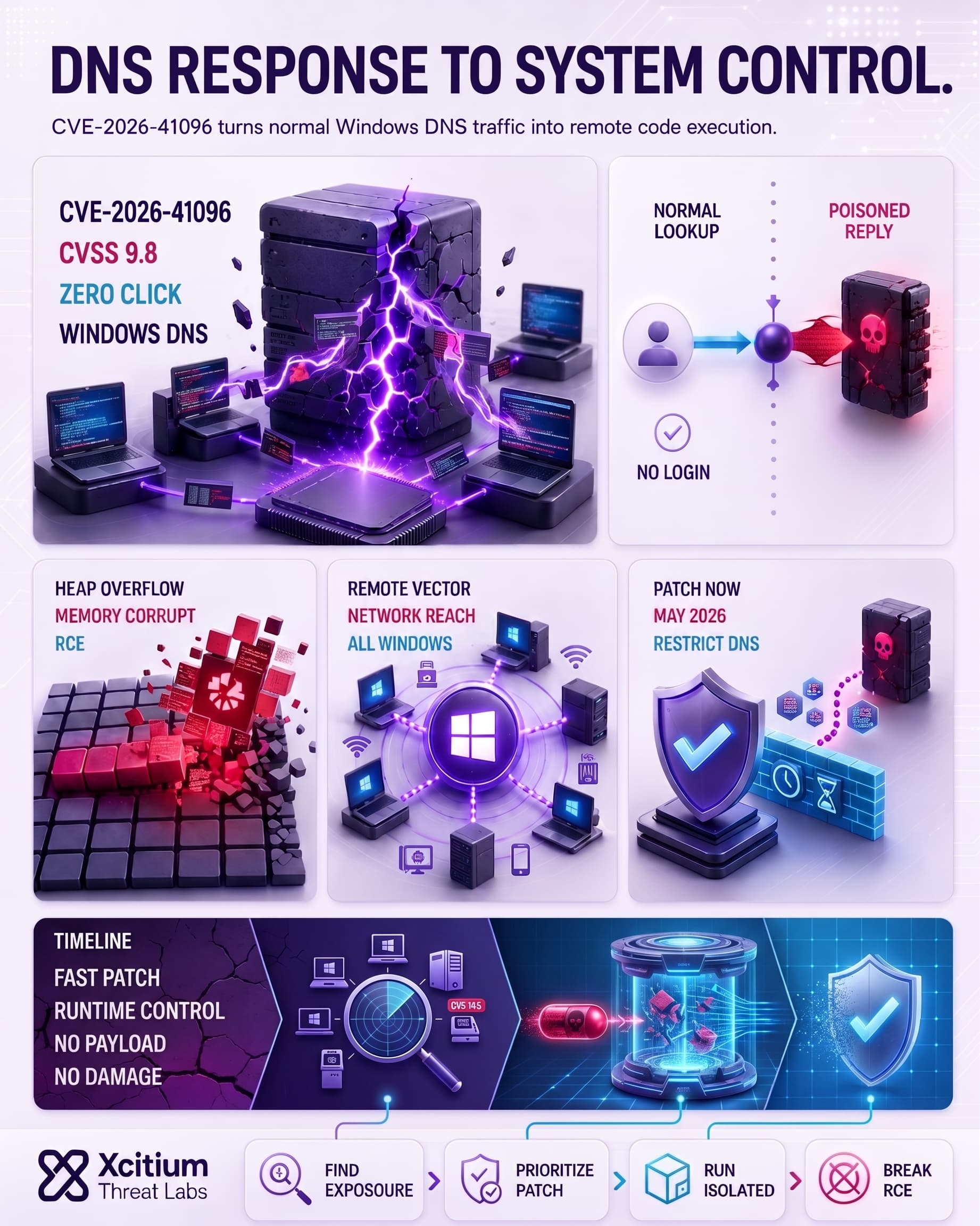
In practical terms, an attacker who can send a crafted DNS answer can corrupt the client’s memory and execute arbitrary code on the target system. Importantly, no user login or interaction is needed, the exploit works purely over the network. Every Windows device routinely performs DNS lookups, so this vulnerability has an extraordinarily large attack surface.
Universal Impact: All Windows Devices at Risk
Windows DNS Client is an essential part of Windows operating systems. Features of CVE-2026-41096 are:
- Heap overflow in DNS Client: The vulnerability exists in
dnsapi.dll, the Windows application used for name resolution. A malicious answer will cause a heap buffer overflow. - Network attack without credentials: The attacker must send a crafted DNS response. No additional credentials are required from the user.
- Wide-ranging impact: Any Windows computer, whether clients, laptop computers, servers, or virtual machines, sending DNS requests is potentially vulnerable. This may apply to any computer on company networks, through virtual private network (VPN), public Wi-Fi, or even personal computers at home.
- Triggering condition: The victim simply has to conduct normal DNS resolution. When the victim receives a poisoned or malicious answer, the overflow occurs.
- High criticality: CVSS 3.1 base metric score is 9.8 (Critical). This indicates that an attacker has access from outside the network, no special technical skills are required, and full impact exists on confidentiality, integrity, and availability.
Remote Code Execution.
• Wide Attack Surface: Every device uses DNS routinely.
• Zero-Interaction: No login or clicks required.
• Network Reach: Can be triggered remotely (AV:N).
Attack Scenario: Malicious DNS Responses Enable RCE
Attacks can take place discretely within the regular DNS communications. For instance, a computer running Windows will occasionally need to resolve domain names when accessing the internet or updating software. If the attacker hijacks or tampers with the DNS reply channel by running a malicious DNS server, exploiting the poisoned cache of the DNS resolver, or setting up a rogue network, then the DNS client may be tricked into receiving a malformed reply.
A crafted DNS message from the attacker causes the victim to execute arbitrary data which ultimately corrupts its own memory space. In other words, simply by interpreting the DNS reply message, the client effectively executes the attacker’s code with the NETWORKSERVICE permissions.
An example of how such an attack could be carried out would include:
- Attacker sets up control over DNS responses. For instance, the attacker runs a malicious DNS server or intercepts DNS messages on the network.
- The victim queries DNS. The Windows PC issues a valid DNS request (e.g., to resolve a website).
- Malicious DNS reply is generated and sent back. The attacker sends a crafted DNS reply which is larger than expected.
- Parsing the DNS reply leads to heap overflow. The
dnsapi.dllincorrectly parses the reply leading to memory corruption. - Remote code execution takes place. The attacker gains remote execution capabilities without requiring any interaction from the victim.
This illustrates why detecting the attack based on DNS logs is difficult since the traffic appears legitimate and the attack occurs under the hood.
CVSS 9.8 Score Underscores Critical Impact
The attack can be launched from anywhere on the network with no special permissions or user help, and it fully compromises confidentiality, integrity, and availability. Such a combination of factors justifies the maximum critical rating of 9.8.
Historically, this vulnerability is reminiscent of high-profile DNS bugs, but with a key difference: it lives in the client resolver. The infamous 2020 “SIGRed” flaw (CVE-2020-1350) affected DNS servers, allowing wormable RCE on domain controllers. By contrast, CVE-2026-41096 affects every Windows endpoint performing name resolution. This ubiquity means attackers have many more targets; any workstation, kiosk, or laptop that ever queries DNS is in scope.
This flaw lets an attacker run code remotely on the affected system without authentication, simply by sending a crafted DNS reply. Organizations must move this patch high in their priority lists and treat the Windows DNS client with serious caution.
Conclusion: When DNS Becomes the Attack Surface
CVE-2026-41096 exposes one of the most dangerous realities in endpoint security. A Windows device does not need to open a file, click a link, or authenticate to be at risk. It only needs to perform a normal DNS lookup and receive a malicious response.
That makes this vulnerability especially serious. DNS is not optional. Every workstation, laptop, server, and virtual machine depends on it constantly. When the client resolver itself becomes vulnerable, the attack surface becomes nearly universal.
Why This Risk Is So Urgent
This is not a niche exposure. It affects the basic network behavior every Windows system relies on.
- No user interaction is required
- No credentials are needed
- Malicious traffic can resemble legitimate DNS responses
- Exploitation may happen silently in the background
- Successful execution can give attackers a foothold before defenders see anything
Any organization that delays patching is leaving a core Windows function exposed to remote code execution.
Where Xcitium Changes the Outcome
For organizations using Xcitium, this risk is addressed at two critical points.
Xcitium Vulnerability Assessment makes the exposure visible before attackers exploit it.
- Unpatched Windows systems are identified
- Critical CVEs are prioritized for urgent remediation
- Risky endpoints and servers are surfaced before they become entry points
Xcitium Advanced EDR reduces the impact if exploitation is attempted.
- Malicious execution is intercepted at runtime
- Follow-on payloads cannot freely establish control
- Code can run without being able to cause damage
- The attacker’s path from DNS response to system compromise is broken early
Patch Fast. Prevent Faster.
CVE-2026-41096 proves that even routine network activity can become an attack path. Patching is mandatory, but visibility and execution control must work together.
Find the exposure before attackers do.
Stop malicious execution before it becomes compromise.
Choose Xcitium Vulnerability Assessment and Xcitium Advanced EDR.