Why This DeepLoad Campaign Stands Out
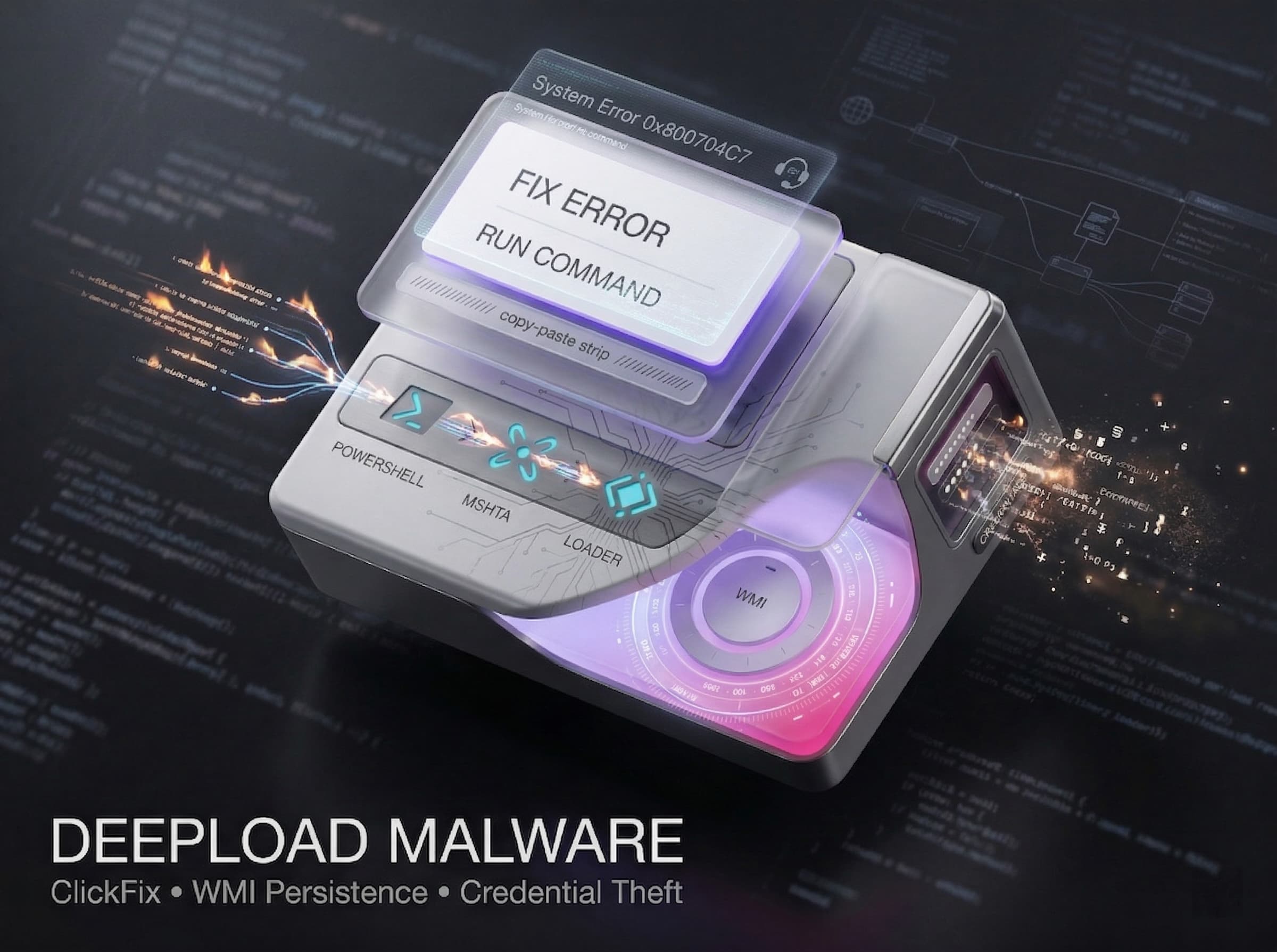
DeepLoad is a newly observed malware loader that shows a modern pattern. Attackers combine social engineering with Windows-native tools. Instead of starting with a software exploit, the campaign reportedly uses ClickFix to persuade a user to run a pasted command. The intrusion can begin with what looks like ordinary troubleshooting. It can then pivot quickly into browser credential theft.
Unlike many “download-and-run” loaders, DeepLoad is described as trying to look native. It hides its payload behind a legitimate lock-screen (LockAppHost.exe). It also enables multiple theft paths, including browser password extraction and a malicious extension.
ClickFix Explained: When The Victim Runs The Payload
ClickFix is successful because it offloads the execution to the user. A false prompt will tell the victim to copy, paste, and run the “fix,” which might be to cure some sort of error. As such, the critical action is being done as part of the legitimate user flow. It might be less suspicious than running something in the background.
Victims might come from phishing sites and compromised sites. ClickFix attacks frequently utilize built-in Windows tools to fetch the payload in memory.
The Reported DeepLoad Chain In Plain Steps
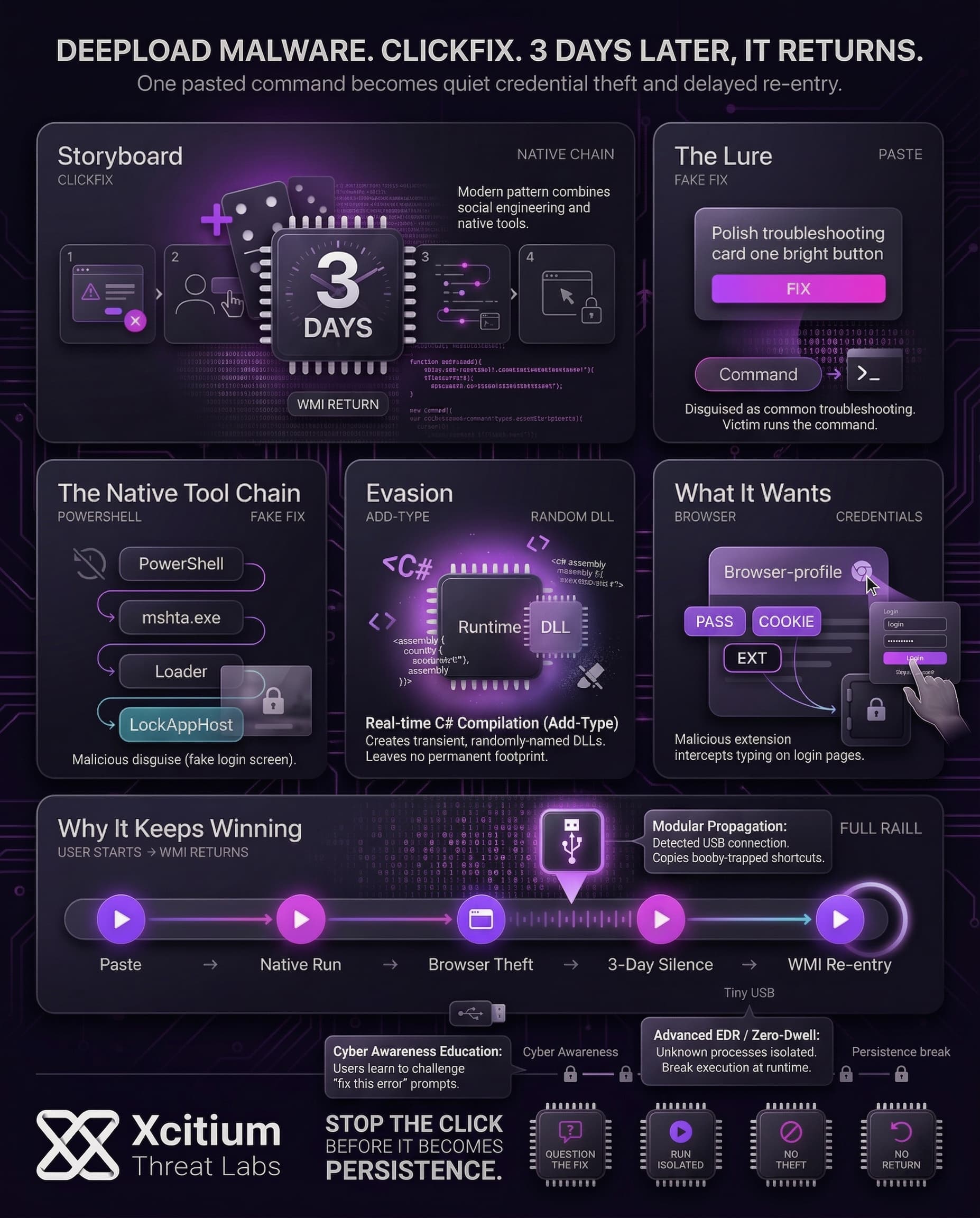
The victim executes the PowerShell command. Next, the command utilizes the legitimate Windows tool mshta.exe to download and execute the PowerShell loader. The loader attempts to obfuscate the actual logic using assignments. It also disables PowerShell history. Finally, blends in with legitimate processes by using legitimate-sounding process names.
A simplified view of the chain looks like this:
- ClickFix: User executes command
- PowerShell: Initiates the flow
- mshta.exe: Retrieves the loader
- Loader: Pivots to steal credentials
Evasion Tactics That Keep Artifacts Unstable
DeepLoad employs techniques that minimize the likelihood of stable fingerprints. It has the ability to produce a secondary component through the compilation of C# code via the Add-Type command in PowerShell. The command drops a DLL file with a randomly generated name. The campaign utilizes process injection techniques, such as APC-style injection. The techniques can execute in a trusted environment.
They can also minimize the likelihood of leaving a payload on the disk. Malware and phishing filtering through email campaigns have a huge volume. Even a small “conversion rate” can translate to a large number of infections. This environment makes ClickFix-style, user-driven execution appealing for use in loaders such as DeepLoad.
WMI Persistence: The “Quiet Return” Days Later
Another significant aspect of DeepLoad is its mechanism of persistence. A WMI-based reinfection was identified three days later. There was no need for any new user actions. Similarly, there was no need for attacker interaction. Thus, a system can appear clean initially, yet cause execution later.
WMI event subscriptions can be used for persistence. In the MITRE ATT&CK model, there are possibilities for the adversary to create event triggers for later execution of codes. Schedules and logons can be event triggers. Additionally, there can be proxy execution of WMI through the WMI provider host process. This can cause confusion in parent-child relationships of the processes.
Browser Credential Theft: Why Attackers Keep Chasing Logins
DeepLoad’s goal is access, and browsers hold high-value secrets. The malware is described as extracting browser-stored passwords. It also deploys a malicious extension that can intercept credentials as users type them on login pages. Consequently, collection can continue across sessions, even if the initial loader becomes less active later.
DeepLoad’s goal is access, and browsers contain high-value secrets. The malware is stealing browser-stored passwords. It also deploys a malicious extension. The malicious extension can steal credentials as users type in login pages.
Removable Media Spread And A Modular Loader Model
DeepLoad also revives an older propagation path. The campaign is described as detecting USB connections and copying booby-trapped shortcut files that masquerade as familiar installers.
The infection can move via offline sharing habits, not only email clicks. Separately, the malware appears very new. Its infrastructure looks templated. That hint may point to reuse, even though the campaign’s overall scale is unknown.
Conclusion: When the User Runs the Attack for the Attacker
DeepLoad reflects a growing shift in malware delivery. The attacker does not need a software exploit, they need a believable workflow. ClickFix lures turn copy, paste, and run into the first stage of compromise, then Windows native tools like PowerShell and mshta.exe carry the chain forward into credential theft and stealthy follow-on activity.
Why This Threat Is So Effective
This campaign succeeds because it blends into normal system behavior instead of fighting against it.
- The first action is performed by the user, which lowers suspicion
- Legitimate Windows utilities are reused for delivery and execution
- Dynamic C# compilation and random DLL creation reduce stable artifacts
- WMI persistence allows the malware to return later, even if the first stage looks gone
By the time browser credentials are at risk, the attacker already looks native.
Where Xcitium Changes the Outcome
If you have Xcitium in place, this attack would not succeed.
With Xcitium Advanced EDR, the execution chain breaks at runtime. Unknown processes are isolated the moment they run. Code can run without being able to cause damage. Browser theft, injected payloads, and delayed WMI based re-entry lose their ability to impact the real system.
Pair that with Xcitium Cyber Awareness Education and Phishing Simulation, and the first step is weakened too. Users learn to challenge “fix this error” prompts before they ever paste a command.
Stop the Click Before It Becomes Persistence
DeepLoad proves that modern malware does not need noisy exploits. It needs one trusted moment. Remove that moment, stop execution at runtime, and the entire chain collapses.