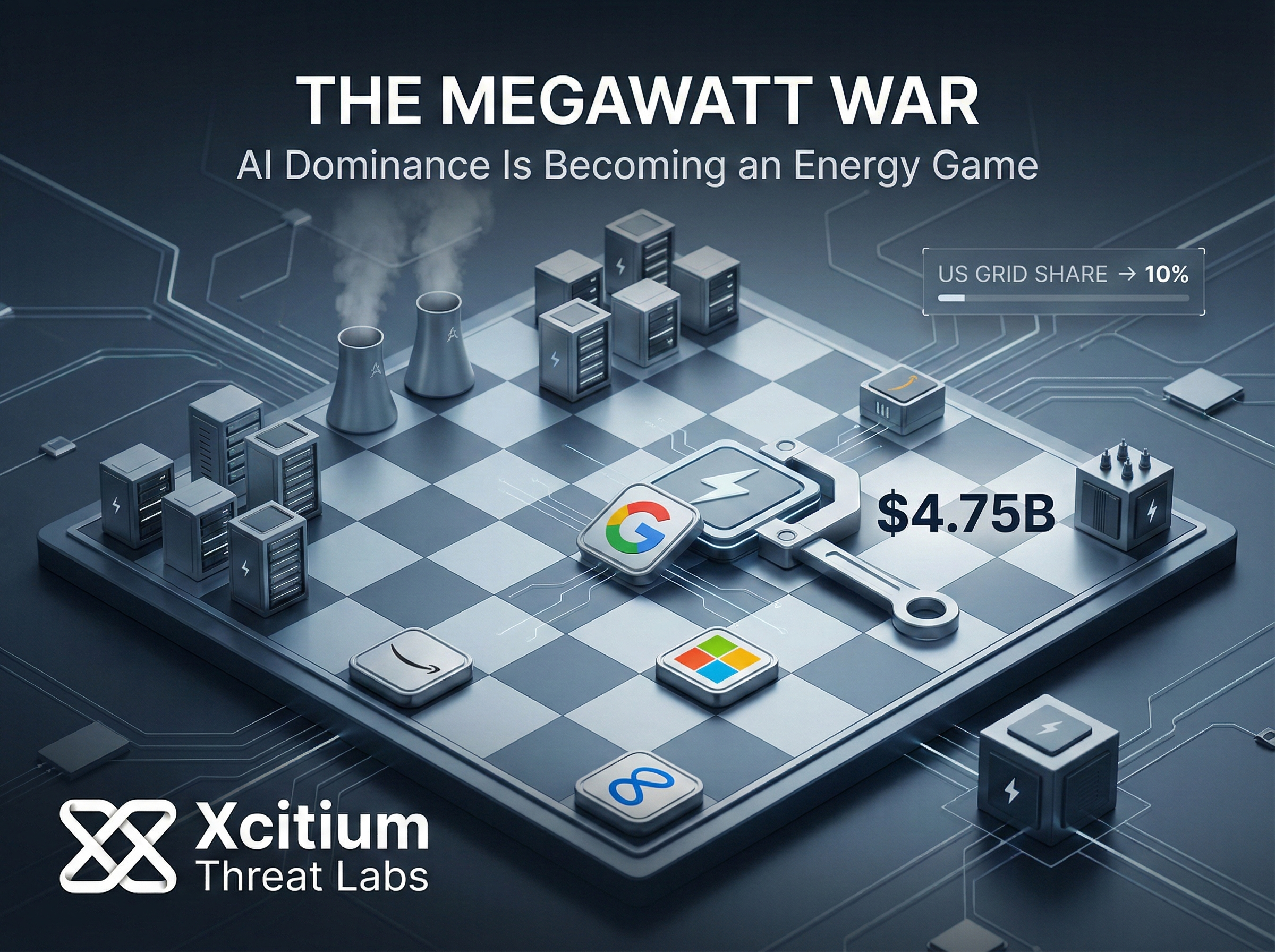

Google’s $4.75B energy deal highlights a trend: tech giants are investing in power to run AI data centers. Surging data center demand is spiking RAM prices.
Google has just announced a blockbuster $4.75 billion investment in the energy sector, taking over a power infrastructure company. But this major play highlights how important power has become for the development of technology. The firm is making sure that its rapidly expanding AI and cloud-based data centers have power.
GOOGLE × INTERSECT
Who is Intersect?
A premier clean energy developer specialized in large-scale solar and storage. They provide the physical infrastructure needed to bridge the gap between renewable power and high-demand AI data centers.
Google’s $4.75 Billion Bet on Energy Infrastructure
Google’s purchase of energy developer Intersect is the strongest indicator yet that energy supply has moved to the top of the agenda. It acquired Intersect to accelerate the development of new data centers alongside new energy projects. Rather than purchasing power, Google is now investing in energy infrastructure.
Consequently, it will add several gigawatts of power capacity online quickly in order to meet the rising demand. Furthermore, the projects developed by Intersect, ranging from Texas to California, fit Google’s approach of developing data centers in collaboration with power generation for optimal results. This indicates scaling up AI services not only involves increasing the server capacity but also acquiring the megawatts required for powering them.
THE TECH GIANT POWER RACE
Tech leaders like Google & Amazon are racing for AI dominance, driving data center energy demand toward 10% of total U.S. power. Traditional grids are failing to keep pace.
AI’s Power Hunger: Tech Giants’ Data Center Boom Is Reshaping the World’s Energy Grid
The race for dominance in AI and cloud computing is seeing these giants construct data centers at a record rate. With this trend, their energy consumption is also increasing exponentially. Currently, data centers consume approximately 1.5% of the world’s energy consumption. In the US alone, data centers contributed about +4.4% of energy consumption in 2025 and could reach a maximum of 10% in a few years.
Google, Microsoft, Amazon, and Meta are investing heavily in new server centers all over the world. Just a couple of examples: Google is building large campuses in Texas and Virginia, and Amazon is the largest corporate purchaser of renewable energy in the world (for powering its AWS cloud infrastructure centers). But the local power infrastructure is not able to support the expansion in the industry. In certain areas, power shortages have caused a halt in data center construction initiatives.
THE DRIVE FOR ENERGY AUTONOMY
Big Tech is bypassing traditional utilities by investing directly in energy production. From nuclear deals to massive solar farms, the goal is total control over the electricity supply chain.
Reliability
Ensuring 24/7 uptime by avoiding local grid bottlenecks.
Speed
Faster capacity deployment without waiting for utility permits.
Cost Control
Shielding from volatile market prices with locked-in rates.
Sustainability
Direct funding of carbon-free assets to meet climate targets.
Why Big Tech Is Investing in Energy
Rather than relying solely on utilities, tech companies are investing directly in their own energy infrastructure. Major players are forging deals to secure long-term power supply.
For instance, Meta recently agreed to procure up to 6.6 GW from nuclear projects to power its future facilities.Microsoft even signed a contract to draw 50 MW from a planned fusion energy plant by 2028.
Meanwhile, Amazon has invested in solar and wind farms to the tune of hundreds, making it the largest clean energy purchaser for the fifth year in a row. All these efforts are geared towards giving Big Tech companies control over one essential resource electricity. Some of the major reasons for this include:
- Reliable Power Supply: Data centers run 24/7 and can’t afford outages or grid bottlenecks. Owning generation (from solar farms to backup gas plants) helps ensure consistent, reliable power for critical servers.
- Faster Expansion: The development of private power infrastructure allows companies to develop power quickly. Furthermore, this will enable companies to develop data centers simultaneously with power infrastructure, thus avoiding delays for power connections.
- Cost Control: Such investments in energy can result in lower future costs. Further, the fact that they can produce their own energy makes them less vulnerable to fluctuating electricity costs, which could be detrimental given the increase in their consumption.
- Sustainability Goals: Large tech companies have very ambitious climate goals. Through their investments in wind, solar, battery storage, and even next-gen nuclear power, they ensure that more renewable power is fed into the grid and that they can operate entirely on 100% carbon-neutral power.
HARDWARE STRAIN: MEMORY SHORTAGE
AI data centers are projected to absorb 70% of global DRAM production by 2026, causing a severe supply vacuum in consumer markets.
Data Center Boom Drives Up Hardware Prices
The effects of the data center explosion go beyond energy consumption. With the increase in the number of servers that support AI, they are also devouring essential components such as memory chips (RAM). It is estimated that data centers will absorb up to 70% of all memory chips in 2026.
As a result, this means that there is a limited supply for the rest of the market, and prices are skyrocketing. There are only a few manufacturers of DRAM, and they are producing as much as they can sell to the cloud service providers who will pay top dollar for it. As a result, the price of RAM has skyrocketed across the globe.
By late 2025, some memory chip prices had almost quadrupled, and PC manufacturers were paying more than 500% more for RAM than a year ago. Consumers are paying the price as analysts predict that a memory chip shortage could last until 2028.
In short, this insatiable demand for AI processing is putting pressure on the electric infrastructure as well as the supply chain, pushing tech giants to think outside the box to meet their needs in terms of energy as well as hardware resources.