Understanding the Firefox SpiderMonkey Engine Vulnerability
Recently, a critical Remote Code Execution (RCE) vulnerability was discovered in Mozilla Firefox. Interestingly, the root cause was not a complex architectural flaw or a deep logic error.
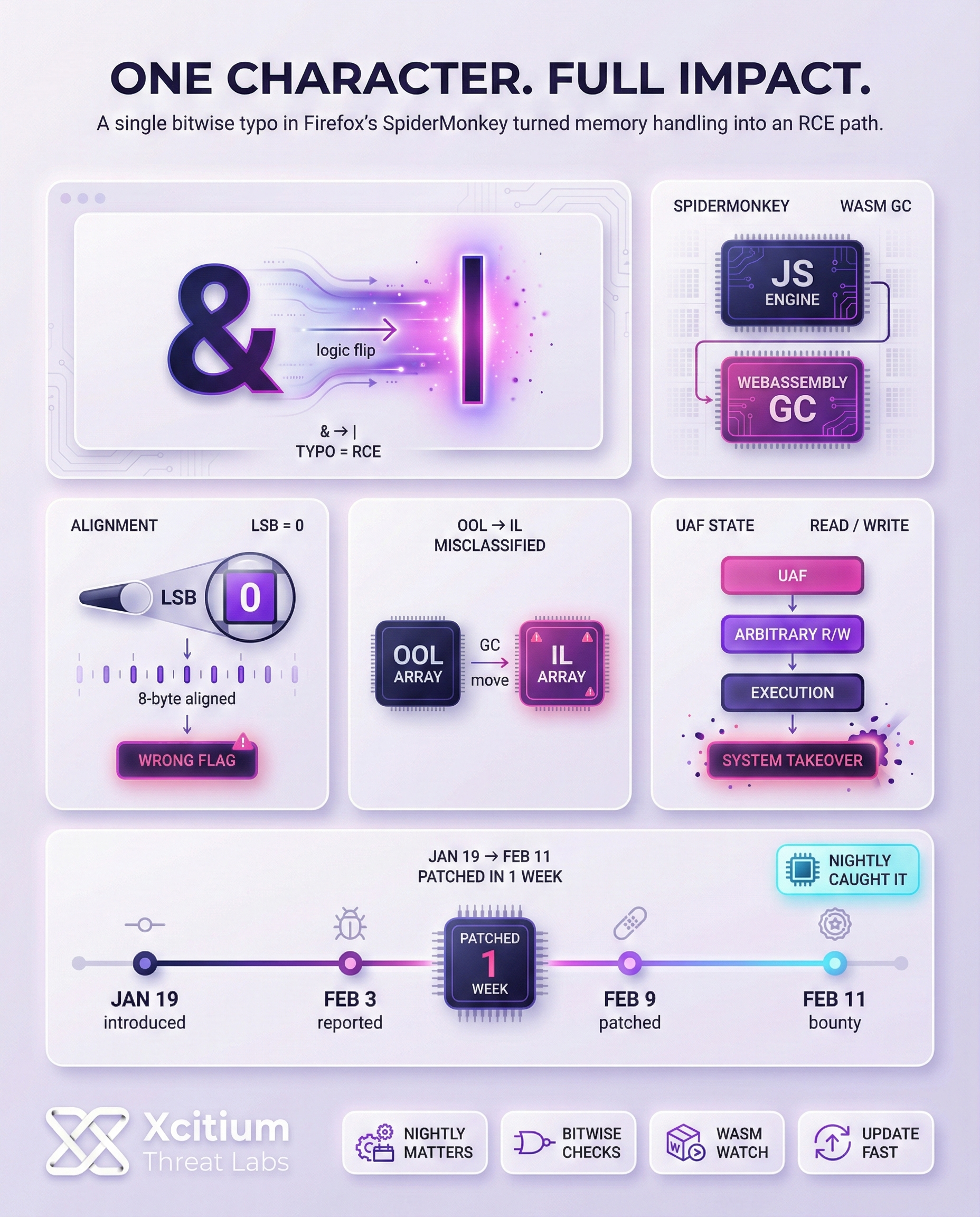
Instead, it was a simple typo in the SpiderMonkey JavaScript engine’s WebAssembly garbage collection code. A developer accidentally used the bitwise AND operator (&) instead of the bitwise OR operator (|).
Consequently, this minor mistake created a significant security loophole in the browser’s handling of memory. The error appeared during a refactoring process of WebAssembly Garbage Collection (GC) array metadata.
While modern compilers catch many errors, bitwise operations are syntactically valid even when logically incorrect. As a result, this specific line of code passed through initial reviews. However, an independent security researcher eventually flagged the issue.
How a Bitwise Typo Triggered Memory Corruption
The specific point of vulnerability lies within the WasmArrayObject::obj_moved() function. This function is used to handle memory when arrays of WebAssembly are moved due to garbage collection. In the event that the arrays are moved due to the “Out-of-Line” (OOL) arrays being moved, the system must ensure that the memory buffer contains a forwarding pointer. To achieve this, the least significant bit of this pointer must be set to 1.
However, owing to the typo in the code, the operation that the code was intended to perform was a bitwise AND instead of OR. Moreover, memory pointers are always 8-byte aligned. This means that the LSB of the memory pointer is always 0. The operation of “pointer & 1” will always result in a result of 0.
This resulted in the system incorrectly identifying the relocated arrays as “Inline” (IL) arrays. Therefore, the garbage collector was not able to correctly update the memory references. This resulted in the creation of a dangerous state in the memory management system of the browser.
Exploring the Technical Impact of the Flaw
The first consequence of this misidentification is that it leads to a Use-After-Free (UAF) condition. This is where the Ion JIT compiler continues to use memory that has been freed or relocated. In a real-world situation, this condition can be exploited by an attacker in the following ways:
- Triggering minor garbage collection to set the forward pointer to zero.
- Preventing stack frame updates to allow the browser to use old memory addresses.
- Heap spraying to fill the freed memory with attacker-controlled content.
- Arbitrary read and write access to the system’s memory.
Furthermore, the researcher who found the vulnerability, named Erge, showed that this could result in the takeover of the whole system. By bypassing the Address Space Layout Randomization (ASLR) protection mechanism, the exploit can overwrite function tables. In the end, this allows the execution of arbitrary commands. For example, the exploit can spawn a shell on the victim’s machine if the exploitation is successful.
Analyzing the Disclosure and Patching Process
Fortunately, this flaw was recognized in the Firefox 149 Nightly builds. This means that this bug never reached the stable version that the general public uses. Mozilla’s security team responded impressively fast once this bug report was filed. They were successful in fixing this bug within one week of its discovery. This prevented any exploitation of this 0-day bug.
- Vulnerability Introduction (Jan 19, 2026): The vulnerability was unintentionally introduced during a routine code refactoring process.
- Bug Report Filed (Feb 3, 2026): Researcher Erge responsibly disclosed the issue and submitted a working proof of concept (PoC).
- Official Patch Released (Feb 9, 2026): The issue was officially resolved and patched in commit
05ffcde. - Bounty Awarded (Feb 11, 2026): A security bounty was awarded to the researchers in recognition of their responsible disclosure.
This timeline highlights the importance of the “Nightly” release channel in catching critical bugs. Furthermore, the collaboration between independent researchers and software vendors remains a cornerstone of modern cybersecurity.
Lessons Learned from the Firefox RCE Incident
This is yet again significant reminder that, in most cases, human error is the weakest link in terms of security. Moreover, in the case of extremely advanced software like Firefox, just one character can breach multiple security levels.
So, testing and coding must be extremely thorough so that security is ensured in browsers. Furthermore, it is extremely important to update tools to detect logical errors in bitwise operations.
In addition, the rise of WebAssembly adds new complexities to browser engines. As developers push for higher performance, the surface area for potential vulnerabilities expands. Security teams must remain vigilant in monitoring low-level memory management code. For users, the best defense remains keeping software updated to the latest versions. In conclusion, while the bug was simple, its potential impact was immense.
Conclusion: One Character Can Break Your Security Model
The Firefox SpiderMonkey incident is a reminder that modern compromise does not always start with sophisticated social engineering or advanced malware. Sometimes it starts with a single character in a low level code path that turns safe logic into memory corruption, then into remote code execution.
Why This Still Matters
Browser engines operate at the edge of performance and complexity, and that edge is where critical bugs hide.
- JIT and WebAssembly paths increase attack surface
- Small mistakes can create high impact exploitation primitives
- Attackers prioritize browser RCE because the initial foothold is instant
Why Most Organizations Are Exposed
Even disciplined teams inherit risk through software they do not control.
- Users browse daily across mixed trust sites
- Patch latency creates an opportunity window
- A single unpatched workstation is enough to start credential theft, session hijacking, or lateral movement after code execution