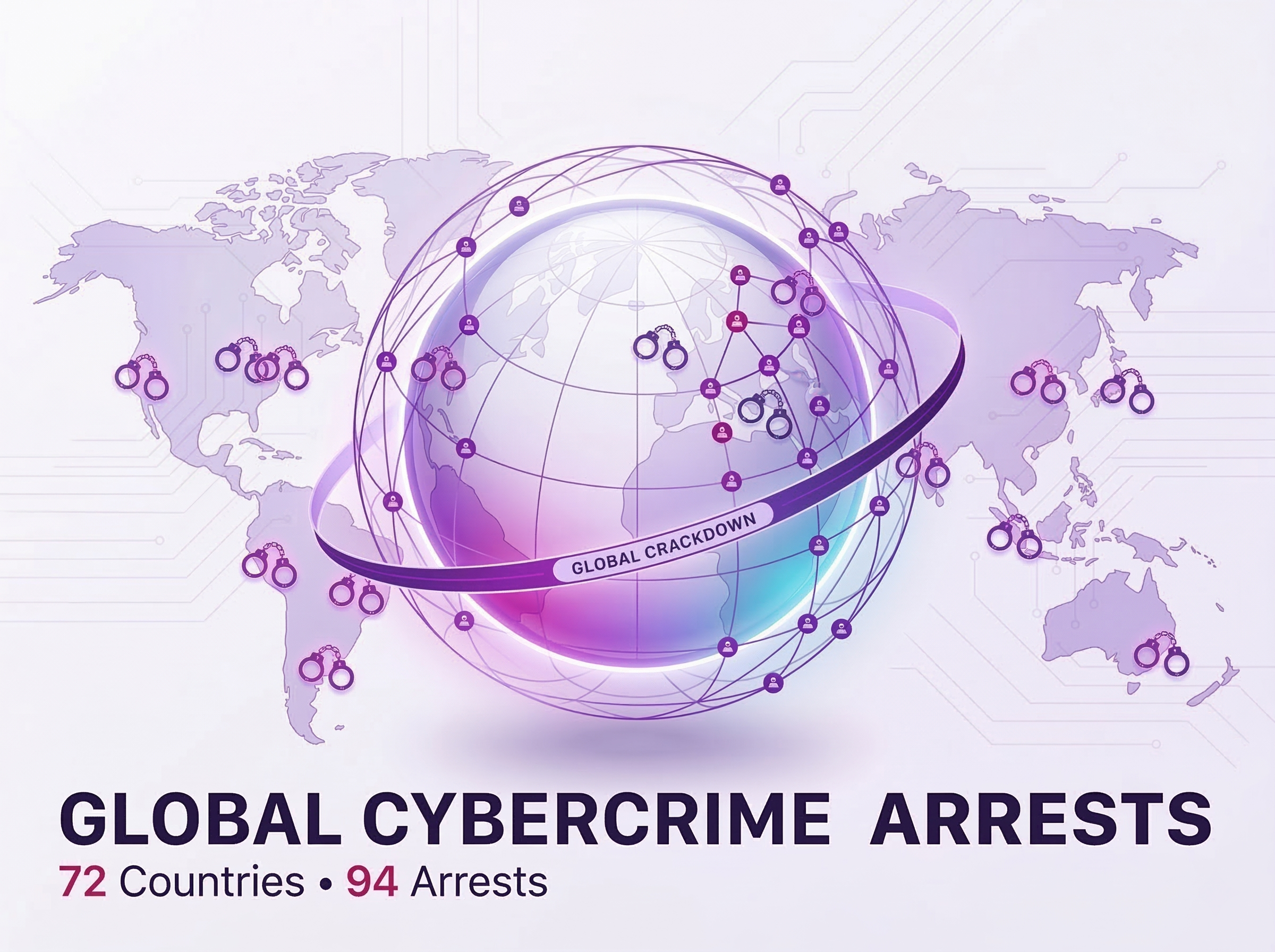
Interpol organized Operation Synergia III, a worldwide crackdown (Jul 2025 – Jan 2026) that took down 45,000+ malicious IPs and servers used in phishing, malware, and ransomware attacks. The operation, which involved 72 countries, made 94 arrests (with 110 more suspects under investigation) and seized 212 devices.
Operation Synergia III: Global Scope and Results
The operation built on prior phases in 2023 and 2024, pooling data and intelligence across agencies. Interpol “transformed data into actionable intelligence” and helped coordinate raids and disruptions around the world. In total, 72 countries and territories (from Angola to Zimbabwe) joined the effort. Authorities from Asia, Africa, Europe and the Americas all took part, highlighting how cybercrime networks span the globe. Alongside arrests and seizures, investigators identified and dismantled large botnet and hosting infrastructures that criminals relied on.
High-Impact Schemes Disrupted
Interpol and other law enforcement agencies revealed various illicit activities that were supported by the seized IP infrastructure. These include:
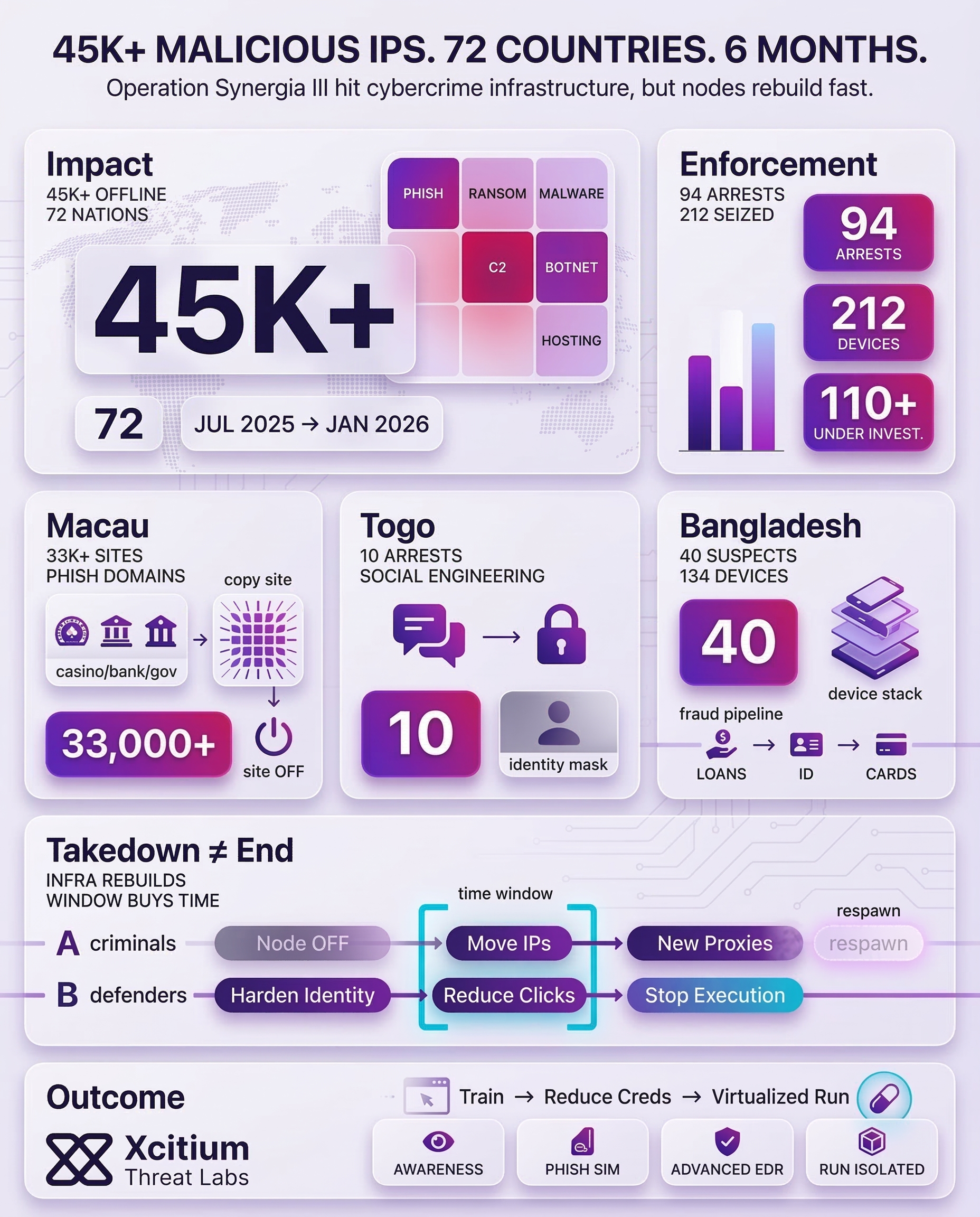
- Phishing campaigns in Macau (China): More than 33,000 phishing websites were discovered, featuring copied casino, banking, and government sites. The scammers lured victims to “top up” their accounts or provide personal details, which were later used for stealing financial assets and identities.
- Romance and sextortion scam ring in Togo: The authorities arrested 10 people who ran the scam ring from a residential complex. Some of the ring members hacked social media accounts and used the stolen identities to scam friends and family in fake online relationships.
- Complex fraud ring in Bangladesh: The police in Bangladesh busted a ring consisting of 40 suspects, seizing 134 devices used in loan, job, identity, and credit card scams. These activities were conducted by a ring that had previously scammed thousands of local residents.
In each of these cases, the servers or IPs were rented, hacked, or otherwise controlled by cybercriminals. Taking down these servers not only stopped the scammers from furthering their activities but also disrupted the command and control infrastructure that made it possible for the scammers to conduct large-scale operations. Thousands of phishing sites and servers were taken down as a result of this operation.
Key Statistics of the Takedown
- 45,000+ malicious IP addresses and servers disabled. Which were used for hosting ransomware, phishing kits, malware payloads, and fraudulent websites in the past.
- 94 suspects arrested globally, and another 110 are under investigation as a result of the raids and sweeps.
- 212 electronic devices and servers seized, including computers, hard drives, and network equipment, which were taken as evidence.
- The operation involved 72 countries, from Nigeria to the United Kingdom, which shows the level of international cooperation that was achieved over the six months of this operation.
The figures shown above give an indication of the level of modern-day cybercrime. Cybercrime rings usually have a decentralized structure; taking down one server may only cause a temporary delay, as these groups use massive IP networks to quickly move around.
Major Cybercrime Activities Disrupted
By taking down the IP infrastructure, law enforcement disrupted a wide array of illicit activities:
- Ransomware attacks: Malware distribution networks built using compromised servers can secretly distribute and update encryption malware to target victims. Taking down these IPs breaks the supply chain used by attackers to launch attacks.
- Credential phishing: A large number of phishing sites and email scams used to extort victims into disclosing passwords and credit card details were hosted on the seized IPs. Taking down these endpoints will render phishing sites useless.
- Identity theft and financial fraud: The seized IPs also hosted databases and scripts used in the processing of stolen identities. For example, fake login pages for banks and credit card-stealing sites in Macau were taken down.
- Social engineering and romance scams: Servers hosting sextortion and romance scams (such as the Togolese scam ring) were also taken down. By taking down the platforms used to reach victims, law enforcement disrupted these scams.
These efforts are aimed at crippling critical infrastructure for criminals. Taking down these points of presence “significantly weakens cybercriminal operations,” as it disrupts command and control communications, prevents new phishing attacks from being launched, and forces cybercriminals to rebuild their infrastructure from scratch.
Why Malicious IP Takedowns Matter
Cybercrimes today use robust networks. Cyber criminals use bulletproof hosting and botnets to carry out their activities. For instance, the SystemBC botnet compromised over 10,000 infected IPs worldwide as SOCKS5 proxies for malware attacks. This enables cyber criminals to conduct ransomware or data-stealing attacks from all over the world. Injuring tens of thousands of IPs in one go is a huge hit to their “infrastructure as a service.”
When law enforcement shuts down these IP networks, it:
- Cut ransomware distribution: Block encrypted data from reaching the target machines.
- Disable massive phishing schemes: Neutralize sites that scrape credentials for phishing.
- Cut command and control (C2) communications: Isolate infected devices and botnet nodes.
- Disrupt international syndicates: By attacking servers that operate in multiple countries, it will take away the international reach of crime rings.
Conclusion: A Global Takedown, and a Reminder That Crime Infrastructure Rebuilds Fast
Operation Synergia III shows what coordinated enforcement can achieve. Across 72 countries, Interpol and partners disrupted 45,000+ malicious IPs and servers, confirmed 94 arrests, and seized 212 devices, targeting infrastructure used for phishing, malware, and ransomware.
Why It Is Not the End
This operation weakened cybercriminal capability, but it does not eliminate the threat. Modern cybercrime is decentralized by design. When one node is removed, operators shift to new hosting, new IP ranges, and new proxy layers quickly. The post itself highlights that taking down one server often causes only temporary delay, because actors migrate across massive IP networks.
What Organizations Should Take Away
Law enforcement disruption buys time. Defenders must use that time to reduce exposure.
- Assume phishing infrastructure will reappear, because it will
- Harden identity and access paths, because scams target credentials first
- Reduce ransomware impact, because operators rebuild distribution channels fast
Where Xcitium Changes the Outcome
With Xcitium in place, the attacker’s follow-on success rate collapses.
- Xcitium Cyber Awareness Education and Phishing Simulation reduces credential capture from phishing waves like the 33,000+ spoofed sites discovered in Macau.
- Xcitium Advanced EDR ensures that even when malware delivery infrastructure resurfaces, code can run without being able to cause damage, so ransomware and payload execution fail at runtime.
Use the Disruption Window
Takedowns slow attackers down. Prevention and readiness stop them permanently in your environment. Strengthen human resistance to phishing, and enforce execution-time controls before the next infrastructure migration hits.