Modern Workflows Halted by Exchange Online Disruptions
Recently, Microsoft has faced a major disruption in Microsoft 365, which has caused a high level of inaccessibility of mailbox and calendar information for thousands of global users. The disruption began at 06:42 AM UTC on March 16, 2026. Microsoft immediately undertook an investigation into the claims of connectivity issues. The problem has escalated quickly through various channels, including Outlook, which is available in both desktop and web forms.
Although Microsoft was able to identify the root cause of the issue in their supporting network infrastructure, the impact of the incident had already been felt. A large number of organizations had already experienced hours of downtime before the effectiveness of the mitigation measures.
Technical Failures in Supporting Network Infrastructure
The reason behind the outage was the failure of the service infrastructure, which was unable to process the traffic in an efficient manner. The particular case was recognized by Microsoft in the admin center alert, which was denoted as EX1253275. The official reports indicate that the underlying reason was the supporting network infrastructure. In this case, the users experienced reduced service availability, which affected the operation of multiple connection protocols.
- Service Impacted: Exchange Online mailboxes and shared calendars.
- Connection Methods: Outlook on the web, Desktop client, and Mobile ActiveSync.
- Secondary Effects: Disruptions to Office.com portals and Copilot sign-in pages.
The company recently mitigated a similar outage affecting the Exchange Online service, where access to mailboxes using the IMAP4 protocol was blocked. There was a similar outage reported in November, where there was selective impact to the classic Outlook desktop client. There is a recurring theme that maintaining a wide global footprint requires continuous refinement of infrastructure.
Stalls Global Workflow
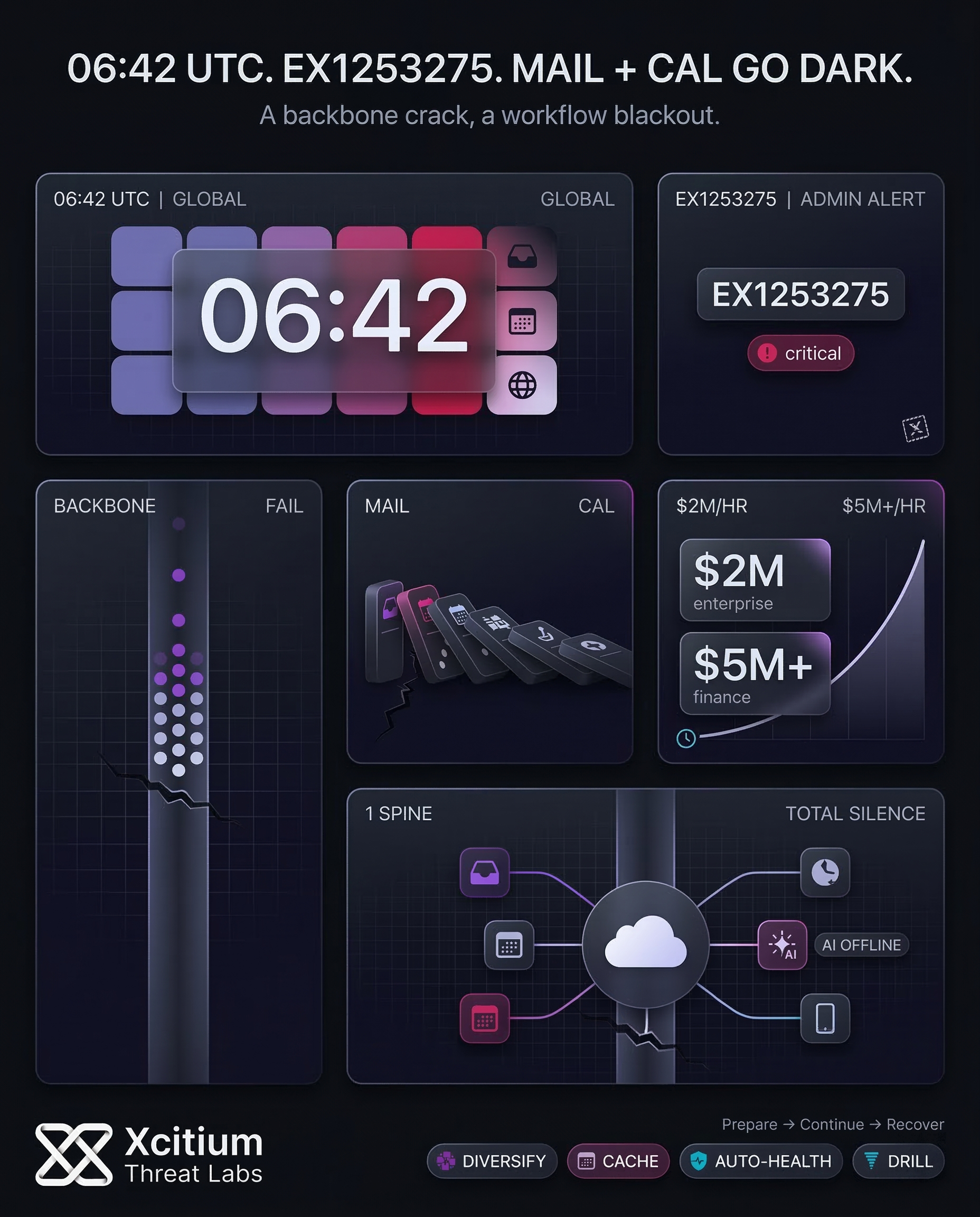
March 16, 2026 | 06:42 UTC: Microsoft 365 services experienced a massive failure, resulting in a complete loss of access to mailboxes and calendars worldwide.
This event highlights the critical vulnerability of centralized cloud systems. A single infrastructure failure leads to a total communication blackout.
The root cause lies within the Supporting Network Infrastructure. Systems were unable to process traffic efficiently, leading to a cascading service failure.
- Exchange ActiveSync: Mobile Sync Loss
- Outlook Desktop: Severe Performance Lag
- Office.com Portals: Routing Loops
“Relying on a single cloud provider is no longer a sustainable risk strategy for modern enterprises.”
The cost of silence is growing exponentially in a hyper-connected world.
Avoid ecosystem lock-in. Establish secondary channels for critical updates and emergency broadcasts.
Enable “offline-first” protocols and distributed storage for mission-critical data access.
Cloud health is no longer optional, it is a strategic necessity.
Economic Consequences of Enterprise Cloud Downtime
Recent statistics show that for significant outages, the financial hit is around $2 million per hour. For high-turnover businesses such as finance, this may escalate to $5 million per hour. This means that an “information technology mitigated” several-hour outage is always a multi-million-dollar problem.
Apart from the financial implications, the outages also affect the trust that users have in the systems that are automated. This outage resulted in the unavailability of the Microsoft 365 Copilot web sign-in page. The role that AI plays in the modern workplace is significant, which means that the disruptions are causing a new level of disconnection, especially for those using the Copilot for chat services as well as the analysis of documents.
Strategies for Mitigating Future Service Disruptions
In order to reduce the impact of cloud outages, organizations are advised to develop effective redundancy plans. The maintenance of offline backups for important electronic correspondence helps in the development of effective continuity.
- Diversify Tools: Use secondary communication platforms for emergency internal updates.
- Monitor Health: Regularly check the Microsoft 365 admin center for early warning alerts.
- Educate Staff: Ensure employees know how to access offline copies of their schedules.
- Local Backups: Implement local caching for essential email data to allow offline reading.
Microsoft continues to investigate the full root cause of this network failure. The company promised a detailed Post-Incident Report to provide transparency for its enterprise clients. These disruptions raises questions about the long-term stability of hyper-scale cloud environments.
Conclusion: When Email Goes Dark, Business Goes Silent
The March 16, 2026 Exchange Online disruption is a reminder that modern work is built on centralized cloud dependencies. When mailbox and calendar access fails, the impact is immediate, meetings break, approvals stall, and global coordination slows to a crawl. This incident began at 06:42 UTC and affected Outlook on the web, desktop clients, and Exchange ActiveSync, with secondary disruption reaching office.com portals and Copilot sign-in pages.
Why This Matters Beyond Microsoft 365
The core issue was supporting network infrastructure that could not process traffic efficiently, causing cascading service degradation. This is not an isolated pattern, the post notes recent Exchange-related disruptions involving IMAP4 access and classic Outlook impact.
Why Every Organization Is Exposed
Centralization is efficient until it becomes a single point of failure.
- One backbone disruption can black out corporate communications at scale
- Outage cost compounds quickly, with estimates around $2M per hour for enterprises and $5M+ per hour in finance
- AI productivity depends on the same network reliability, so “AI-first” workflows fail when core services fail
What To Do Next
Resilience must be engineered, not hoped for.
- Maintain secondary communication channels for critical updates
- Implement offline-first access, local caching, and offline copies of schedules
- Automate early warning signals using M365 service health telemetry
- Run outage drills and treat each incident as a continuity test, not an anomaly