MiniPlasma Turns A Standard Account Into Full Windows Control
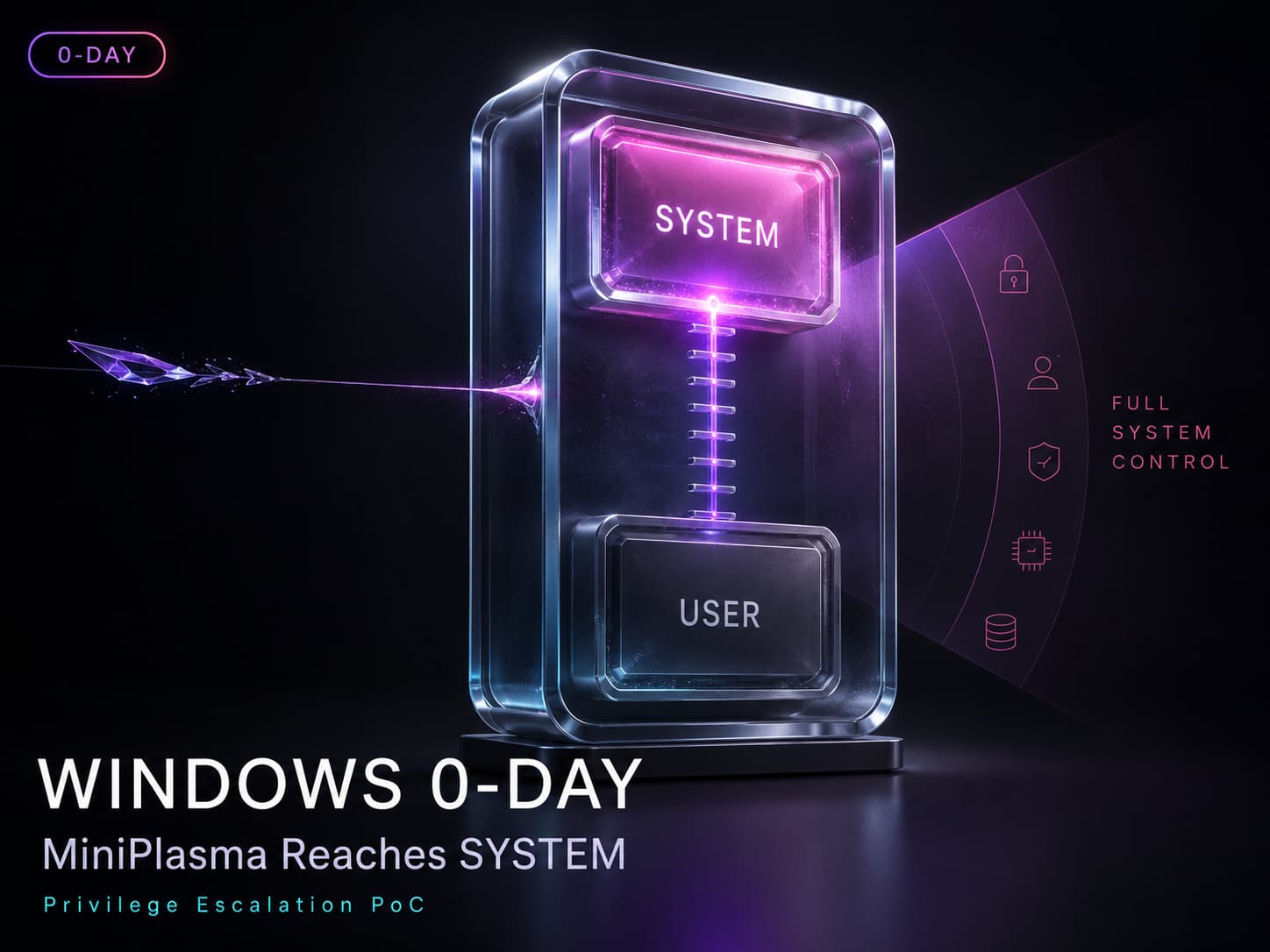
MiniPlasma is an exploit aimed at privilege escalation, rather than a remote worm exploiting the internet. However, despite that, one cannot overlook its significance because attackers still need an entry point. Nevertheless, it was able to escalate privileges from a regular user account to SYSTEM, which is the ultimate privilege level on Windows OS.
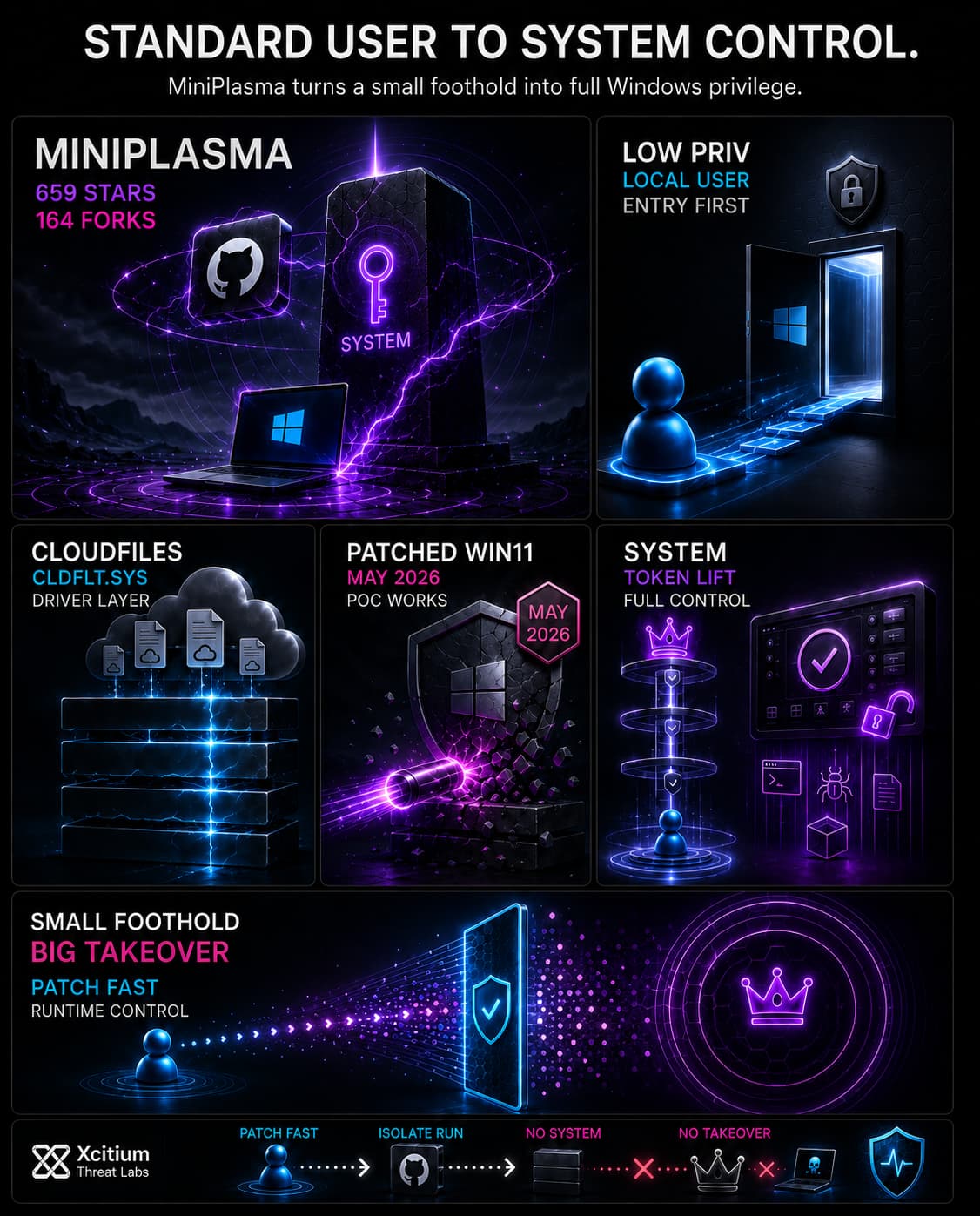
The same result was achieved through independent testing of the proof of concept, which was performed on a patched version of Windows 11 Pro equipped with the latest May 2026 security update.
This release quickly changed the threat landscape. Lately, the GitHub page showed the last commit being tagged with “Release” on May 16, together with receiving 659 “stars” and 164 forks. This means that the exploit is now far from being an obscure lab note it became an open exploit kit likely to garner attention from both defensive researchers and malicious parties.
The Vulnerable Driver Sits Close To Everyday Cloud File Features
MiniPlasma attacks the cldflt.sys driver. This driver is of high importance in terms of placeholder files in the storage stack. The layer between the application and cloud synchronization engine, which makes it possible for the OS to provide cloud-based files as if they were local ones. It makes this component even more important than it seems from the name alone.
First of all, the component located in the kernel gives the potential errors very wide consequences. Moreover, such an attack vector has already been exploited successfully before. The vulnerability found in the previous year in the form of CVE-2025-62221, has been added to the CISA catalog of known exploitable vulnerabilities in December 2025.
The Real Danger Is Attack Chaining After A Small Foothold
These attacks allows attackers to compromise any computer from the Internet automatically. There is no factual support to back up such a statement. The importance of the bug in question is that modern attacks typically involve chaining vectors. While an initial attack vector, including a spear-phishing attempt, malware loader, or stolen credential, might provide an initial level of access, a local privilege-escalation bug will help turn the partial foothold into full machine takeover. This technique is one of many used by attackers according to the ATT&CK knowledge base developed by MITRE.
This information becomes especially important for 2026, exploits continued to account for the greatest share of intrusion techniques for six years straight. Exploits have been responsible for 32% of intrusions. The average time before handing off the initial access to secondary operators has dropped to 22 seconds. Therefore, while the published vulnerability exploit should be treated as more than just another exploit, there is no need to frame it as part of the mass exploitation narrative.
Windows Users Do Not Have A Patch Yet, So Defenders Need A Short Playbook
As of May 21, 2026, there is no official patch for MiniPlasma, and Microsoft says it is still investigating. At the same time, the exploit does not work on the latest Windows 11 Insider Preview Canary build. That may hint that a code change already exists in preview, although Microsoft has not publicly linked that build behavior to a specific fix.
Without the availability of a patch from Microsoft, the safest option is to decrease the attack surface and increase observability. Security teams should consider developing an evidence-based checklist including:
- Implementation of execution control techniques. Allow-listing applications by default is one way of preventing the attack through blocking the attack before it hits the vulnerable part of code. While this does not fix the root cause of the vulnerability, it may help avoid the problem.
- Monitoring of relevant registry paths. As was noted above, writes to \Registry\User\Software\Policies\Microsoft\CloudFiles\BlockedApps* and \Registry\User.DEFAULT\Volatile Environment* have been identified as indicators that merit monitoring via EDR.
- Focusing on devices allowing the execution of arbitrary code on behalf of users. Testing was done with the use of a standard user account, and CVE data regarding the original issue states that the threat exists via the local, low privilege attack vector. Hence, any system where the user executes arbitrary binaries should be considered a high-risk environment.
- Preparation for fast patching of the vulnerability. The author’s previous discoveries disclosed in early 2026 turned out to have been used in attacks soon after their announcement.
Conclusion: When a Standard User Becomes SYSTEM
MiniPlasma is a reminder that local privilege escalation is never a “local only” problem. Attackers rarely need one perfect exploit. They chain small footholds together. A phishing payload, stolen credential, or malware loader can provide the first step, then a privilege escalation flaw turns that limited access into full Windows control.
When a standard user can become NT AUTHORITY\SYSTEM, the endpoint is no longer just compromised. It is owned.
Why This Threat Matters Now
MiniPlasma is especially concerning because it targets a kernel level Windows component tied to everyday cloud file functionality, and as of the article’s timeline, no official patch is available.
That creates a dangerous window for defenders:
- Initial access can come from ordinary user execution
- The exploit can turn low privilege access into SYSTEM control
- Kernel adjacent flaws create high-impact consequences
- Public proof of concept code increases attacker interest
- Patch uncertainty forces teams to rely on prevention and visibility
Any environment where users can run arbitrary binaries becomes a higher-risk target.
Where Xcitium Changes the Outcome
For organizations using Xcitium Advanced EDR, MiniPlasma-style attack chains fail before privilege escalation becomes control.
- Unknown exploit binaries are isolated the moment they execute
- Code can run without being able to cause damage
- Attempts to reach vulnerable system components are blocked before impact
- Follow-on payloads cannot turn a small foothold into SYSTEM takeover
- The attack chain collapses before the endpoint is lost
If you have Xcitium in place, this attack does not succeed because the exploit never gains the freedom it needs to abuse the system.
Stop Escalation Before It Becomes Takeover
Zero-days are hardest when defenders must wait for patches. That is why execution control matters.
Reduce user execution risk.
Monitor privilege escalation behavior.
Stop unknown code before it reaches the vulnerable layer.
Choose Xcitium Advanced EDR, powered by the patented Zero-Dwell platform.