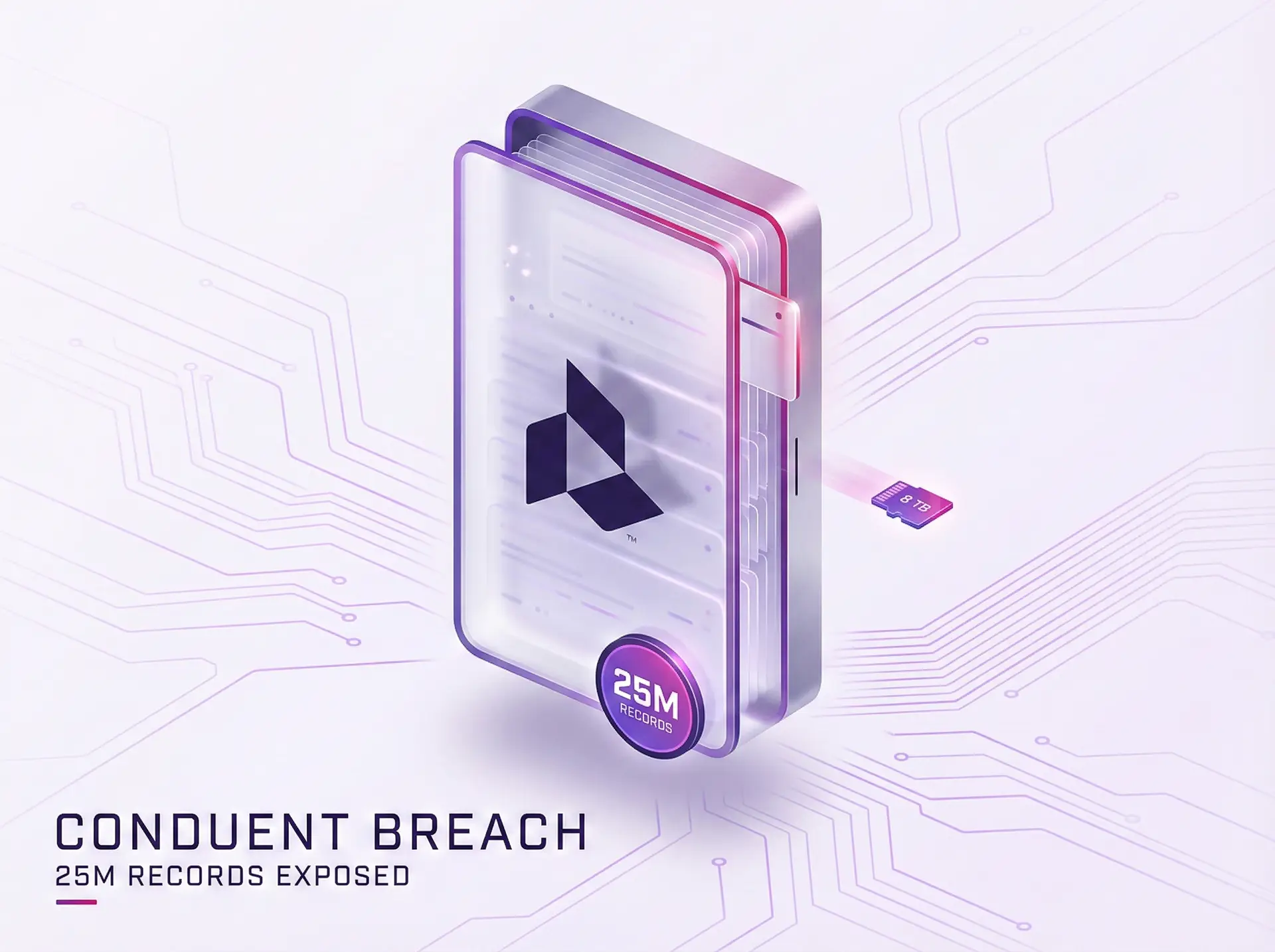
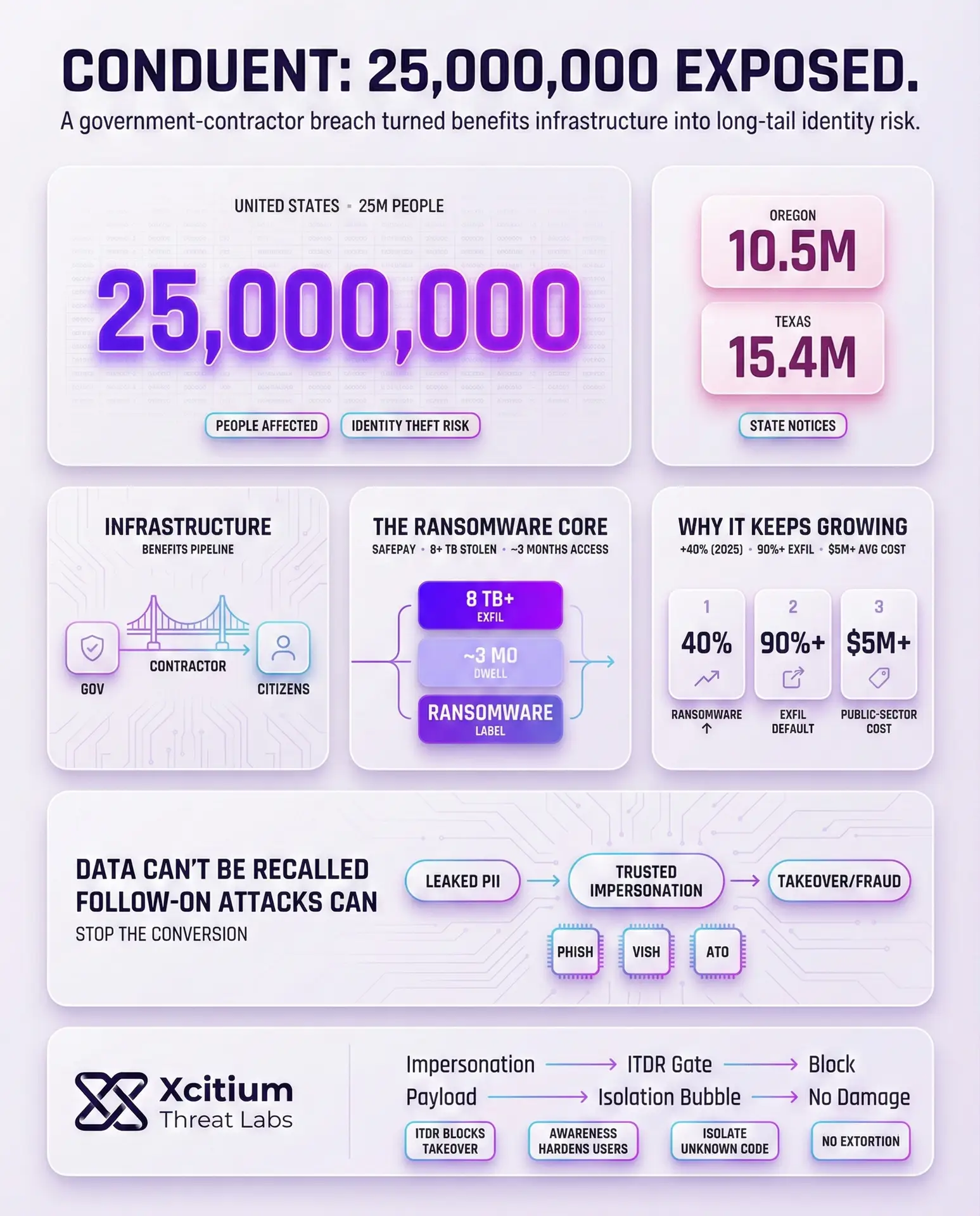
The recent changes in the cybersecurity world came about due to a massive update in the Conduent breach. Total of 25 million people in the United States are facing a critical threat of identity theft.
Conduent is a bridge between the government and citizens. They are in charge of providing essential services such as food and unemployment benefits. This means a breach in their security system is a breach of the most sensitive information of many citizens.
The recent news from the state notification pages of Oregon and Texas is alarming, with 10.5 million and 15.4 million victims, respectively. There are also warnings from other states such as Massachusetts and New Hampshire. This is considered a major breach of security.
This is a new trend where infrastructure is a primary target. Conduent is in charge of providing information to 100 million people, so the figures may increase.
Safepay Ransomware and the 8 Terabyte Data Heist
The root cause of this calamity can be traced back to a highly sophisticated ransomware attack, which took place in early 2025. In this regard, it is worth pointing out that the ransomware group, known as Safepay, claimed responsibility for the attack. The attackers are alleged to have stolen over 8 terabytes of sensitive information during the heist. Furthermore, it is worth pointing out that the attackers were able to access the data for nearly three months, which meant that they were able to retrieve sen
It is also worth noting that hackers usually target companies like Conduent because they tend to have centralized data storage. Once the hackers gain entry into the contractor’s database, they gain entry into many government database systems.
However, the approach that Conduent took to the situation has been quite criticized by many experts. One of the issues was that the company used “noindex” tags for their incident notice pages. This approach ensured that the information was not available to the general public. As a result, many victims were not aware of the situation for quite some time.
THE CONDUENT BREACH
Public dependency meets private security negligence. As a critical infrastructure provider, Conduent’s recent failure exposed private records of millions.
RECORDS: 12.4M PERSONS
VULN: CVE-2024-X991
STATE DATA LEAK
The leak spans across Texas, Oregon, and Vermont. Information ranging from unemployment benefits to SNAP assistance was exfiltrated.
HIDDEN NOTICES
Technical audits reveal the use of ‘noindex’ meta tags. Conduent effectively hid legal notices from search engines.
<meta name="robots" content="noindex">
// ACTION: BLOCK_WEB_CRAWLERS
SECURITY INTEGRITY
When private corporations handle public welfare, transparency cannot be optional. This serves as a critical warning.
Why Government Contractors Are the New Prime Targets for Hackers
In the public sector, third-party contractors play a significant role in digital transformation, and although it increases efficiency, it creates a fresh risk. These contractors are handling valuable information, but not at the same level of federal agencies. This means that cyber criminals consider these organizations the “soft underbelly” of national security. This incident with Conduent seems to be a continuation of what happened in the Change Healthcare hack, where there was a single point of failure for an entire industry.
The current statistics available about the number of cyberattacks against infrastructure indicate an increasing trend. This is supported by the following factors:
- Stolen credentials are the most common entry point for sophisticated gangs.
- There has been an increase of 40% in ransomware attacks against government contractors in 2025.
- Data exfiltration is a key feature of over 90% of ransomware attacks.
- The average cost of a breach in the public sector is more than $5 million.
These statistics show the problem within the current cybersecurity system. Moreover, the Texas Attorney General has initiated a formal investigation into Conduent’s case. Such a legal move implies that regulators are no longer tolerating corporate negligence.
As such, companies should focus on multi-factor authentication and monitoring. Without these simple security measures, the cycle of massive data leaks will persist.
Protecting Your Identity After a Major Infrastructure Failure
When a breach of such enormity takes place, urgent action is required by all concerned. The information that has been stolen includes permanent identification numbers like Social Security numbers. Unlike credit card numbers, you cannot cancel your medical history or your birth date.
Therefore, the threat of identity theft is extremely high. The victims must remain watchful against phishing and other forms of fraud. For example, the hackers use the information to claim government benefits.
In order to mitigate these risks, the following steps can be considered:
- Keep an eye out for official announcements from health or labor departments in your respective states.
- Freeze your credit reports with all major credit bureaus.
- Keep a lookout for suspicious activities in your bank accounts or insurance policies.
- Enable two-factor authentication on all sensitive digital accounts.
- Be cautious of unsolicited calls or emails asking for personal information.
The data privacy laws are continually shifting in 2026. New laws in states are holding corporations accountable for delayed notifications, which means that victims may be able to sue corporations in class action lawsuits. However, the most important aspect remains defensive strategies.
Cybersecurity is no longer just an information technology issue; it is a personal safety issue. As we continue into 2026, the Conduent case will be a reminder of how fragile we are as digital citizens.
Conclusion: A Breach You Cannot Undo, and the Attacks You Can Still Stop
The Conduent incident shows why large scale exposures create long tail risk. Once sensitive identity data is copied, it cannot be recalled. What follows is predictable, criminals convert stolen records into impersonation, account takeover, and fraud for months or years. You cannot stop the fact that data was taken, but you can stop what attackers try to do with it next.
Why Government Contractors Are Prime Targets
Contractors concentrate high value data, often with less security maturity than the agencies they support.
- Centralized databases create one point of failure across programs and states
- Stolen credentials remain the most common entry point for sophisticated groups
- Data theft is now a default feature in most ransomware operations
When the contractor is compromised, citizens inherit the risk.
What Attackers Do After the Leak
Stolen PII becomes a targeting engine:
- Spear phishing and vishing that sounds legitimate because it uses real details
- Recovery and verification abuse to hijack accounts
- Credential stuffing and session theft using blended identity signals
- Ransomware and extortion attempts once access is achieved
This is where breach impact is decided.
Where Xcitium Changes the Outcome
With Xcitium in place, the follow on attack chain breaks.
- Xcitium Identity Threat Detection and Response (ITDR) detects anomalous identity behavior and blocks takeover attempts before they become access.
- Xcitium Cyber Awareness Education and Phishing Simulation reduces successful social engineering, training users to resist high pressure impersonation that uses leaked data to build trust.
- Xcitium Advanced EDR, powered by Xcitium’s patented Zero Dwell platform, ensures ransomware and unknown payloads fail at execution, code can run without being able to cause damage.
If you have Xcitium in place, attackers can have the data, but they cannot convert it into access, disruption, or extortion.
Reduce the Real Damage, the Follow On Damage
Treat leaked identity data as an active threat. Harden identity controls, train for targeted scams, and stop ransomware at execution. That is how you turn a mass breach into limited impact instead of a continuing crisis.