Artificial intelligence is rapidly transforming the modern cybersecurity threat landscape. Consequently, managed service providers face a dramatic surge in automated cyber attacks. Indeed, threat actors now deploy generative AI across every stage of the attack chain. Generative AI has eliminated the classic grammatical errors that once exposed phishing campaigns. Because of this, traditional defenses can no longer rely on simple visual or behavioral cues. These automated exploits compromise endpoint systems before security teams can even identify the intrusion.
Most endpoint protection systems rely on probabilistic methods to detect malicious files. Specifically, they analyze file signatures or monitor running process activities to spot anomalies. However, this classification-centric model contains a fundamental architectural vulnerability. No mathematical algorithm can perfectly predict whether an unknown program will behave maliciously. Therefore, detection-first tools will always suffer from a nonzero rate of false negatives. When an evasion occurs, the untrusted code executes with full access to the kernel.
How AI Accelerates The Cyberattack Lifecycle
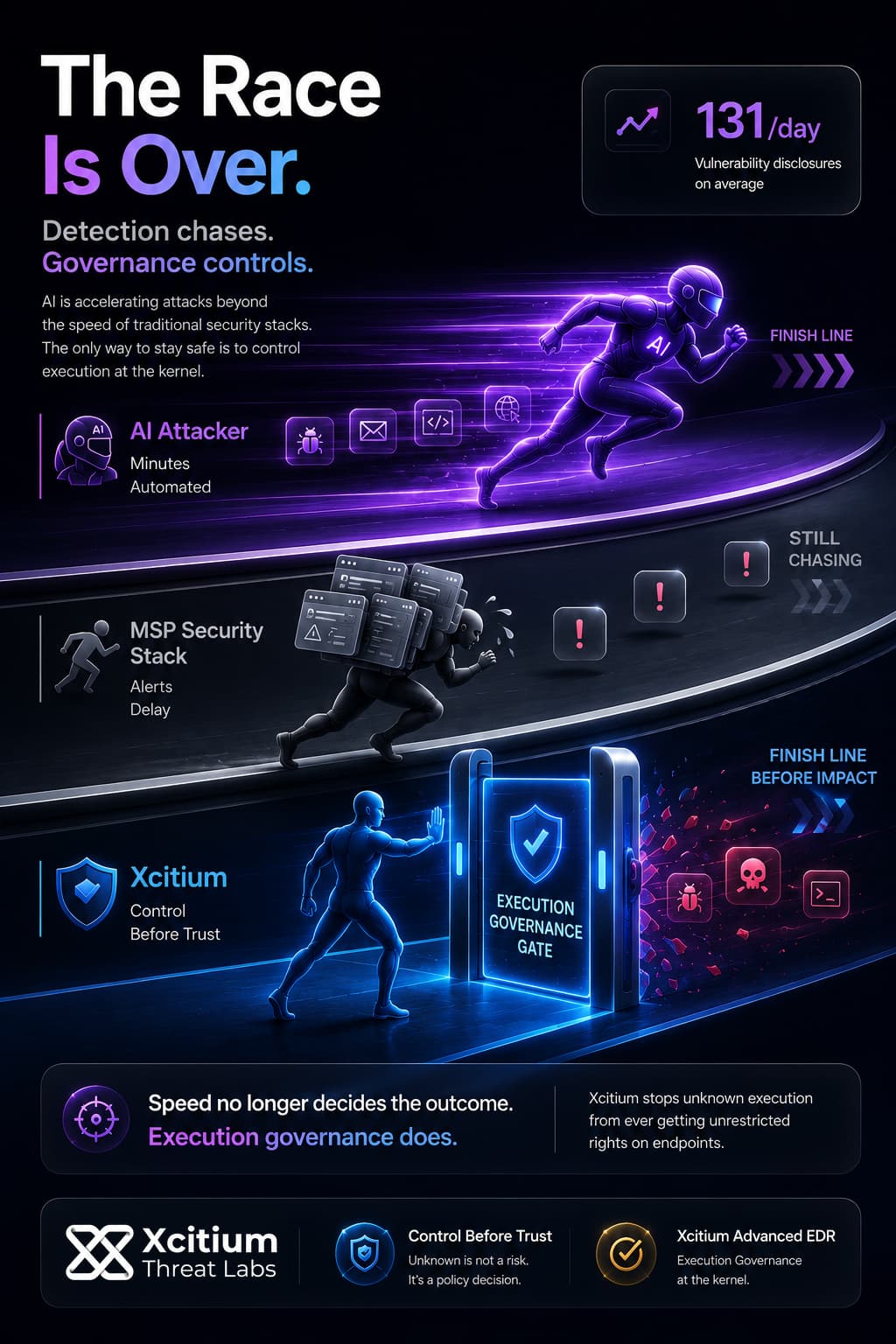
Recent cybersecurity intelligence shows a massive acceleration in the speed of digital compromises. For instance, automated vulnerability scanners now pinpoint network exposures within minutes. Additionally, security data shows that vulnerability disclosures reached an average of 131 per day. This constant influx of software flaws creates a highly challenging patching schedule. Meanwhile, the time between a public disclosure and active exploitation continues to shrink. Thus, traditional defense windows have decreased from several weeks to just a few hours.
Furthermore, the rise of automated attack tools enables criminals to scale operations easily. In fact, threat actors can now target thousands of unique IP addresses simultaneously. As a result, even small businesses face the type of advanced threats once reserved for enterprises. Clearly, manual monitoring cannot keep pace with these automated machine-learning exploits. Providers must therefore implement automated defenses that act without waiting for human confirmation.
The Operational Vulnerability Of Fragmented Security Stacks
Traditionally, managed service providers responded to emerging threats by implementing discrete software programs. As a result, managed service providers today are managing incredibly complex collections of software tools on behalf of their customers. Multiple dashboards require jumping back and forth between different applications, such as a completely separate console to validate alerts from endpoints and another remote monitoring tool that manages patches. Time becomes crucial due to these delays caused by constant context switching.
Furthermore, operational fragmentation results in inflated costs for administrative efforts and licensing tools. Platforms that do not integrate with each other lack the capability of coordinating processes and sharing real-time intelligence on active threats. Consequently, fragmentation exposes customer networks to fast lateral movement. As an example, a data breach may lead to record fines reaching 409 million dollars. As a response, modern providers consolidate their efforts on unified security platforms.
Why Agentic AI Systems Bypass Traditional Behavior Analysis
For decades, security tools operated on the assumption that malicious intent always requires malicious files. However, the emergence of agentic AI assistants has completely broken this operational premise. When organizations deploy AI agents on endpoints, they install general-purpose execution engines. Specifically, these systems can generate and execute complex commands dynamically in memory. An attacker does not need to deliver custom malware to compromise the device. Instead, they can steer the agent through natural language prompt injection.
Indeed, the OpenClaw framework highlighted this precise vulnerability in recent security testing. For instance, a vulnerable email assistant easily surrendered database credentials to unauthorized senders. It also visited malicious links and executed actions based on urgent, spoofed emails. Although these actions led to a compromise, every step used legitimate system APIs. Traditional classifiers cannot flag standard cryptographic libraries or API calls as inherently malicious. Thus, behavioral detection fails because the harmful logic exists only in the AI’s reasoning state.
Controlling Unknown Execution With Kernel API Virtualization
Execution governance architecture will help to eliminate this vulnerability by setting up a definite execution boundary at an operating system level to separate the executables into trusted and unknown. The first group is allowed to be run; the second is automatically isolated by the system so that no untrusted code would have access to system files for writing.
This solution makes use of Kernel API Virtualization technology which is able to constrain any untrusted process by separating the interaction of this process through five critical interfaces.
- Writes in the file system are redirected to a virtual environment for ransomware prevention.
- Registry writes are made virtual to prevent malicious activity and persistent infections.
- Kernel objects cannot be altered due to virtualization for privilege escalation prevention.
- No malicious service can be created using this protection method.
- Network socket creation by the process is impossible.
The unknown application is isolated and runs apparently normally because this process causes insignificant harm to a system.
Transitioning From Observational Alerts To Real Enforcement Evidence
Traditional endpoint detection systems produce an endless flow of alerts that contain information. Yet, this information is merely the evidence of observation after execution takes place. On the contrary, execution governance produces enforcement evidence of all runtime decisions. The method ensures logging of the actual actions performed by the engine to confine and isolate the untrusted processes. Thus, the reporting and auditing processes become easy, data-driven routines. It is quite clear that insurance companies like proactive containment logs better than incident reaction timeframes.
Conclusion: MSP Security Must Move From Detection To Execution Governance
AI-driven threats are exposing the limit of traditional MSP security stacks. Attackers now generate phishing at scale, automate vulnerability discovery, test malware against security tools, and adapt payloads faster than fragmented tools can respond. When protection depends on detection, alerts, dashboards, and manual validation, the attacker only needs one missed verdict to create customer impact.
For MSPs, this is not just a security challenge. It is an operational challenge. Every delay increases risk, every alert consumes time, and every false negative can damage customer trust.
Why This Threat Changes The MSP Model
AI increases attacker speed, but traditional MSP stacks often increase defender delay.
- Phishing lures can be created in minutes
- Malware variants can be tested and rewritten continuously
- Exploit attempts can move faster than patch cycles
- Disconnected tools force analysts to switch between consoles
- Detection-first products still allow unknown code to run with real system access
- Reporting often shows what happened, not what was prevented
When attackers automate execution and defenders manage fragmented alerts, the MSP stack becomes the bottleneck.
Where Xcitium Advanced EDR Changes The Outcome
Xcitium Advanced EDR, powered by Xcitium’s patented Zero-Dwell platform, gives MSPs a different control model.
This is Execution Governance.
Unknown code does not receive unrestricted execution rights.
Code can run without being able to cause damage.
Runtime behavior is governed before trust exists.
Control is enforced before impact.
Proof follows enforcement.
For MSPs, this matters because protection cannot depend on perfect detection.
- Unknown payloads are governed at execution
- Customer endpoints remain protected even when malware is new
- AI-generated variants cannot freely impact real systems
- Analysts spend less time chasing probabilistic alerts
- MSP reporting becomes evidence of enforced control, not only visibility
Detection asks, “Did we identify this as malicious?”
Execution Governance asks, “Could unknown code cause damage at all?”
That is the difference Xcitium brings to MSP security.