A Stray “!”: The Tiny Typo That Opened a Huge Hole in Linux Security
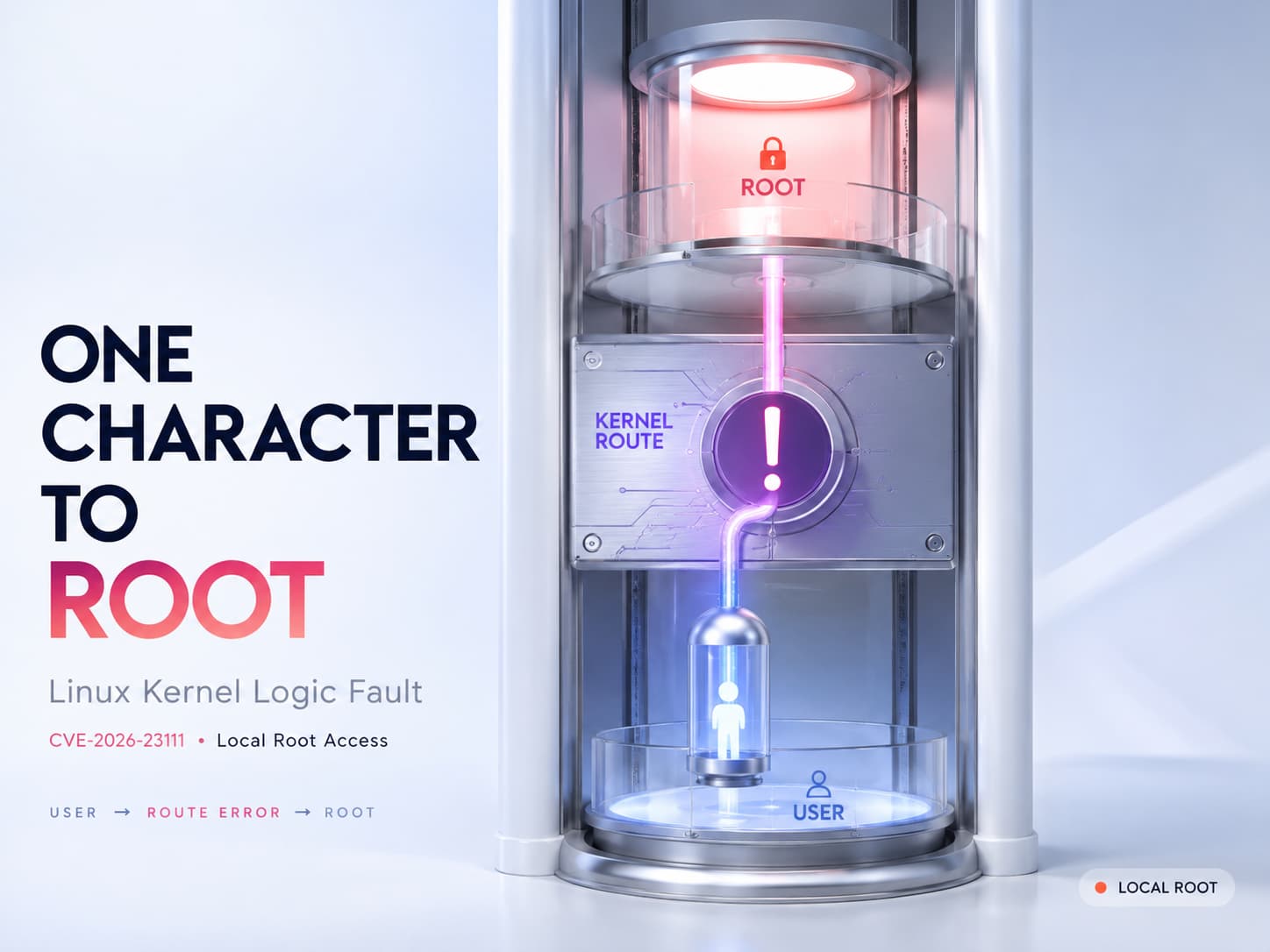
CVE-2026-23111 is a use-after-free vulnerability found in nftables packet-filtering component of Linux kernel in early 2026. A simple change of one character caused a critical error, the kernel started skipping reactivation of certain “catchall” objects because of an erroneous condition that was used.
An attacker exploits this vulnerability by repeatedly setting the chain’s reference counter to zero and deleting the chain from memory even though it was being used at the time. The exploit uses a use-after-free vulnerability that makes possible to run any program in kernel mode, get root privileges, and break out of the container. All because of a small typo that included just one “!”
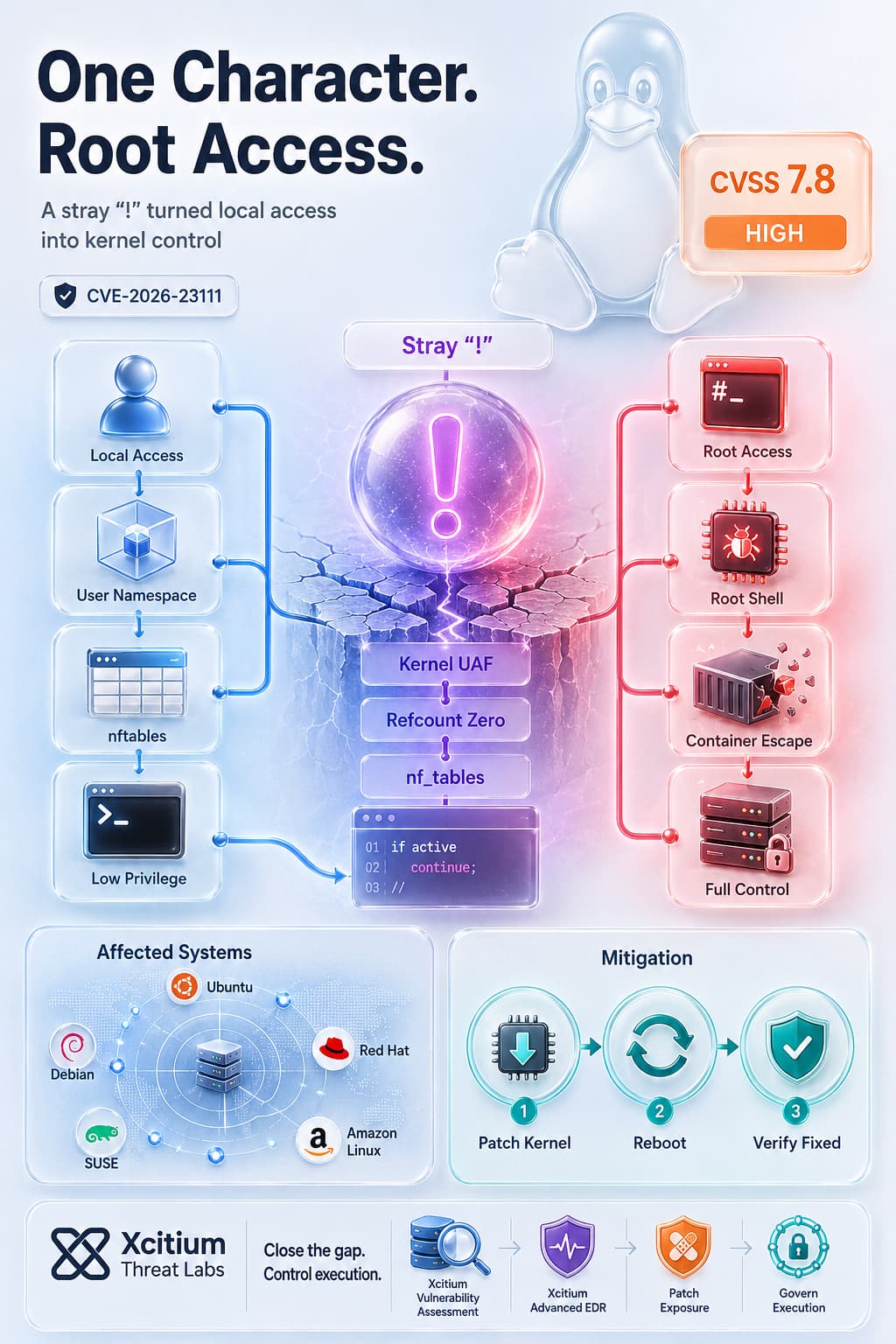
Nf_tables is a component that organizes all rules in tables, chains, and individual rules. Nftables process changes in a special “abort” phase in case something went wrong. The faulty logic of nf_tables causes failed deletions of catchall set elements not to update a chain’s reference counter. Specifically, nft_map_catchall_activate() uses if (!active) continue statement instead of skipping active elements.
Deleting ! resolves the issue, causing inactive elements to be reactivated again. Simply put, there needs to be only one-character fix. During abort phase the chain’s reference counter can be set to zero and the chain deleted despite of its usage due to missing call of nft_setelem_data_activate().
Linux Kernel UAF
• Debian: Bookworm, Trixie (backported to Bullseye LTS)
• Also: Red Hat, SUSE, Amazon Linux and others with CONFIG_NF_TABLES + CONFIG_USER_NS enabled.
How The Exploit Works
Root can be obtained through a use-after-free in the kernel when there is an attack from an unprivileged user namespace with local access. The attacker uses user namespaces with nftables, sends netlink messages, removes a “pipapo” set with a catchall rule, aborts the transaction, and deactivates the catchall rule.
With further manipulation of the generation mask, the attacker deletes the catchall rule once more, however, this catchall rule then becomes active in the following generation and is improperly freed, leading to memory corruption. This leads to kernel pointer leakage and exploitation using ROP through netlink messages, ultimately allowing root shell access.
In practicality, the attack would allow any local attacker with a foothold to gain full root either in a low privilege shell, a compromised container, or even just an account in a service. As user namespaces and nftables are widely enabled by default on Ubuntu, Debian, Red Hat, SUSE, and Amazon Linux operating systems, many vulnerable machines exist.
No network-based exploit is possible, an attacker must first gain host-level access before exploiting this vulnerability through nftables.
Affected Versions And Patches
Several major Linux distributions have patched their kernels accordingly Ubuntu 22.04, 24.04, 25.10; Debian Bookworm and Trixie (and backported to Bullseye LTS), RedHat, SUSE, Amazon Linux and others. Acccording to Ubuntu CVSS 7.8 (High).
Updating your system with a single-character patch involves installing the latest kernel version and restarting the computer. All those Linux users who use unpatched versions of Linux with CONFIG_NF_TABLES and CONFIG_USER_NS configuration options must update their systems, as PoC is released and an attacker will be able to leverage that vulnerability.
In conclusion, we need to note that this bug in nftables led to serious security vulnerabilities. As you can see from this example, Linux kernels need regular updates, especially when working with such potentially dangerous capabilities as user namespaces.
Conclusion: When One Character Becomes Root Access
CVE-2026-23111 shows how small kernel logic errors can create major security consequences. A single misplaced “!” in the Linux nf_tables subsystem created a use-after-free path that lets a local unprivileged user manipulate kernel memory, leak pointers, build a ROP chain, and gain root access.
This is not a remote exploit. It is a post-foothold escalation risk. Once an attacker has a low-privilege shell, compromised container, or service account, the endpoint can become fully controlled if the kernel remains exposed.
Why This Threat Matters
This vulnerability is dangerous because it turns ordinary local access into root-level control.
- User namespaces and nftables are enabled across many Linux environments
- A low-privilege account can become a root shell
- Compromised containers can become escape paths
- Public exploit details increase pressure on unpatched systems
- One missed kernel update can expose entire server fleets
For cloud workloads, developer systems, and Linux servers, local privilege escalation is often the bridge between initial access and full operational impact.
Where Xcitium Changes the Outcome
For organizations using Xcitium Vulnerability Assessment, this exposure becomes visible before attackers can turn it into root access.
- Vulnerable Linux kernels are identified for urgent remediation
- Systems with exposed nftables and user namespace configurations are prioritized
- Patch gaps across Ubuntu, Debian, Red Hat, SUSE, Amazon Linux, and other distributions can be tracked
- Security teams gain evidence of which assets require immediate kernel updates and reboot validation
And for attack chains that depend on unknown tools, scripts, or payloads before escalation, Xcitium Advanced EDR, powered by Xcitium’s patented Zero-Dwell platform, applies Execution Governance.
Unknown execution does not receive unrestricted rights.
Code can run without being able to cause damage.
Runtime control is enforced before trust exists.
Proof of control follows enforcement.
Patch the Kernel. Govern the Execution Path.
CVE-2026-23111 proves that local bugs are never “local only” risks. Once attackers gain any foothold, privilege escalation can turn limited access into full control.
Detection explains what happened.
Governance proves what could not happen.
Identify vulnerable Linux systems.
Patch and reboot immediately.
Govern unknown execution before trust.
Choose Xcitium Vulnerability Assessment and Xcitium Advanced EDR.