A Ruby web service can corrupt its own memory while normalizing text from an incoming request. Ruby2Shell, tracked as CVE-2026-132825, affects how Ruby changes the case of strings in certain legacy encodings. In some web applications, the request can reach that code before the service checks whether the sender has an account.
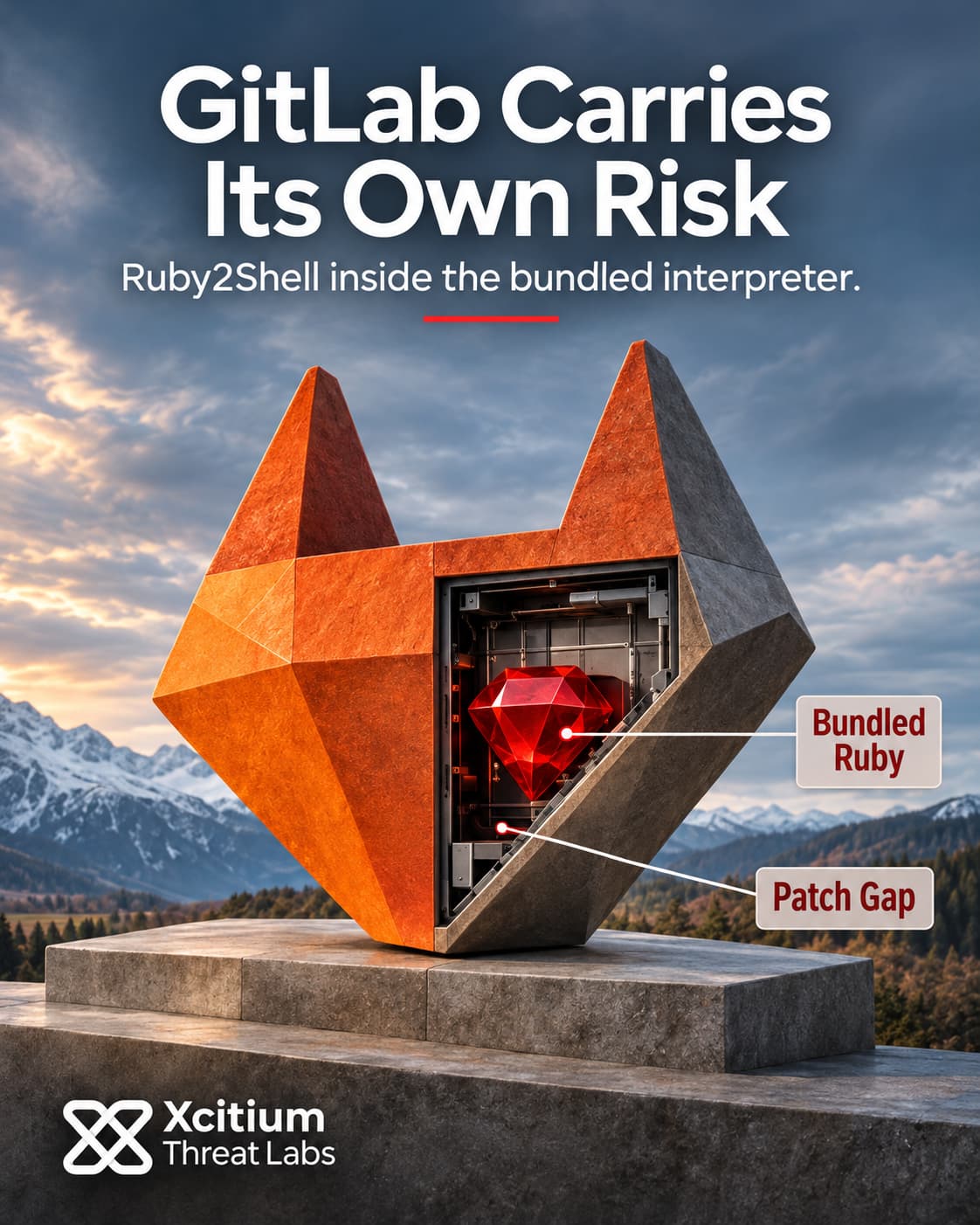
The defect sits in the Ruby interpreter. An application can therefore inherit it even when the application code itself has no memory management bug. GitLab illustrates the deployment problem. Its official packages ship their own Ruby, so a system update can leave the interpreter inside a self-managed GitLab installation unchanged.
Case Conversion Writes Past the Buffer
Applications change text to upper or lower case to compare values consistently. A service may treat two spellings of the same label as equivalent even when their capitalization differs. Ruby reserves a region of memory for the converted result. That region, called a buffer, has a fixed boundary.
Some case mappings produce more output bytes than they consume. For example, a single letter can uppercase to a pair of letters. The interpreter must reserve space for the entire replacement before writing it. In the affected conversion, the bounds check can accept too little space for the full replacement. The remaining byte crosses the boundary because the write still emits the full result.
On the affected path, Ruby can write one byte past the end of the output buffer when changing case in certain single-byte encodings. Examples include ISO-8859-1 and Windows-1252. The conversion routine runs inside the interpreter, so ordinary application code can trigger the bad write without managing memory directly. A string processed exclusively as UTF-8 follows a different path. The encoding that matters is the one Ruby uses when it performs the conversion.
Although the write is only one byte, it occurs in the heap, where the process keeps other allocations. The neighboring memory can vary across builds and workloads. Corrupting a neighboring byte and gaining control of program execution are separate outcomes. Ruby’s maintainers acknowledge demonstrations of remote code execution in some scenarios. Under those test conditions, execution takes place inside the Ruby process. The service account therefore sets the starting permissions. Investigators need different evidence for a crash and for code execution, even when both begin with the same memory error.
The Web Framework Determines Who Can Reach It
A web request reaches framework code before it reaches many application features. That early code parses the request and prepares values that other components use. If it passes external text to the vulnerable conversion routine before authentication, a sender can reach the defective code without signing in. In that sequence, the framework processes the text as part of preparing the request. A controller can later reject the request and still leave the earlier operation outside its access checks.
Testing identified that exposure in default setups of Rails and classic-style Sinatra running affected Ruby. However, the runtime bug and the web path answer different questions. A version check tells an operator whether the faulty interpreter is present. The framework and deployment determine whether a remote request can reach it, and at what point in request processing. Plain Rack did not expose this path by default in the same assessment. However, application code can create a reachable path if it performs affected case conversion on external text.
GitLab’s advisory confirms the underlying Ruby memory error and the affected release lines. The Rails demonstration leaves the outcome on individual GitLab installations open. As of November 25, the public evidence reviewed for this article has yet to establish a successful attack in production.
The Fix Travels Through Different Release Channels
Ruby shipped upstream fixes in 3.3.14, 3.4.13 and 4.0.10 on November 18, 2026. The same release addressed six additional issues in case conversion and regular expression handling. Ruby2Shell refers specifically to the one-byte case-conversion overflow.
GitLab released 19.4.10, 19.5.8 and 19.6.1 on November 20. Its official Linux packages and container images include the fixed interpreter. However, installations compiled from source use a separately maintained Ruby build. GitLab directs those operators to rebuild the interpreter that runs the service using a fixed release in the supported Ruby series. The company also reported that its hosted GitLab.com and Dedicated services were already running a patched version. For a source installation, the relevant distinction is who built the interpreter. The application release and its locally built dependency may need separate updates.
Linux distributions can deliver the same security fix under a different version string. For example, Debian fixed the issue in its Debian 12 ruby3.1 package at 3.1.7-1~deb12u2. Ruby 3.1 is outside upstream support, but Debian maintains that package through its own update channel. As a result, the upstream version table and the distribution advisory apply to different builds.
The Running Service Provides the Final Evidence
An inventory can identify several Ruby installations that share a host. On the same machine, an administrator’s command line may find the operating system package, while a packaged service starts with a separate interpreter. Likewise, a container can keep using the Ruby build inside its image even after the host receives updates.
That difference changes what counts as a completed patch. A published fix establishes availability. An updated package or image establishes what the deployment can use. Finally, the active application process shows which build actually serves requests. In a fleet with several replicas, each running instance needs to match the fixed deployment.
Conclusion: Verify the Ruby That Serves Requests
Ruby2Shell turns a routine text operation into a memory boundary failure. In affected web stacks, request handling can reach that operation before sign-in. The first decision is therefore which reachable services run an affected interpreter. A login page provides little evidence about the code that handles a request on its way there.
GitLab makes the second decision concrete. Its official packages and images bundle Ruby, while source installations maintain a separate interpreter. Debian also delivers the fix through its own package revision. As a result, the right evidence depends on who built each runtime and which artifact the service actually loaded.
Why This Threat Matters
- Early processing. A framework can normalize incoming text before application authentication begins.
- Shared code. The same interpreter defect can affect unrelated applications that call the vulnerable routine.
- Separate package owners. A distribution, a product vendor and a platform team can each ship a different build of Ruby.
- Uneven rollout. Older replicas may still receive requests while an updated image moves through the fleet.
- Different evidence. A controlled demonstration establishes possible code execution. Confirming a production incident requires evidence from the affected service.
Where Defensive Control Must Operate
Xcitium Vulnerability Assessment inventories internet-facing services and prioritizes findings through automated scanning and manual validation. That view helps teams decide which reachable Ruby applications and self-managed GitLab instances to examine first.
Next, service owners can match each deployment to the applicable advisory and inspect the package or image that supplies its interpreter. For clustered services, compare the deployed artifact across replicas after the rollout. Include any older release still available to the rollback process, since a rollback can restore a vulnerable build.
Record the Build at Closure
Keep the applicable advisory, fixed package or image identifier, and evidence from the running service in the change record. If updating takes longer, restrict network access to the affected service while the team prepares the fix. After deployment, check both service health and the runtime build before restoring ordinary access. Also check any persistent application failures against request and process logs, since a crash can have several causes.