An incomplete security fix has left thousands of managed service provider servers vulnerable to remote takeover. N-able confirmed that attackers are actively exploiting a critical authentication bypass in its N-central remote monitoring platform. The vulnerability allows unauthenticated attackers to gain full administrative control over unpatched servers.
The flaw, tracked as CVE-2026-18577, stems directly from an incomplete patch released for an earlier vulnerability, CVE-2026-18556. Threat actors are abusing the security gap to pivot across corporate networks and plant persistent backdoors on client endpoints.
What is CVE-2026-18577? A critical authentication bypass vulnerability in N-able N-central servers caused by an incomplete patch for CVE-2026-18556. It allows unauthenticated remote attackers to gain full administrative access and deploy persistent backdoors on managed endpoints.
From Server Takeover to Endpoint Persistence
Attackers exploiting the vulnerability first gain full administrative privileges on the N-central server. Once inside, they abuse legitimate management capabilities, including the built-in Take Control feature. This allows them to push commands directly to managed customer devices.
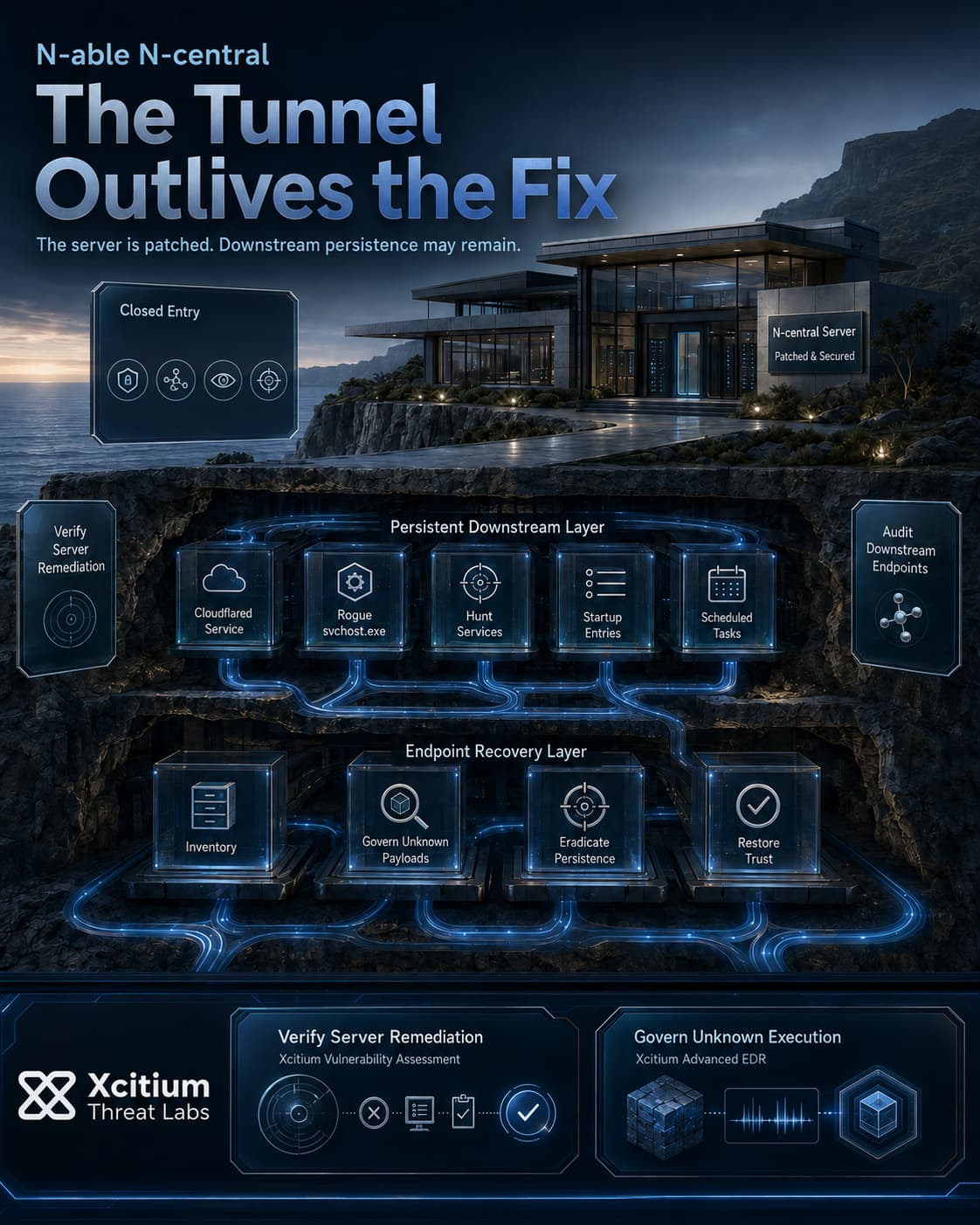
Security analysts observed attackers registering custom Cloudflare Tunnels on compromised endpoints to retain long-term access. Persistent access manifests as a registered service named Cloudflared or a rogue executable named svchost.exe placed inside user Documents folders.
Patching the Server Does Not Clear Backdoors
Hotfix version 2026.3.1.7 of N-able was issued on August 2, 2026 to fix the issue. Updates are automatic for the hosted deployments; however, on-premises deployments need a manual fix. The U.S. Cybersecurity and Infrastructure Security Agency included CVE-2026-18577 in their Known Exploited Vulnerabilities list right after the disclosure.
Just updating the server does not eliminate those threat actors that have established their persistence in the endpoint environment. Those threat actors can still maintain access through Cloudflare tunnels despite the fact that the primary N-central console is patched by the administrator.
Administrative Access and Execution Governance
It demonstrates the natural vulnerability in centrally managed systems that have unlimited rights in the system. With any vulnerability in the authentication process for administrative consoles, hackers break into the network and execute arbitrary code on the downstream systems.
Depending only on identity-based controls or administrative boundary does not provide security in case of any vulnerabilities with the central credential. In order to secure the system, execution control needs to be at the kernel level of the managed end-points.
Conclusion: When Trusted Management Becomes the Attack Path
N-central is designed to give administrators centralized authority across large endpoint environments. When authentication fails, that same authority can become an attack multiplier.
The incident described here does not end with control of the N-central server. After gaining administrative access, attackers can abuse legitimate remote management functions to issue commands to customer endpoints, establish Cloudflare Tunnels, and leave services or binaries behind for continued access.
Patching the server closes the original entry path.
It does not remove what was already deployed downstream.
Why This Threat Matters
An RMM compromise is different from the takeover of an ordinary application server. The platform already has trusted reach into the systems it manages.
- An incomplete security fix can create false confidence while the original attack path remains usable.
- Unauthenticated administrative access removes the need to steal credentials or deceive a user.
- Legitimate RMM features can become a command-delivery channel.
- One compromised management server can expose endpoints across multiple customers and environments.
- Attackers can use legitimate tunneling technology to preserve remote access.
- Endpoint persistence can survive remediation of the central server.
- A successful server update does not prove that downstream systems are clean.
- Incident response must investigate both the management plane and every endpoint it may have reached.
The decisive trust failure is not simply that an attacker entered the console. It is that the management platform’s authority allowed attacker-controlled actions to arrive at endpoints through a channel administrators normally trust.
Where Xcitium Changes the Outcome
The first responsibility is to remove the vulnerable server path.
Xcitium Vulnerability Assessment helps organizations identify vulnerable N-central deployments, exposed management services, outdated versions, missing security updates, and remediation gaps within the supported assessment scope.
Organizations should:
- Apply the complete vendor fix.
- Restrict the management console to approved administrative networks.
- Review N-central administrative and remote-control activity.
- Revoke or rotate affected credentials, tokens, certificates, and API material.
- Audit every endpoint that received commands during the suspected period.
- Hunt for unexpected Cloudflared services, unauthorized tunnel configurations, and suspicious executables in user directories.
- Validate endpoint services, scheduled tasks, startup entries, and remote-access tooling.
- Treat server remediation and endpoint recovery as separate workstreams.
The second responsibility is to govern what arrives through the management channel.
On managed customer endpoints, Xcitium Advanced EDR, powered by Xcitium’s patented Zero-Dwell platform, applies detection and Execution Governance to downstream activity.
Unknown scripts, renamed executables, loaders, payloads, and services pushed through an RMM platform do not receive unrestricted execution rights simply because the delivery channel is trusted.
Unknown execution is governed before it can freely alter real files, registry state, services, or other protected system resources on the managed endpoint. Security teams also gain evidence of which policies were enforced and what unknown execution was not permitted to change.
EDR detects execution. Xcitium governs unknown execution.
Legitimate tools require a separate control decision. Cloudflared and remote management software may have valid administrative uses, but a legitimate binary is not proof of authorized intent. Behavioral detection, explicit policy, administrative telemetry, and endpoint hunting remain necessary when attackers abuse known tools rather than introducing unknown code.