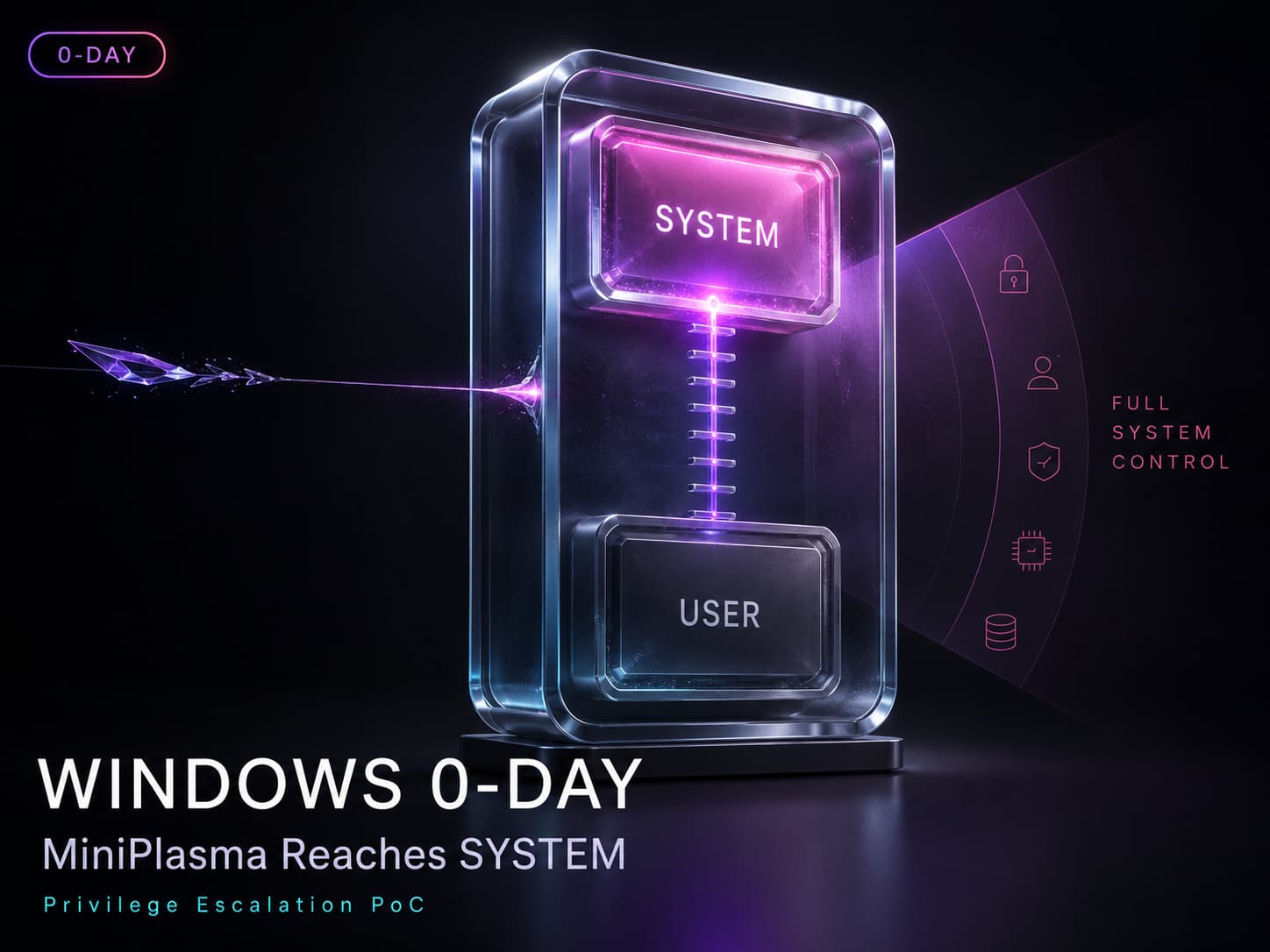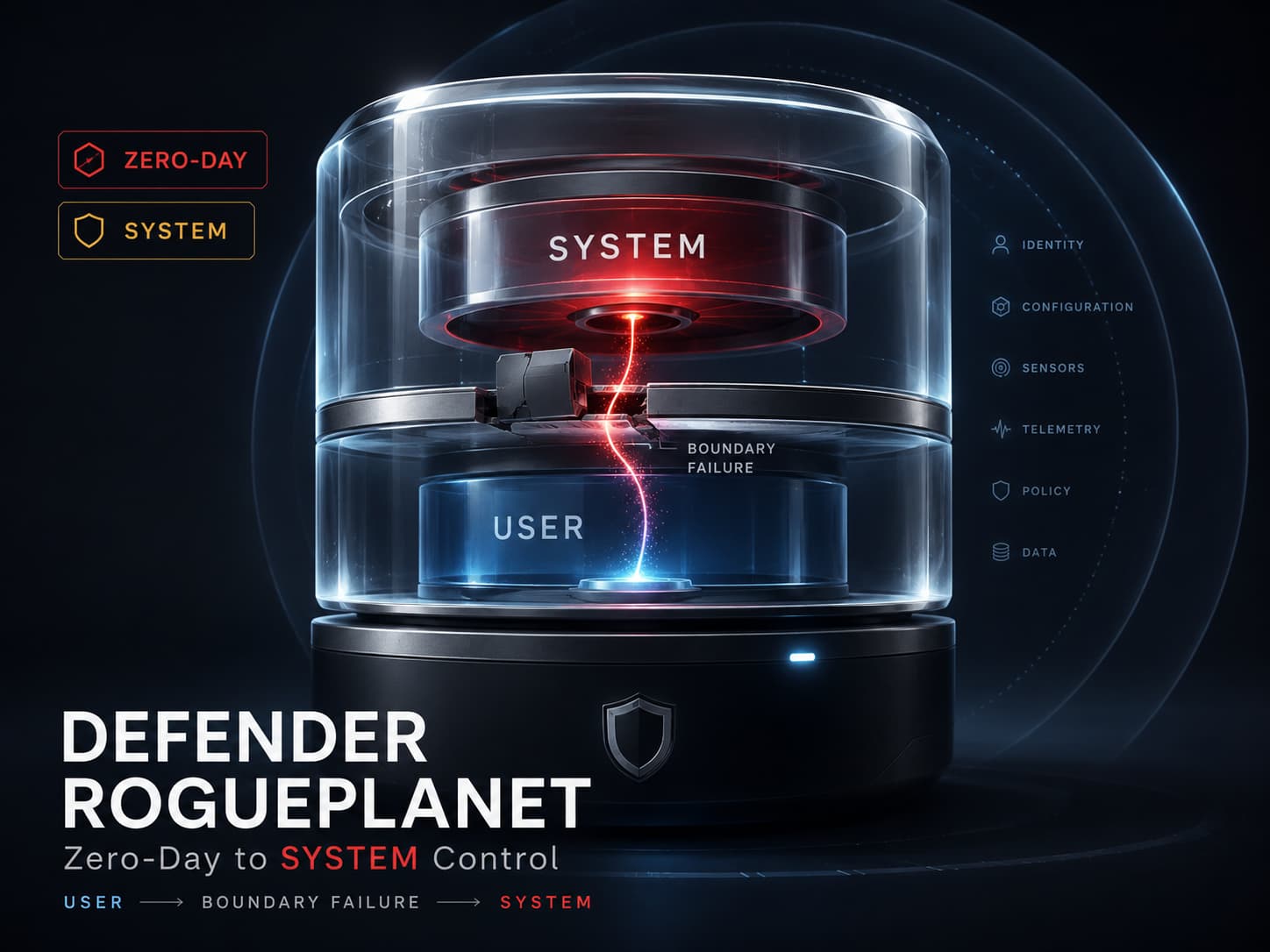
The antivirus engine included in Microsoft Defender comes with another zero-day vulnerability called RoguePlanet. Discovered in June 2026, this race condition flaw targets Defender’s real-time scanning functionality. By exploiting the vulnerability, an attacker can escalate the privileges of a user with access to the machine and create a Windows shell as NT AUTHORITY\SYSTEM. Interestingly, the RoguePlanet exploit was published shortly after the June 2026 Patch Tuesday release, meaning that this vulnerability also affects all machines patched with those updates.
Some important details about the RoguePlanet exploit are:
- Race condition exploit: RoguePlanet exploits the timing issue in Defender’s scanner and performs both check and use actions separately.
- SYSTEM shell spawn: After successful exploitation, it launches the command prompt as ‘NT AUTHORITY\SYSTEM’ with maximum privileges.
- Targeted platforms: The exploit works on the latest versions of Windows 10 and 11 with June 2026 updates installed.
- Originally an RCE: In early versions, the exploit used a malicious .vhd(x) file saved on a shared folder, tricking Defender into executing remote code.
- Unpredictable exploit behavior: The random nature of the exploit makes it unreliable across different machines.
How RoguePlanet Exploits Defender’s Scanning Race
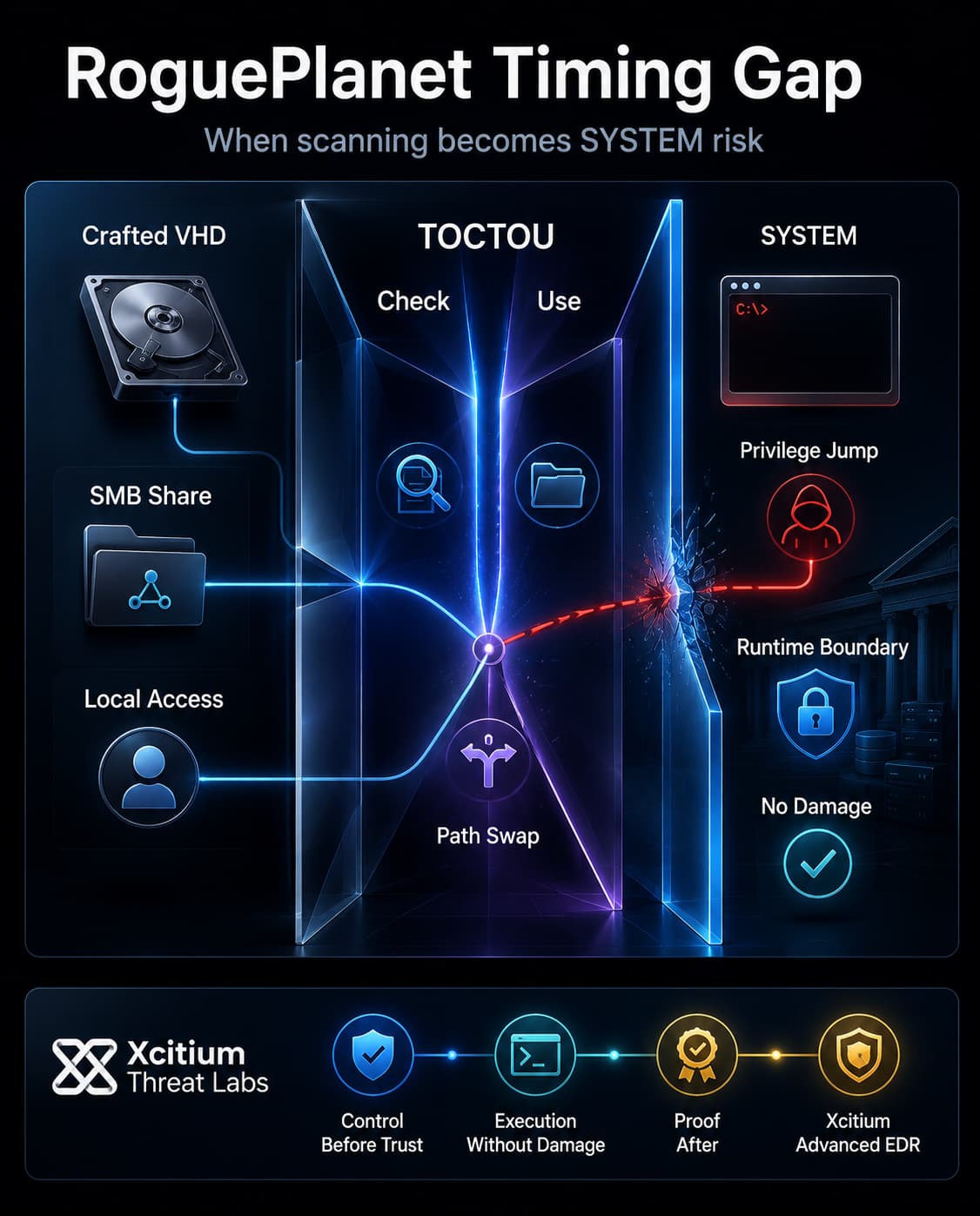
The malicious actor creates a VHD/ISO and lures the victim into executing it via any medium like a network share and .vhdx on SMB.
It can be considered a race condition (Time-of-check to Time-of-use). The malicious actor manages to coordinate two operations in parallel. The following image depicts whoami command outputting NT AUTHORITY\SYSTEM within the shell, implying a SYSTEM-level elevation privilege. A rogue shell running as ‘NT AUTHORITY\SYSTEM’ is achieved via this exploit.
Patch Impact: From RCE to Local Escalation
Interestingly, it is claimed that the original design of RoguePlanet allowed for full remote code execution (RCE). Indeed, in their initial testing, researchers found a working RCE scenario where, upon a user opening a maliciously crafted VHD located on a remote network share, Defender would scan the content first and, because of the race condition, overwrite its executables, thereby allowing the attacker to execute their payload as SYSTEM.
Unfortunately, at some point, Microsoft had stealthily made Defender more resistant to such attacks, making it hard for the original RCE to work by modifying certain parts of its I/O functions related to file handling, which are internally referred to as mpengine!SysIO*. As a consequence, the current version of the attack will only lead to a local privilege escalation (LPE), since the patched Defender does not allow for remote exploitation anymore.
Context: Disclosure Drama and Other Defender Zero-Days
RoguePlanet is another vulnerability in the Defender software revealed by the unknown person “Nightmare Eclipse.” Previously, it was published proof of concepts of vulnerabilities named BlueHammer (CVE-2026-33825), RedSun (CVE-2026-41091), UnDefend, GreenPlasma, and YellowKey. Some of them allow for gaining the SYSTEM level on recent Windows versions.
The issue has led to discussions in cybersecurity circles. It is alleged that GitHub repositories were removed by Microsoft and access to MSRC has been terminated. Thus, it was decided to operate via self-hosted resources. In turn, Microsoft states that the organization supports security research but will resort to law enforcement in case of any real damage caused by the disclosure. Many specialists came to the researcher’s defense, and the company stated that criminal prosecution will not be initiated against responsible disclosure researchers.
Defender software users should be concerned about these news because RoguePlanet is one more zero-day related to this program, which is currently under active exploitation. The risk is especially relevant for local users whose machines have been penetrated, since rogueplanet allows for privilege escalation.
Conclusion: When the Security Engine Becomes the Escalation Path
RoguePlanet shows a dangerous weakness in the endpoint trust model. Microsoft Defender is designed to inspect suspicious content, but this zero-day turns Defender’s own scanning workflow into a privilege escalation path. A crafted VHD or ISO, a race condition, and a successful path swap can move an attacker from user-level access to NT AUTHORITY\SYSTEM.
This is not just a Defender vulnerability. It is a reminder that any security control can become part of the attack chain when execution is not governed before trust is established.
Why This Threat Matters
RoguePlanet is especially serious because it affects patched Windows 10 and Windows 11 systems and targets a security component organizations rely on every day.
- The exploit abuses a TOCTOU race condition in Defender real-time scanning
- Successful exploitation can spawn a SYSTEM-level shell
- Patched machines may still remain exposed until Microsoft releases a specific fix
- Local access can quickly become full endpoint control
- Defender itself becomes the mechanism that helps the attacker escalate
Once an attacker reaches SYSTEM, they can disable defenses, steal credentials, deploy follow-on tools, and prepare for broader compromise.
Where Xcitium Changes the Outcome
For organizations using Xcitium Advanced EDR, powered by Xcitium’s patented Zero-Dwell platform, this attack chain fails before escalation becomes real control.
Unknown execution does not receive unrestricted rights.
Code can run without being able to cause damage.
Suspicious payloads, scripts, and follow-on tools are governed at runtime before they can impact real assets.
Even if an attacker attempts to use Defender’s scanning behavior against the system, the malicious workflow cannot freely turn execution into damage.
This is Execution Governance in practice.
Control before trust. Runtime boundaries before impact. Proof after enforcement.
Detection Can Fail. Governance Proves What Could Not Happen.
RoguePlanet proves that relying only on detection creates a dangerous gap. The tool watching the system can become the tool abused by the attacker.
Xcitium changes the question.
Not “Did Defender catch it?”
But “Could unknown code gain the freedom to cause damage?”
That is the difference between observation and Execution Governance.
Patch as soon as guidance becomes available.
Reduce local execution risk.
Govern unknown execution before trust exists.
Choose Xcitium Advanced EDR.