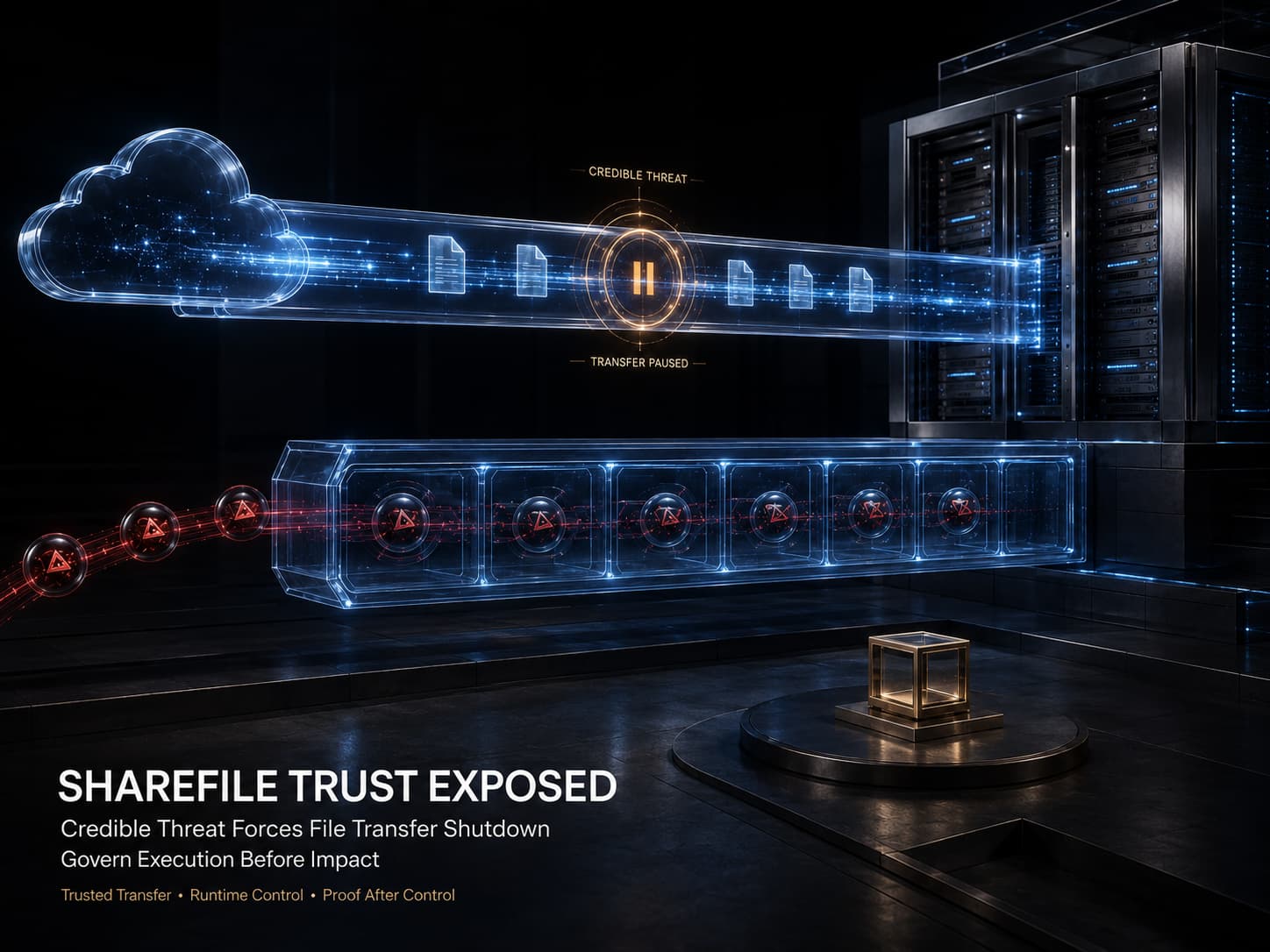

Progress Sounds The Alarm On ShareFile Servers
Recently, Progress Software emailed ShareFile customers with an urgent warning. The subject line read “Service Disruption. Immediate Action Required.“
The company flagged a “credible external security threat” against ShareFile Storage Zone Controllers. Consequently, it told administrators to power down the Windows servers hosting those controllers.
They also disabled cloud access to affected accounts. Moreover, it stressed that a manual shutdown was a critical extra step. The ShareFile status page still lists these customers as “not operational,” following an update posted at 12:12 p.m. EDT on July 10.
Notably, Progress reported no evidence of unauthorized access. However, it declined to name the threat, confirm a zero-day, or attribute the activity. The company promised further updates within 24 hours.
What ShareFile And Storage Zone Controllers Actually Do
ShareFile is Progress Software’s enterprise file sharing and collaboration platform. Businesses in accounting, healthcare, legal, and finance rely on it daily.
Most customers use the cloud version. Some, though, deploy Storage Zone Controllers to keep files on their own infrastructure.
This hybrid setup satisfies data residency and compliance needs. Yet it comes with a catch. Because the controller bridges the cloud and local storage, it usually sits at the network edge, exposed to the internet.
That exposure makes it useful. Unfortunately, it also makes it a target. The controller runs as a .NET web application, handling file uploads and downloads directly at the perimeter.
A Pattern Of Attacks On File Transfer Tools
In 2023, the Clop extortion gang exploited a MOVEit Transfer zero-day. As a result, breaches and downstream exposures at more than 2,700 organizations compromised the personal data of more than 93 million people, with U.S. organizations making up roughly 78.9% of known victims.
- Accellion FTA (2020-2021): at least 100 companies impacted, ending in an $8.1 million class-action settlement reached in January 2022.
- GoAnywhere MFT (2023): over 130 organizations compromised by Clop.
- Cleo (2024): dozens of victims, with Clop later listing many more on its leak site.
Clearly, attackers return to these tools again and again.
Why Attackers Love Managed File Transfer Software
Managed file transfer products concentrate sensitive data in one place. Therefore, a single breach can unlock records from many partners at once.
These systems typically hold financial data, health records, and personal identifiers. In addition, they connect to third parties and enable lateral movement across networks.
Since 2014, the National Vulnerability Database has logged about 136 flaws in MFT software. Of those, 51 rank as high risk.
Because compliance rules push companies toward these tools, high regulation often equals high impact. Attackers understand that logic well.
What ShareFile’s Past Bugs Reveal
The Storage Zone Controller was also the target of criticism in the past. For example, CVE-2023-24489 was exploited by attackers in 2023. CISA included this vulnerability into its Known Exploited Vulnerabilities list and required organizations to fix the issue by September 6, 2023.
CVE-2026-2699 is an authentication bypass vulnerability, which scores 9.8, and CVE-2026-2701 is a remote code execution vulnerability rated 9.1.
Together, they allowed for uploading of malicious webshells and controlling of servers by unauthenticated parties. This issue was resolved in version 5.12.4 on March 10, 2026. The 6.x branch remained free from vulnerabilities. At the same time, watchTowr’s scan detected around 30,000 internet-facing controllers, whereas it was spotted approximately 784 vulnerable instances mostly in the US and Germany.
The Stakes For ShareFile’s Customers
Progress completed its ShareFile acquisition on October 31, 2024 for $875 million.
Following MOVEit, Progress faced a U.S. SEC inquiry after an October 2, 2023 subpoena, plus a wave of class-action lawsuits consolidated in Massachusetts. The SEC closed its investigation on August 6, 2024 without recommending enforcement action.
For now, the shutdown order signals urgency over reassurance. Because no patch exists yet, pulling servers fully offline suggests a fresh, unresolved flaw rather than a known one.
Conclusion: When File Transfer Infrastructure Becomes the Emergency
The Progress ShareFile shutdown shows why managed file transfer systems must be treated as high-risk infrastructure. These platforms do not just move files. They sit between cloud services, local storage, partners, customers, and regulated data. When a credible external threat is serious enough to require shutting down Storage Zone Controller servers, the risk is already operational.
That is the real warning. No confirmed breach does not mean no urgent exposure.
Why This Threat Matters
ShareFile Storage Zone Controllers are valuable because they bridge cloud access and on-premises data. That same role makes them attractive targets.
- Internet-facing controllers sit close to sensitive file repositories
- File transfer systems concentrate regulated and partner data
- A single compromise can affect many downstream relationships
- Past MFT attacks show how quickly exploitation can become extortion
- Webshells, scripts, and server-side execution can turn file access into system control
- When no patch exists, normal remediation timelines are not enough
Attackers return to managed file transfer products because the reward is high. One exposed system can unlock data from many organizations, partners, and workflows.
Where Xcitium Changes the Outcome
This risk must be addressed at two points, before exposed file transfer infrastructure remains reachable and before unknown server-side activity becomes impact.
Xcitium Vulnerability Assessment helps organizations identify exposed ShareFile Storage Zone Controllers, internet-facing file transfer services, risky configurations, and systems that require urgent review.
But when there is no patch yet, visibility alone is not enough.
Xcitium Advanced EDR, powered by Xcitium’s patented Zero-Dwell platform, applies Execution Governance when attackers attempt to run unknown scripts, payloads, webshell activity, commands, or lateral movement from managed servers.
Unknown code does not receive unrestricted execution rights.
Code can run without being able to cause damage.
Runtime behavior is governed before trust exists.
Security teams gain proof of what unknown execution could not do.
This is the correct sequence of control.
Find the exposed system.
Reduce the reachable surface.
Govern execution before file transfer access becomes compromise.
Do Not Wait For The Patch To Define The Risk
The ShareFile shutdown is a reminder that defenders often have to act before the full threat picture is public. A credible threat against file transfer infrastructure is enough to justify emergency action, especially when those systems handle regulated, financial, healthcare, legal, and partner data.
Take exposed controllers offline when required.
Review file transfer infrastructure immediately.
Investigate suspicious uploads, scripts, webshell activity, and unexpected server behavior.
Govern unknown execution before trusted file transfer systems become attacker-controlled infrastructure.