The Silent Ransom group started its latest extortion attack on law firms operating in the United States by mid-2026. The extortioners use benign-looking email phishing and follow up phone calls to gain entry into corporate networks through remote access provided by employees.
The extortioners make ransom claims shortly after gaining access and threaten their victims with leaking sensitive documents to clients and authorities. It has been found through investigations that several law firms in the country have fallen victim to this extortion attempt during the months of January to May 2026.
Social Engineering: Phishing Emails and Vishing
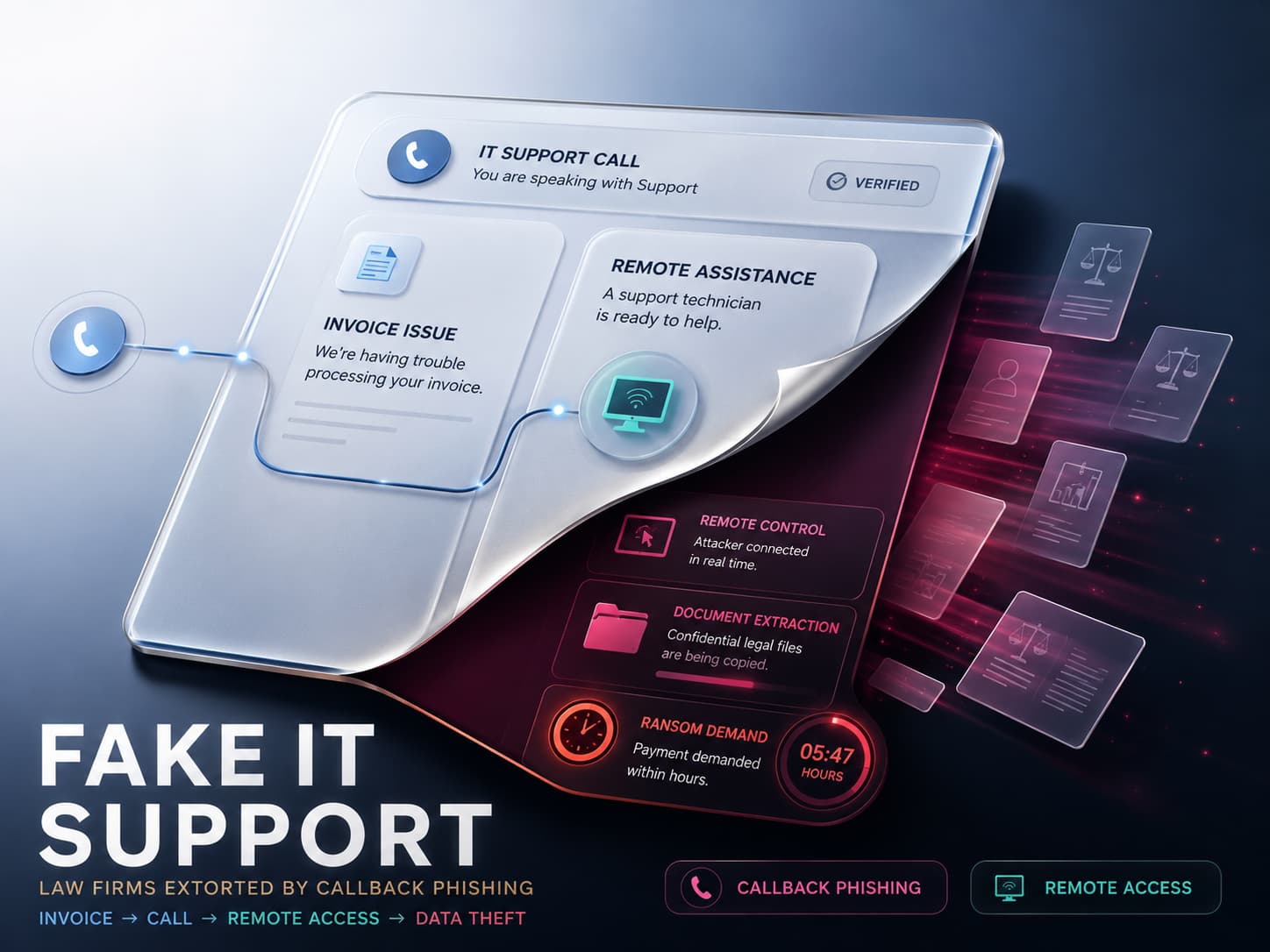
The attack commences with an innocuous-looking email. The target usually receives a message related to invoices, but which does not include any malware attachments. In the simulation below, the target is requested to make a phone call to deal with the alleged invoice problem. On dialing the specified number, the victim will connect to an attacker posing as internal IT or support personnel.
By using social engineering tactics, the impostor persuades the user to initiate a remote session (through Microsoft Teams, Zoom, or Windows Quick Assist), where he would attempt to fix the problem for the user. In this active session, the impostor persuades the user to install genuine remote management applications (AnyDesk, Zoho Assist, or Bomgar) on the workstation. This leads to compromising the user’s computer.
Unlike email phishing, this type of callback attack (also called BazarCall) exploits human nature and avoids detection through security filters. The strategy involves using an email only as a bait, instead of an attack method. This fake IT method also relies on the experience gained through years of other such phishing schemes used by ransomware groups like Ryuk or Conti.
According to the FBI, SRG members sometimes conduct their phishing activity personally. In these instances, a member pretending to be a technician comes to the office of the targeted company, bringing along a USB drive, from which he copies data files or creates images of the hard drives.
Attack Chain Simulated
By illustrating this flow, the simulation highlights how a routine helpdesk call can rapidly turn into a full data breach. Each stage is carefully designed to look legitimate: even the software installed is approved remote-support tools, and instructions are often exchanged over ephemeral notes. The result is that an organization may not notice anything wrong until the attacker is ready to strike with a ransom demand.
Sneaky Tools and Data Harvesting
SRG combines consumer software and covert channels in order to accomplish its goal. Specific attack techniques include:
- Phishing/Vishing: Innocuous emails followed by phone calls that pretend to be IT support in order to build rapport and trick the victim into giving out personal data or permissions.
- Genuine Remote Assistance: The victims set up a session of remote support and install tools such as AnyDesk or Zoho Assist which give the attacker administrative access without detection.
- Stealthy Communication: During the phone call, self-destructing messages (e.g., Privnote) provide the attacker with instructions, while avoiding leaving any evidence behind in the form of emails.
- Normal Exfil Software: Within the system, SRG employs ordinary programs such as WinSCP or Rclone to steal information in a discrete manner.
- Fast Flux Hosts: SRG utilizes a DNS fast flux scheme involving a large number of Internet of Things (IoT) hosts compromised in order to serve as proxies. They shift between domains such as business-data-leaks.com on various IPs around the world.
Using these techniques, attackers try to blend in, making use of common software programs and temporary links for exfiltration. Using normal means of sending stolen data, they may fly under the radar of security measures until unusual activity is observed, e.g., WinSCP usage.
Rapid Data Theft and Extortion
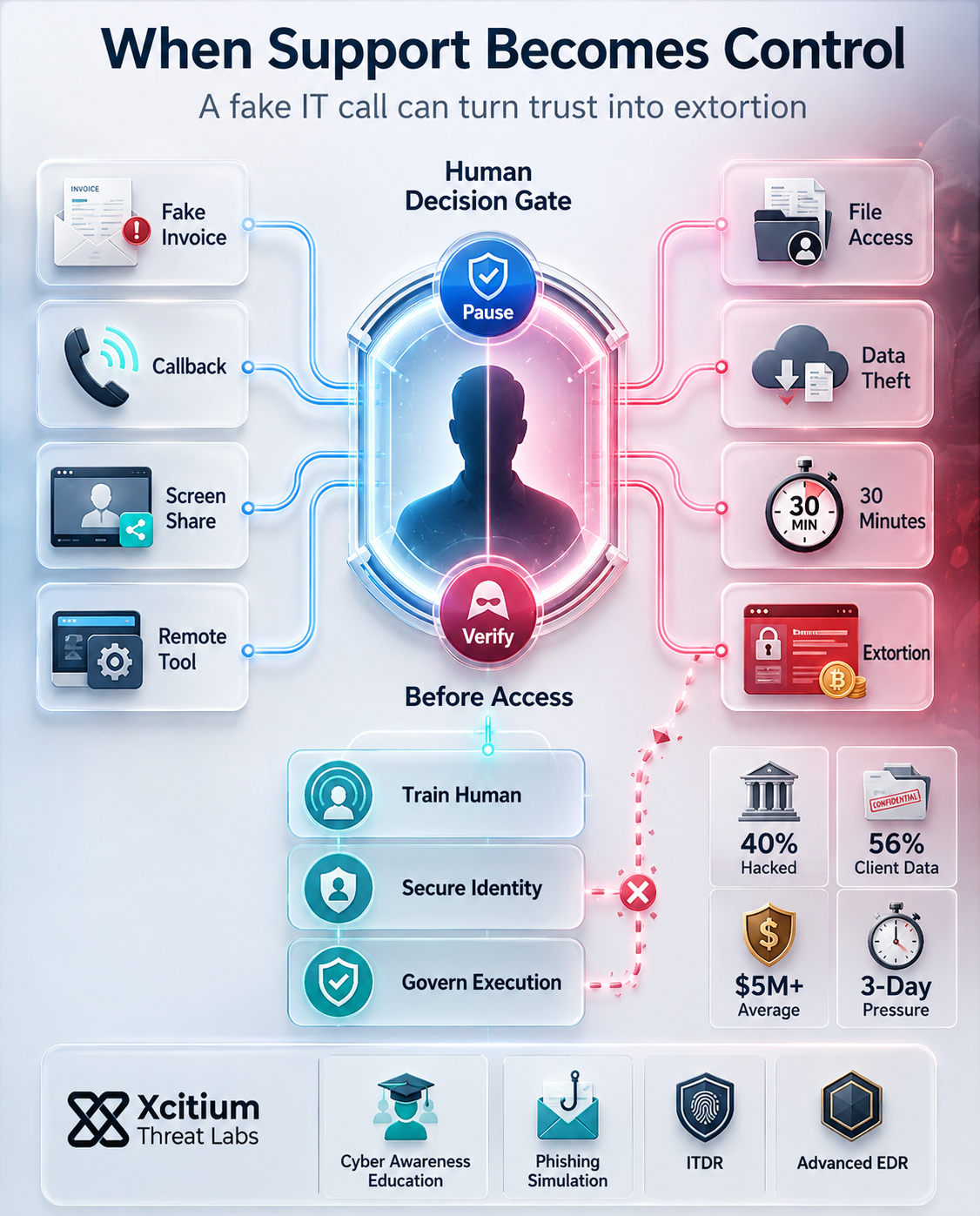
Once access is obtained, SRG acts fast and starts focusing on important documents like contracts, finances, M&A documentation, tax papers, and Social Security numbers. They target centralized document stores and cloud drives with private case files and client information. Staged for exfiltration and removal, the stolen data is exported off the company premises. It has been reported that a typical extortion letter usually reaches the company’s mailbox very quickly, often within 30 minutes after the attacker left the infected server.
SRG ransoms are unique for their strong tone and short deadline – only three days to make the payment before facing consequences from attackers. In cases where ransom is not paid, there is a threat that SRG will leak stolen information to clients, press, and authorities. Sometimes an additional threat includes selling data in public domain. Thus, the practice of triple extortion ransom, leaking information to clients, and regulatory actions is used to pressure the law firm into payment.
In rare cases where remote attacks do not yield results, SRG can escalate the attack. According to the FBI, SRG’s affiliate group can attempt live intrusion by visiting the office and plugging a storage device in the network to get data imaged and copied.
The Legal Sector in the Crosshairs
What makes law firms targets of cyber-attacks? The reason lies in highly confidential information held by law firms. It includes mergers and acquisitions plans, intellectual property, trade secrets, litigation strategies, and other documents that can be used to make money or affect the market. Nearly 20% of firms in the United States suffered cyber-attacks, with over 50% of these attacks causing the release of client information. The average amount paid per attack is greater than $5 million.
There are many reasons for a law firm to settle quickly and quietly. It would mean losing the privilege of confidentiality. Also, they may suffer legal consequences such as being sued by clients. They must negotiate fast to prevent any unwanted attention to the event. Law firms become the top targets for ransom attacks by the end of 2026 because of their confidentiality and the role they play for executives and corporate counsels.
According to industry surveys, 40% of law firms were hacked, with 56% resulting in releasing client information.
Fast-Flux Networks and Resilience
To enhance their leverage, after the theft of data, the Silent Ransom Group (SRG) controls when, where, and how the stolen data is leaked. SRG maintains a public leak site on the clear web. It operates via the use of fast-flux DNS network infrastructure, which points to the leaking site’s domain. The leak site domain uses rotating proxies from a global botnet of hacked routers and IoT devices.
The fast-flux network of compromised nodes extends over multiple countries (Latin America, Eastern Europe, Central Asia, Middle East, Asia, Caribbean, etc.). Thus, blocking the site requires the blocking of a huge and ever-changing number of proxies. Any attempt to block the domain redirects to new proxies. SRG has established an unbreakable and self-recovering backbone for leaking stolen information.
Through the use of technical evasion and social engineering techniques, the SRG group has developed an assault strategy aimed at attacking professional services. Although the attacks are customized to each organization, the attack vector remains identical tricking an employee, accessing the corporate resources, stealing data, and demanding payment by morning.
Conclusion: When a Phone Call Becomes the Breach
Silent Ransom Group proves that modern extortion does not always begin with malware. Sometimes it begins with a harmless invoice email, a phone number, and a convincing voice pretending to be IT support. No malicious attachment is needed. No suspicious link is required. The employee becomes the delivery path.
Once trust is established, the attacker turns a normal support workflow into remote access, data theft, and extortion within hours.
Why This Threat Works So Well
Law firms are high-value targets because they hold the kind of data attackers can weaponize quickly, client files, contracts, M&A documents, tax records, Social Security numbers, and privileged communications.
SRG succeeds because it abuses gaps that look normal until it is too late:
- Emails contain no malware, links, or attachments
- Phone calls create urgency and authority
- Remote support tools appear legitimate
- Temporary notes leave little evidence
- Data theft tools blend into normal administrative activity
- Extortion pressure arrives before the victim can fully investigate
This is not just phishing. It is social engineering converted into operational control.
Where Xcitium Changes the Outcome
With Xcitium in place, this attack would not succeed.
Xcitium Cyber Awareness Education and Phishing Simulation reduces the attacker’s first advantage, human trust under pressure.
- Employees learn to challenge invoice lures, callback scams, and fake support requests
- Simulated campaigns build pause and verify behavior before a remote session begins
- Helpdesk impersonation becomes a recognized threat pattern, not a successful access path
Xcitium ITDR strengthens the identity layer when attackers attempt to turn user access into broader compromise.
- Suspicious identity behavior is detected before access becomes data theft
- Risky sessions and abnormal access patterns are flagged early
- Unauthorized movement across cloud drives and document stores is stopped before extortion escalates
And when attackers attempt to run unknown tools, scripts, or payloads, Xcitium Advanced EDR applies Execution Governance.
Code can run without being able to cause damage.
Unknown execution does not receive unrestricted rights.
The attacker’s workflow breaks before trust becomes impact.
Stop Extortion Before the Call Becomes Control
Silent Ransom Group shows that attackers no longer need to hack their way in when they can talk their way in. Defense must start before the call is trusted, continue through identity validation, and govern execution before damage is possible.
Train the human layer.
Secure the identity layer.
Govern execution before trust.
Choose Xcitium to stop social engineering from becoming extortion.