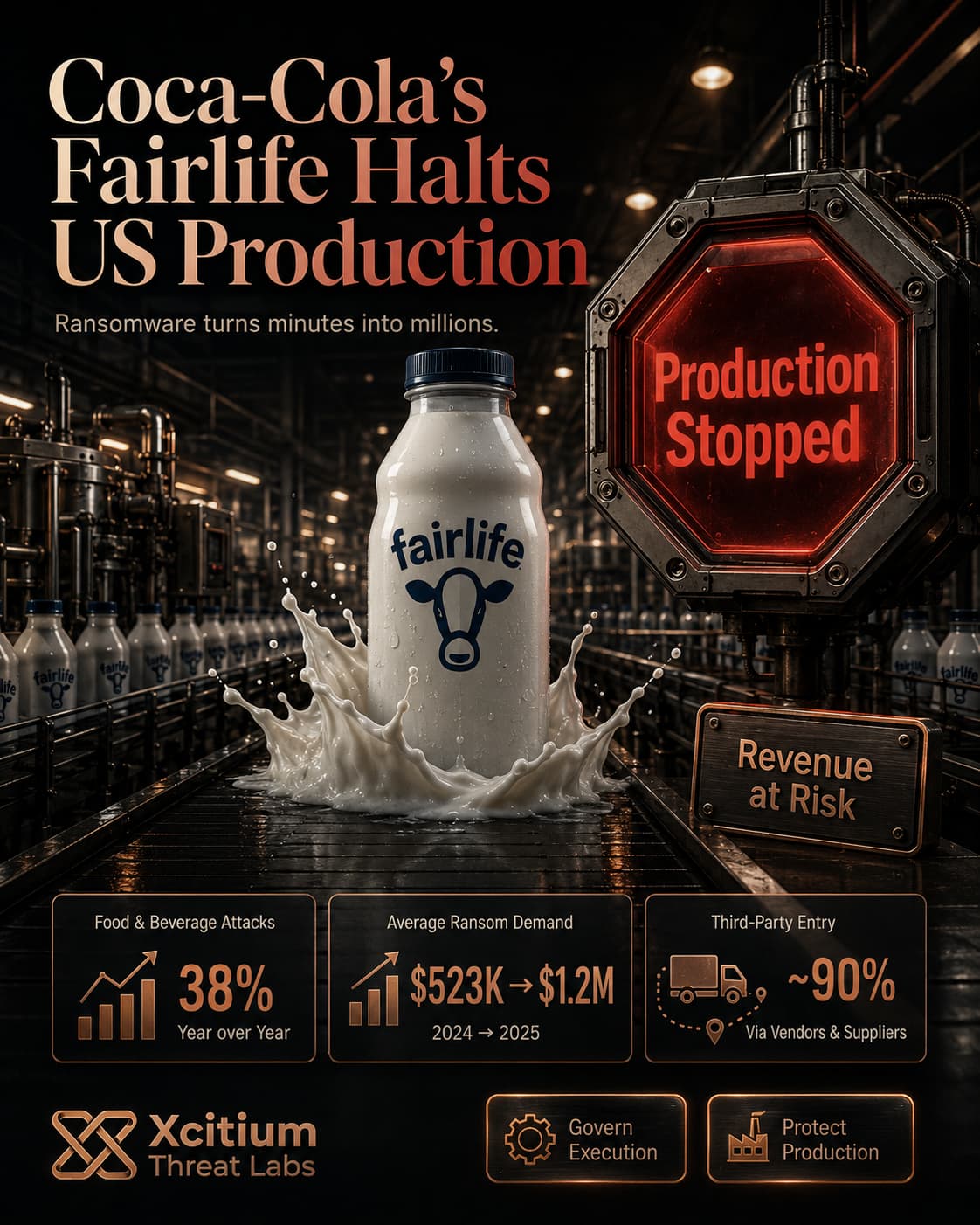
A Sudden Halt at One of Coca-Cola’s Fastest-Growing Brands
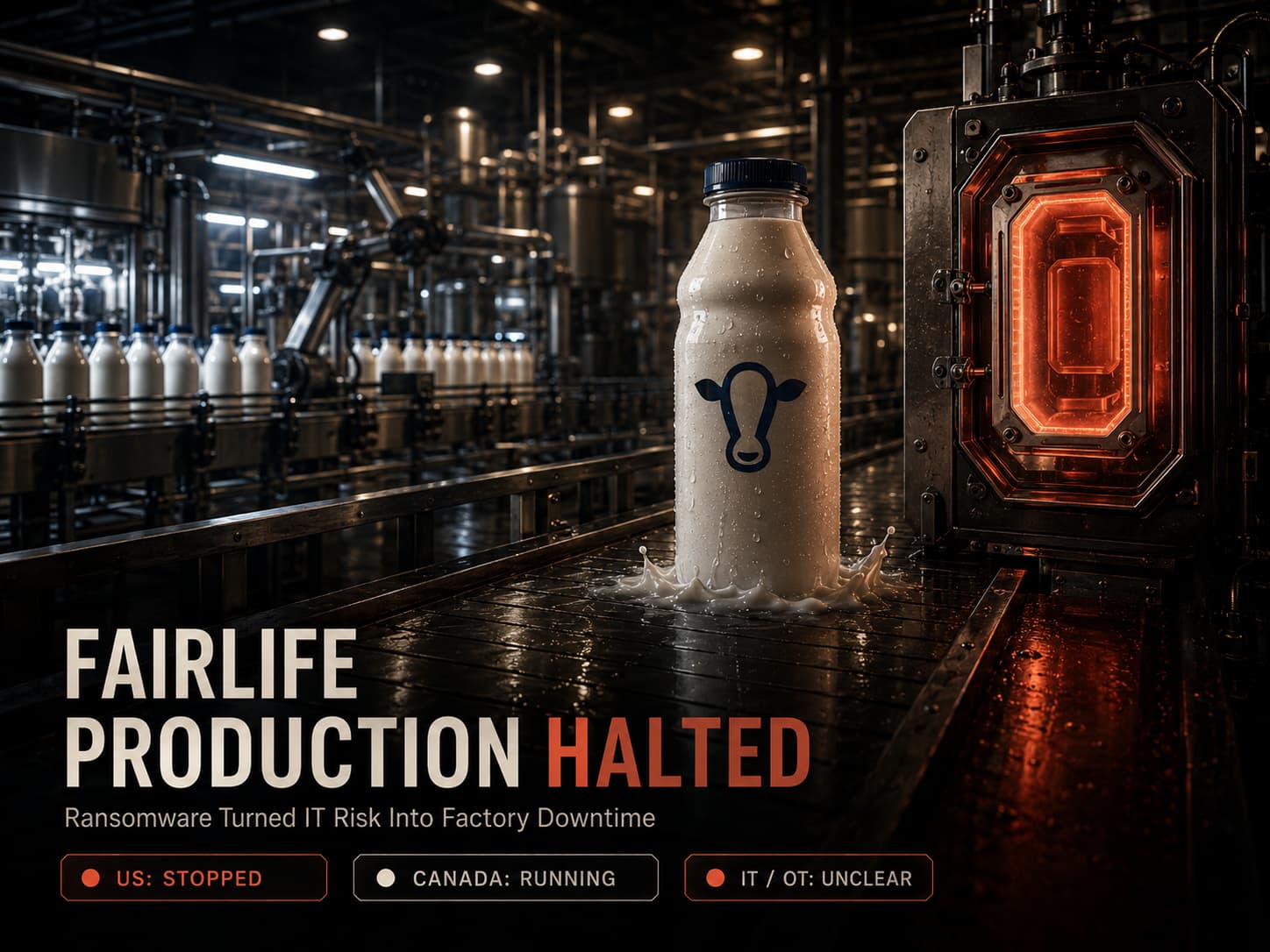
Fairlife, had been hit by a ransomware attack severe enough to freeze every US production line.
The disclosure came through a Form 8-K, a document companies use to report material events to the Securities and Exchange Commission. According to the filing, an unauthorized third party accessed a portion of Fairlife’s systems, including those tied directly to production.
Canadian operations kept running. Only the US side went dark. That detail alone hints at something useful: whatever network segmentation Fairlife had in place may have actually worked, at least partially.
What Coca-Cola Has Confirmed So Far
Details remain thin, and that’s not unusual this early in a breach investigation. Still, a few facts stand out.
Coca-Cola stated plainly that product quality and safety were not affected. Nonetheless, production across US facilities stopped. Fairlife runs plants in Coopersville, Michigan; Goodyear, Arizona; and Dexter, New Mexico, with a fourth site under construction in Webster, New York.
Notably, the company filed under Item 8.01 rather than Item 1.05. That distinction matters more than it sounds. Item 1.05 is reserved for incidents a company has determined to be material. By choosing 8.01, Coca-Cola signaled it hasn’t yet reached that conclusion, or simply needs more time to assess the damage.
A few things remain unclear:
- No ransomware group had publicly claimed responsibility as of this writing
- There’s no confirmation that data was stolen
- No ransom amount has surfaced
- Whether the attack reached factory-floor equipment or stayed confined to office systems is still unknown
That last point deserves attention. Ransomware that touches operational technology, the machinery controlling actual production, tends to take far longer to recover from than an attack limited to corporate IT.
Coca-Cola’s Dairy Brand Goes Dark
• No confirmation data was stolen, no ransom figure disclosed
• Unclear if the attack reached factory-floor equipment or stayed in office IT
• Average ransom demand roughly doubled: $523K → $1.2M (2024→2025)
• ~90% of attacks on this sector arrive through third-party suppliers
Why This Keeps Happening to Food Companies
The Fairlife incident is not an exceptional occurrence but rather the newest installment in a trend that has become difficult to ignore.
For the past four years, manufacturing companies have been the main target of ransomware operations. In the last year alone, cyberattacks targeting food and beverage companies went up by 38% from the previous year, according to the industry’s statistics. The average ransom demanded from businesses in the sector went up by over 100%, rising from about $523,000 in 2024 to almost $1.2 million in 2025.
Examples from previous years reveal the reasons for persistent attacks on the same sector:
- JBS Foods (2021): The meat manufacturer had to pay $11 million after shutting down nine US plants
- Dole (2023): There were salad-kit shortages following a shutdown at plants in North America
- Clorox (2023): The corporation experienced a $356 million drop in sales as a result of the breach
- UNFI (2025): There was $350-$400 million drop in sales at Whole Foods distributor
The main reason why food manufacturers become attractive targets lies in their perishable products. The difference between pausing software implementation and halting production of milk in particular is clear. In such situations, companies will often prefer paying ransoms quickly.
Third parties play a key role in attacks on food manufacturing facilities. An estimated 90% of cyberattacks on food and beverage companies come through their suppliers and vendors.
Why a Dairy Plant Doesn’t Just “Reboot”
Food plants nowadays work with two technology universes, IT (emails, databases, scheduling systems) and OT (programmable logic controllers, various sensors, and industrial systems which operate pasteurizers, fillers, and packaging robots).
In case of a ransomware attack, first the attackers penetrate the IT infrastructure through phishing, stealing credentials, using some remote administration tools and then move laterally looking for something valuable to either encrypt or steal.
There is a big difference for Fairlife if the lateral movement was limited to the corporate network or extended to the plant floor. The consequences vary significantly:
- IT system breach only: Plants get shut down to prevent any further damage, but once the IT is cleaned up, the production starts again within days.
- OT system breach: The Programmable Logic Controllers might require wiping, reconfiguration, or even unit-by-unit verification; such recovery may take weeks and even more time depending on the safety requirements related to handling consumable goods.
Coca-Cola says about “production-related systems” which are rather vague. This can refer to either scheduling software or controllers of the bottling line. As long as Fairlife doesn’t give more information, we can only speculate on the recovery time.
Conclusion: When Ransomware Stops the Production Line
The Fairlife incident shows why ransomware in manufacturing is measured differently. The damage is not limited to encrypted files or unavailable business applications. When production-related systems are affected, digital disruption becomes physical interruption.
Fairlife halted every US production line while Canadian operations continued. Product quality and safety were reportedly unaffected, but the recovery timeline remains uncertain because it is not yet clear whether the attack remained inside corporate IT or reached plant-floor operational systems.
That distinction will determine whether recovery takes days or weeks.
Why This Threat Matters
Food manufacturers operate under pressures attackers understand well.
- Production delays can affect perishable goods
- IT outages can stop scheduling, logistics, and plant coordination
- OT involvement can require equipment-by-equipment safety validation
- Backup disruption can extend recovery time
- Third-party access can expand the attack surface
- Every hour of downtime increases operational and financial pressure
By the time ransomware shuts down production, the critical security decision has already passed. The payload has executed, moved, and gained enough authority to affect the business.
Where Xcitium Changes the Outcome
Xcitium Advanced EDR, powered by Xcitium’s patented Zero-Dwell platform, applies Execution Governance before ransomware can turn execution into production impact.
Unknown code does not receive unrestricted execution rights.
Code can run without being able to cause damage.
File encryption, persistence, backup disruption, and lateral movement are stopped before impact.
Security teams gain proof of what unknown execution could not do.
Detection asks, “Did we recognize this as ransomware?”
Execution Governance asks, “Could unknown code stop production at all?”
That is the difference.
Xcitium = No Ransomware
The Fairlife shutdown proves that ransomware becomes a business crisis when execution reaches the systems production depends on. Security cannot wait for encrypted files, stopped lines, or recovery teams to confirm the damage.
Govern execution before trust.
Stop ransomware before encryption.
Protect production before digital compromise becomes physical downtime.