When AI Agents Become the Attack Vector
AI agents are no longer just text generators. Today, they read files, browse websites, call APIs, and run tools on your behalf. That versatility is their greatest strength. However, it also introduces a category of security risk that most developers have not fully considered.
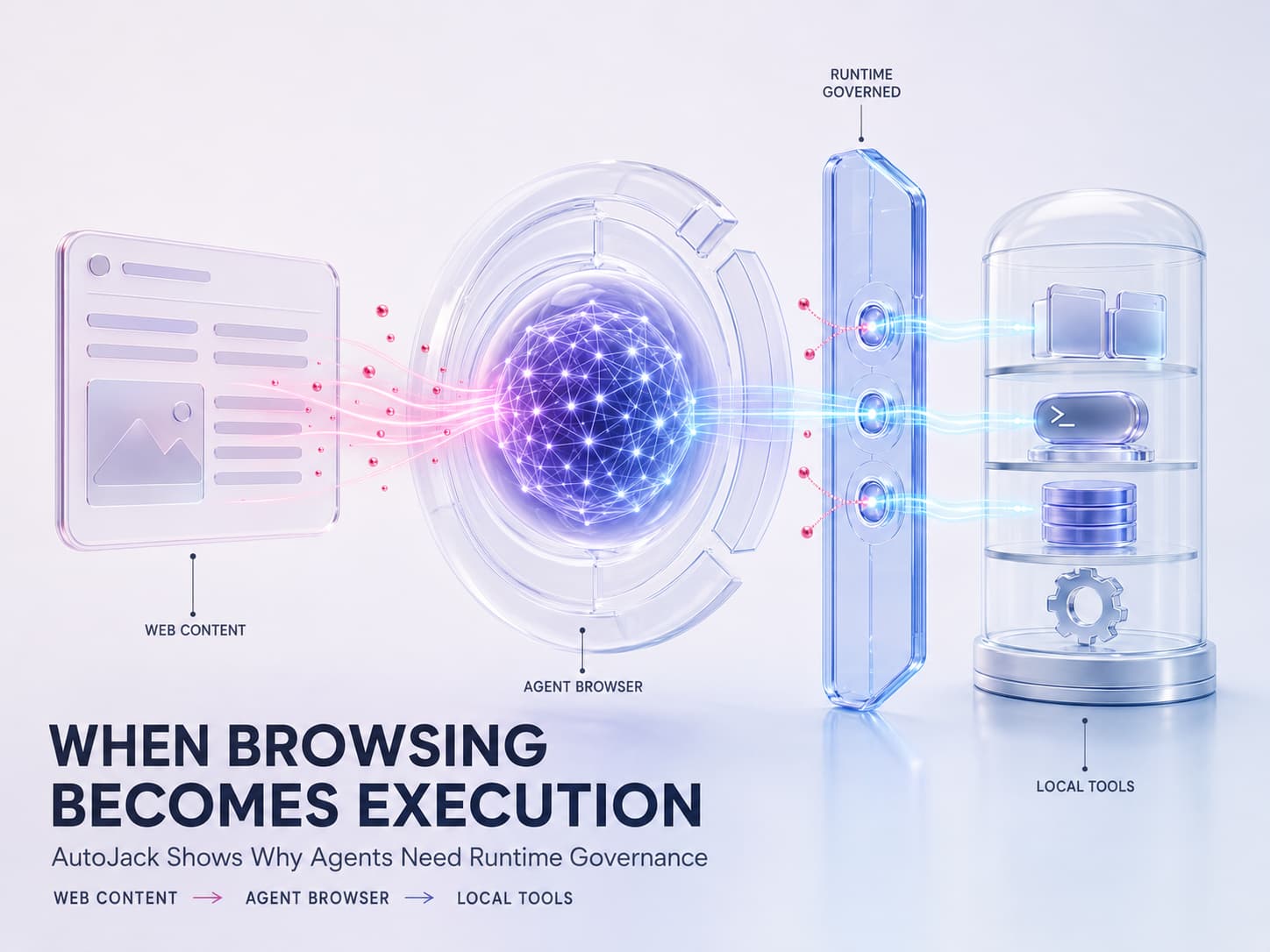
A recently disclosed exploit chain called AutoJack illustrates this risk with striking clarity. By chaining three separate vulnerabilities in AutoGen Studio, an attacker can turn a browsing AI agent into a remote code execution (RCE) vehicle. Furthermore, the attack requires no interaction from the user beyond simply pointing the agent at a malicious URL.
This is not a theoretical edge case. It is a preview of how agentic AI systems will be targeted at scale.
What Is AutoGen Studio and Why Does It Matter?
AutoGen Studio is a prototyping interface built on top of AutoGen, Microsoft Research’s framework for building multi-agent AI systems. It allows developers to:
- Compose and configure AI agents
- Attach external tools, including Model Context Protocol (MCP) servers
- Run quick experiments using a visual interface
By design, AutoGen Studio is a developer tool. Its defaults prioritize ease of iteration, not hardened deployment. That tradeoff is reasonable for a research prototype. Nevertheless, it becomes dangerous when agents with browsing capabilities are run on the same machine as this control plane.
Your AI Agent Is the Backdoor
• Auth skipped: middleware bypasses the MCP routes, so the socket needs no credentials
• Arbitrary command: the endpoint runs a command from a base64 URL parameter, with no allowlist
• The agent visits an attacker URL (directly or via prompt injection)
• The page’s JavaScript opens a WebSocket to the local MCP endpoint with a base64 payload
• AutoGen Studio spawns the attacker’s process (e.g. calc.exe) under the dev’s account
The Three Vulnerabilities That Make AutoJack Possible
AutoJack is not a single flaw. Instead, it is a chain of three independent weaknesses that, when combined, produce a devastating result.
Issue 1: An Origin Check That the Agent Itself Can Bypass
MCP WebSockets on AutoGen Studio will accept connections from only http://127.0.0.1 or http://localhost. This appears to be an excellent way of security on a first look. It does serve the purpose for a person browsing through their browser tab to evil.com.
But it becomes a problem for a browsing agent. When the browsing agents, say like MultimodalWebSurfer, Playwright-powered surfers, or any headless browser on the same machine browses a web page, all the JavaScript run from the browser process gets localhost identity. Therefore, when the browsing agent visits a malicious site, the WebSocket connection initiated from that agent browser will have an origin header passing the filter. The allowlist meant for stopping human browsers becomes completely invisible to an agent browser.
This is depicted by the second diagram in the original research very clearly.
Issue 2: Authentication Middleware That Skips MCP Routes Entirely
AutoGen Studio supports multiple authentication modes, including GitHub, MSAL, and Firebase. Each of these flows through a centralized AuthMiddleware. However, that middleware contains an early-return that skips any path starting with /api/ws or /api/mcp.
The intent was reasonable: WebSocket handshakes are difficult to gate the same way as HTTP requests, so the design expected each WebSocket handler to enforce its own authentication. The MCP handler never implemented that check.
The practical result is striking:
| Auth Configuration | REST API Protected? | /api/mcp/ws/* Protected? |
|---|---|---|
| None | No | No |
| GitHub | Yes | No |
| MSAL | Yes | No |
| Firebase | Yes | No |
Enabling authentication in the config does not protect the MCP WebSocket. Consequently, an attacker who reaches the socket needs no credentials whatsoever.
Issue 3: Arbitrary Command Execution via a URL Parameter
The third vulnerability is the most direct. The MCP WebSocket endpoint reads a server_params query parameter from the URL, base64-decodes it, parses the result into a StdioServerParams object, and passes the command and args fields directly to stdio_client(), which spawns a subprocess.
There is no allowlist. No validation. The endpoint will accept calc.exe, powershell.exe, or bash -c '...' with equal indifference. A minimal payload looks like this:
json:{
"type": "StdioServerParams",
"command": "calc.exe",
"args": [],
"env": { "pwned": "true" }
}
Base64-encode that JSON blob, append it to the WebSocket URL, and the AutoGen Studio process will spawn the specified executable under the developer’s account.
How AutoJack Plays Out in Practice
This exploit has just two elements in the end-to-end chain. Firstly, a malicious webpage which uses JavaScript code that opens up a WebSocket URL crafted specifically for the purpose. Secondly, an AutoGen agent with browsing functionality running on the same system as the AutoGen Studio.
The attack workflow goes like this:
- A developer runs an AutoGen browsing agent, such as a web summarizer tool, alongside AutoGen Studio on their workstation.
- The agent is directed to browse a URL controlled by the attacker, either directly or through a prompt injection embedded in a third-party page.
- The agent’s headless browser renders the attacker’s page.
- JavaScript on that page opens a WebSocket to
ws://localhost:8081/api/mcp/ws/with a base64-encoded payload. - The Origin check passes because the request originates from the local machine.
- The auth middleware skips the route entirely.
- AutoGen Studio decodes the payload and spawns the attacker-specified process under the developer’s account.
Specifically, the “Web Content Summarizer” agent based on MultimodalWebSurfer was made to visit an attacker-controlled URL. After a few moments of rendering the attacker’s page, calc.exe was launched on the developer’s desktop. Importantly, it was not the browser or the headless Chromium which started this process. It was AutoGen Studio.
Why This Pattern Will Recur Across the AI Ecosystem
AutoJack is most significant not because of its individual bugs but because of the architectural pattern it exposes. Each vulnerability is a reasonable shortcut in a research-grade prototype. Together, they reveal a systemic blind spot.
The pattern that makes this attack possible has three parts:
- A local control plane with powerful capabilities (in this case, arbitrary process execution via MCP)
- Access protection based on origin or localhost assumptions (which agents on the same machine inherently satisfy)
- A browsing agent that renders arbitrary external content (turning any web page into a potential attack entry point)
This triangle is not unique to AutoGen Studio. Any developer tool that exposes a local control plane and is used alongside a browsing agent shares the same structural risk. As AI agent frameworks proliferate and developers routinely run browsing agents on the same machines as their development infrastructure, this attack surface will grow.
What This Means for Developers Building on Agent Frameworks
There are a number of lessons learned here for developers of AI agents that are either built or operated by them:
- Consider all tool parameters accessible via model output as under attacker’s control. Agents that have ability to be driven by content outside of themselves can potentially be used to drive tools with malicious input parameters.
- Do not connect privileged control planes to localhost without authentication. Loopback interface is no more secure for same-host processes than anything else, particularly for browsing agents.
- Whitelist executable files to be spawned as MCP servers. Passing arbitrary arguments to such file is the same as opening up a shell access.
- Use separate agent and developer identities. Running agent in a separate low-privileged account or inside container reduces attack surface in case of an attack.
Agentic AI development framework is evolving much faster than security frameworks surrounding it. AutoJack is a good documented example of the outcome of introducing such capabilities to development environment without reconsidering underlying assumptions about trust.
Conclusion: AI Agents Need Runtime Governance Before Tool Use
AutoJack shows why agentic AI security cannot be treated like traditional application security. The exploit does not depend on a malicious attachment, a user running an unknown file, or a classic malware dropper. A single web page can influence a browsing agent, reach a local control plane, and cause code to execute on the developer’s own machine.
That changes the security question.
The issue is not only whether the agent was useful.
The issue is whether the agent was allowed to turn untrusted content into trusted execution.
Why This Threat Matters
AutoJack exposes a pattern that will appear again across AI development environments. Agents are being connected to browsers, tools, APIs, local services, MCP servers, and developer workflows faster than security models are being redesigned around them.
- Localhost trust can be abused by same-machine agent activity
- Browser-based agents can render attacker-controlled content
- Tool parameters can become attacker-controlled input
- MCP and local control planes can expose powerful execution paths
- Developer workstations can become the first point of compromise
- Detection-first controls may see execution only after the agent has already acted
This is not just an AutoGen Studio issue. It is an architectural warning for the agentic AI era.
Where Xcitium Changes the Outcome
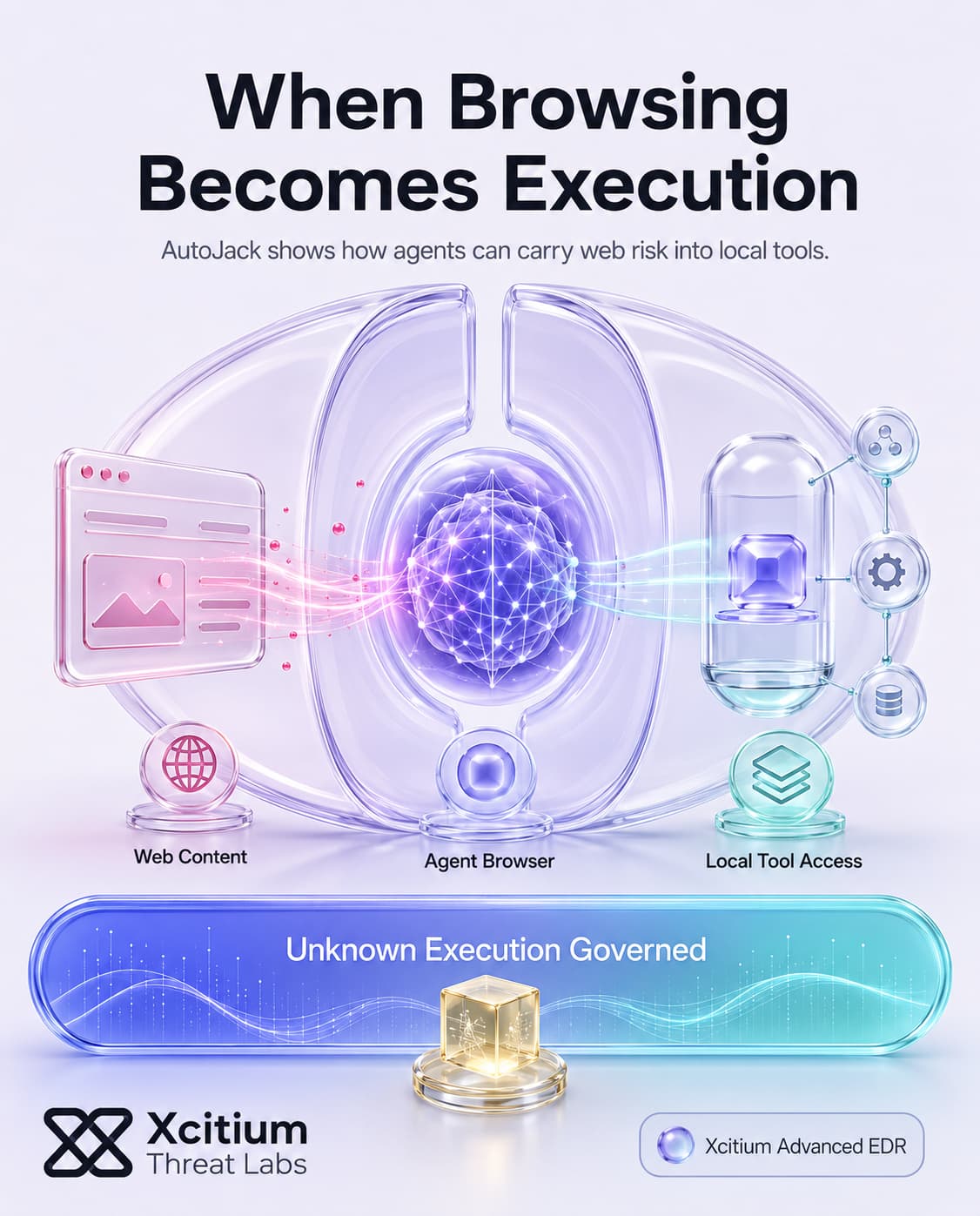
AutoJack proves that AI agents need more than guardrails around prompts. They need enforceable runtime control over what execution is allowed to do.
That is where Xcitium’s patented Zero-Dwell platform changes the model.
When an agent-driven workflow causes unknown code, tools, scripts, commands, or subprocesses to run, Execution Governance ensures they do not receive unrestricted execution rights.
Unknown code does not receive unrestricted access to the real endpoint.
Runtime behavior is governed before trust exists.
Execution is controlled before it can become compromise.
Security teams gain proof of what unknown execution was not allowed to do.
Detection asks, “Did we recognize this as malicious?”
Execution Governance asks, “Could agent-driven execution cause damage at all?”
That is the difference.
AI Agents Create New Execution Paths. Xcitium Governs Them.
AutoJack is a preview of the next security challenge. As agents browse, summarize, automate, call tools, and interact with local services, attackers will look for ways to turn those capabilities into execution paths.
Prompt security matters.
Tool validation matters.
Authentication and allowlists matter.
But when untrusted content reaches execution, the decisive control is runtime governance.
Govern unknown execution before trust exists.
Prevent agent-driven tool use from becoming system compromise.
Prove control before impact.
Choose Xcitium’s patented Zero-Dwell platform to govern unknown execution before trust exists.